1382-second window · 3 observations · Measured Aug 28, 2026, 7:12 AM UTC · Provider: go_recent_snapshot_v2
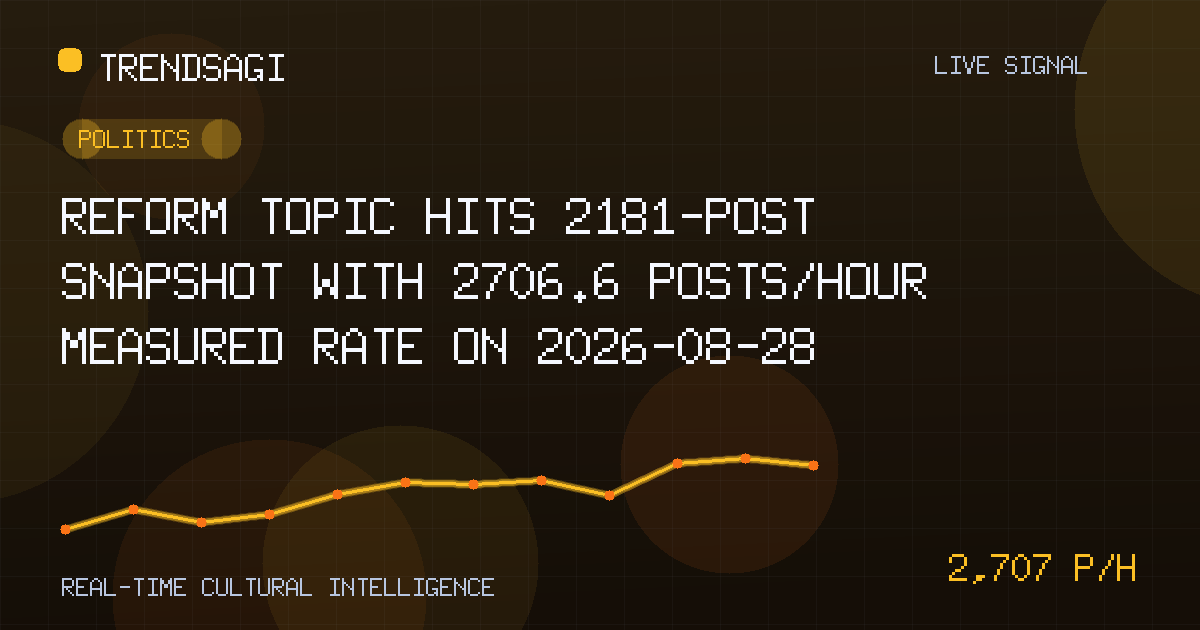
Reform Topic Hits 2181-Post Snapshot With 2706.6 Posts/Hour Measured Rate on 2026-08-28
At 2026-08-28T07:12:15Z, Reform politics posts hit 2181 snapshot volume with 2706.6 posts/hour measured rate; briefing explains limits and next checks.
Automated briefing. Generated from stored signal measurements and source-backed research; it is not manually reviewed. Read the methodology and limitations.
Metrics in this briefing are a snapshot associated with its publication date and may not reflect current conditions.
What changed
At 2026-08-28T07:12:15Z, the politics topic labeled "Reform" showed a snapshot volume of 2181 posts, a concentrated burst of discussion that stands out against quieter periods. The direct takeaway for editors is that this topic demands a verified explainer rather than assumption.
Across an exact 1382-second window measured at that same timestamp, three stored observations produced a measured snapshot rate of 2706.6 posts per hour. This number is a measured snapshot rate derived from stored samples, not a live current rate, not a forecast, and not a count of unique people or engagement actions.
The combination of a four-figure snapshot volume and a measured snapshot rate above 2700 posts per hour signals that something pushed the topic into a high-velocity state, even if the underlying trigger remains unconfirmed.
| Observation time | Measured posts/hour | Snapshot volume |
|---|---|---|
| 2026-08-28T07:12:15Z | 2706.6 | 2181 |
Why this topic may be moving
We checked indexed publishers and public posts to confirm why "Reform" was moving. As of the snapshot time, no single attributable event could be verified through available publisher reporting. Several plausible angles exist, but each remains unconfirmed and must not be presented as fact.
The term "Reform" is broad. In a politics category it could reference voting reform, healthcare reform, institutional reform, or a specific reform-oriented party or movement. Without a verified publisher statement, naming a cause would be speculative.
Historically, broad political labels like reform have often risen around scheduled policy debates, election cycles, or official consultations. That general pattern does not, however, confirm the cause of this specific snapshot, and we do not attribute it to any such event.
If a newsroom later publishes a confirmed trigger, such as a government white paper or a court ruling, that context should be appended to the signal. Until then, the honest assessment is that the cause is unclear.
Why it matters
The spike matters because volume alone can shift newsroom priorities, alert monitors to emerging friction, and prompt premature narratives if mishandled. The following groups should treat the signal as a flag for verification, not as a conclusion:
- Political journalists assigning explainers on short deadlines.
- Campaign and issue advocacy teams tracking public attention.
- Public sector communication offices monitoring sentiment risk.
- Researchers building early-warning datasets for institutional change.
- Platform integrity teams assessing sudden topic concentration.
What the signal can establish: that a measurable cluster of posts occurred, that the measured snapshot rate was 2706.6 posts per hour over the stated window, and that the latest snapshot held 2181 posts. It confirms attention, not direction.
What the signal cannot establish: the sentiment of the posts, the geographic origin, the share from authentic individuals versus automated accounts, the precise policy subject, or whether the conversation will persist beyond the window.
The count of posts in a snapshot tells us how loudly a topic is being discussed at one moment, not why it is being discussed or who is behind the messages.
Editors should resist converting the 2181 snapshot volume into a reach estimate. Snapshot volume is a count of captured posts, not a rate, and it does not equal people or impressions. Likewise, the measured snapshot rate should not be reported as a live meter; it describes a past interval only.
The politics category adds mild context but little specificity. Many distinct subtopics can hide under one label, so a single volume number can mask multiple concurrent conversations.
What to watch next
Practical next checks for any newsroom or analyst:
- Re-poll the same topic label over the next identical 1382-second window to see if the measured snapshot rate holds or decays.
- Search publisher indexes for the exact phrase "Reform" paired with date-specific politics news before attributing a cause.
- Segment the captured posts by referenced entities once a verified event is identified.
- Compare the 2181 snapshot volume against the topic's own 30-day baseline once historical stored observations are available.
- Monitor for crossover into adjacent labels such as "election" or "policy" that might reveal the sub-topic.
Concrete watch signals that would upgrade this from noise to story:
- A second consecutive window with measured snapshot rate above 2000 posts per hour.
- Emergence of a named law, official, or organization in verified publisher copy.
- Divergence between snapshot volume and measured rate suggesting backlog rather than fresh surge.
- A decline below 500 posts per hour within two windows, indicating a flash spike.
- Stable volume above 1000 posts across three windows, suggesting a sustained campaign.
Thresholds should be calibrated to the topic's own history. Because we only have the supplied snapshot and rate, any baseline must come from further stored observations or verified publisher archives.
Methodology and limitations
The measured snapshot rate of 2706.6 posts per hour was computed from three stored observations across an exact 1382-second window, with the final observation at 2026-08-28T07:12:15Z. The latest snapshot volume of 2181 posts is a separate count taken at that same time. Neither figure was transformed or extrapolated by this briefing.
Limitations are significant. The stored signal description was empty, so no pre-existing context was supplied. Category "Politics" is a broad bucket. The measurement reflects only posts captured by the storage process, not the full public conversation. Because external verification did not surface a publisher-attributed cause, this briefing intentionally omits speculative triggers.
Readers should use the measured snapshot rate as a historical pace indicator from stored data, not as a real-time dashboard reading. Any operational decision should wait for verified publisher context and a follow-up window.
Finally, all numbers here are treated as fixed inputs. The 2181 snapshot volume is not a rate; the 2706.6 posts per hour is not a forecast. They are two distinct measurements that together describe a single observed surge.
Track This Topic for New Signals
Set alerts for future velocity or sentiment changes around this topic.
Explore Tracking PlansAbout TrendsAGI research
TrendsAGI's automated research pipeline publishes dated signal snapshots, methodology notes, and practical workflows for teams evaluating cultural momentum. Read how signals are scoped, scored, and limited in our research methodology.