906-second window · 3 observations · Measured Oct 8, 2026, 3:11 AM UTC · Provider: go_recent_snapshot_v2
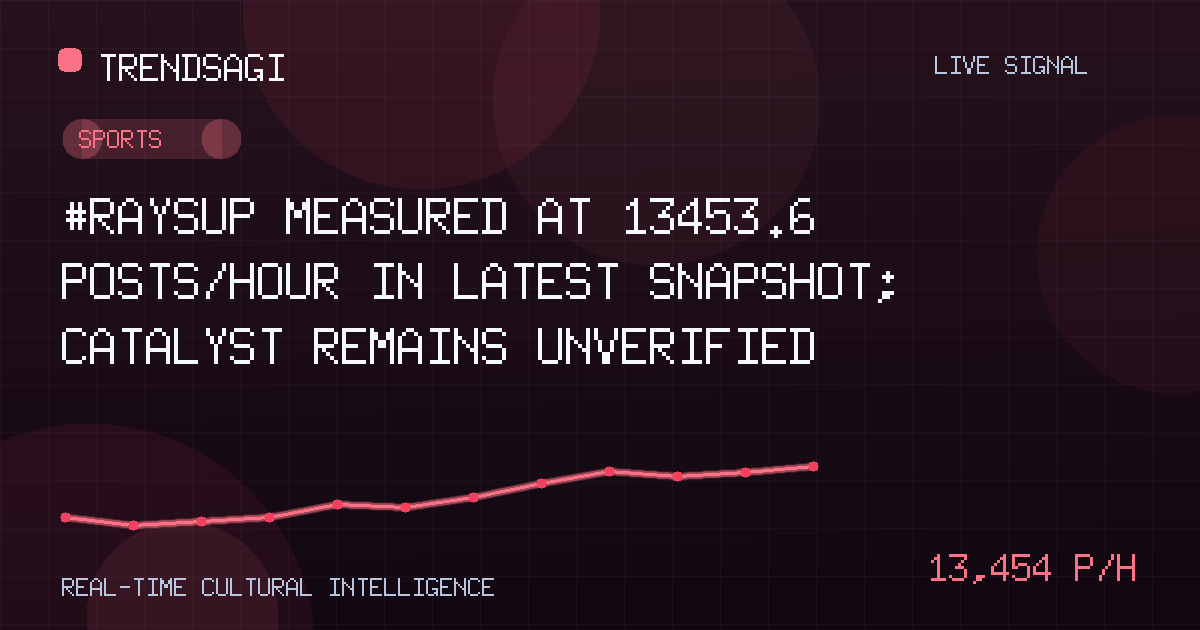
#Raysup measured at 13453.6 posts/hour in latest snapshot; catalyst remains unverified
#Raysup was measured at 13453.6 posts/hour in the latest snapshot; the catalyst is unverified, with practical checks for fans and analysts.
Automated briefing. Generated from stored signal measurements and source-backed research; it is not manually reviewed. Read the methodology and limitations.
Metrics in this briefing are a snapshot associated with its publication date and may not reflect current conditions.
What changed
Direct answer: At 2026-10-08T03:11:37Z, posts carrying #Raysup registered a sharp short-window change, but the cause remains unverified. The stored record supports an investigation alert, not a conclusion that a specific game, team decision, player story, or controversy triggered the activity. No external catalyst has been verified for this briefing.
The measured snapshot rate was 13453.6 posts/hour over an exact 906-second window using 3 stored observations. The latest snapshot volume was 3789 posts. The rate is a measured historical snapshot, not a live or current rate, and neither figure establishes a forecast, reach, engagement, sentiment, or unique-person count.
| Metric | Stored value |
|---|---|
| Observation time | 2026-10-08T03:11:37Z |
| Measured snapshot rate | 13453.6 posts/hour |
| Latest snapshot volume | 3789 posts |
Why this topic may be moving
The signal is categorized as Sports, but its stored description is empty. That matters because the system detected movement around an exact label without supplying a semantic account of the posts. It would be premature to name a result, roster move, broadcast, fan dispute, or promotional action as the driver.
Several explanations are possible, testable hypotheses rather than established facts:
- Event reaction: A game or postgame development may have generated time-sensitive commentary. The signal does not identify one.
- Team or player news: A lineup, injury, transaction, award, or broader story could have prompted discussion. No such item is verified here.
- Conversation mechanics: A popular post, creator amplification, repetition, or coordinated reposting could lift labeled activity without representing a new event.
These possibilities should not be treated as interchangeable. The first task is to determine whether the posts refer to one shared event, several stories, or mostly copying and reaction. Without reviewing the underlying posts, the signal cannot establish even the basic narrative behind the surge.
Interpretation: A fast rise in labeled posts is an instruction to investigate, not proof of what happened, why it happened, or how many distinct people participated.
Why it matters
For supporters, the label can function as a live alert that something has changed, but it is not enough to learn what happened. For baseball journalists and editors, the short-window spike is useful for triage: check timestamps and authoritative context before publishing a causal explanation. For team, league, and brand communications teams, it can flag a possible audience-response window, but only content inspection can show whether people are celebrating, criticizing, asking questions, or simply repeating a post.
For analysts, the episode shows why speed and scale should be reported separately. A large number of labeled posts can coexist with limited evidence about independent participation. Conversely, a sharp measured rate can be useful even when the latest snapshot volume is not a direct audience count. Neither measure, by itself, reveals how many people saw the conversation.
What to watch next
The next checks should proceed from evidence that can identify a cause to evidence that can characterize its scale:
- Recover the actual post sequence. Inspect items immediately around 2026-10-08T03:11:37Z and note the earliest claims, direct language, repeated phrases, and references carried in the posts. Determine whether they point to a common trigger. Do not infer chronology from the final snapshot alone.
- Verify a public catalyst through Google Search. Search the exact label and relevant team, player, and game terms around the observation time. Open results from the official organization, league, game service, or established newsroom and compare publication time with the 906-second window. A result is a lead until its publisher, timestamp, and claim are checked; it should not become background fact merely because it ranks.
- Classify the content. Separate original reactions from copied text, questions, promotional posts, corrections, and satire. Look for independently posted accounts of what prompted the burst. Repetition may indicate amplification, but it does not by itself establish coordinated behavior or automated activity.
- Check persistence. Compare later stored observations with this one. Continuing high measured snapshot activity would support the idea of sustained conversation; a quick fade would be more consistent with a time-sensitive reaction. Neither pattern would prove the underlying cause.
- Broaden only after the label is understood. Compare team, player, game, and media terms that appear in the actual posts rather than assuming which adjacent conversation should have moved. This helps reveal whether #Raysup led a wider baseball conversation or was an isolated burst.
Concrete watch signals
- A verified catalyst: A timestamped item from an identified publisher aligns with the start of the activity and is repeatedly referenced in the posts.
- Narrative convergence: Independent posts describe substantially the same event rather than unrelated uses of the label.
- Persistence: Subsequent stored observations continue to show elevated measured snapshot activity, extending the story beyond a momentary burst.
- Amplification: Many posts share wording or sources. That warrants review, not an automatic claim of artificial activity.
- Correction or cooling: An authoritative update, clarification, or decline in activity changes the interpretation and should be reflected promptly.
Methodology and limitations
This briefing uses the canonical observation at 2026-10-08T03:11:37Z. The measured rate applies only to the exact 906-second window and its 3 stored observations. The latest snapshot contains 3789 posts. The supplied definitions do not document the relationship between those measures, so they should not be added, divided, or presented as interchangeable.
- The signal does not reveal the underlying posts, their authors, sentiment, geography, platform distribution, or whether they were original and copied.
- It provides no direct count of unique accounts, people reached, or people who saw the label.
- The short observation series does not establish a normal baseline, seasonality, or a durable long-term trend.
- No causal event is assigned because a timestamped public catalyst has not been verified.
The practical takeaway is to treat #Raysup as a fast-moving alert worth checking, not as a completed explanation. Establishing the cause requires recovering the post sequence and matching it to verified, timestamped public context.
Track This Topic for New Signals
Set alerts for future velocity or sentiment changes around this topic.
Explore Tracking PlansAbout TrendsAGI research
TrendsAGI's automated research pipeline publishes dated signal snapshots, methodology notes, and practical workflows for teams evaluating cultural momentum. Read how signals are scoped, scored, and limited in our research methodology.