898-second window · 3 observations · Measured Sep 29, 2026, 1:39 PM UTC · Provider: go_recent_snapshot_v2
Raphael sports-post signal measures 156.3 posts/hour; trigger unverified
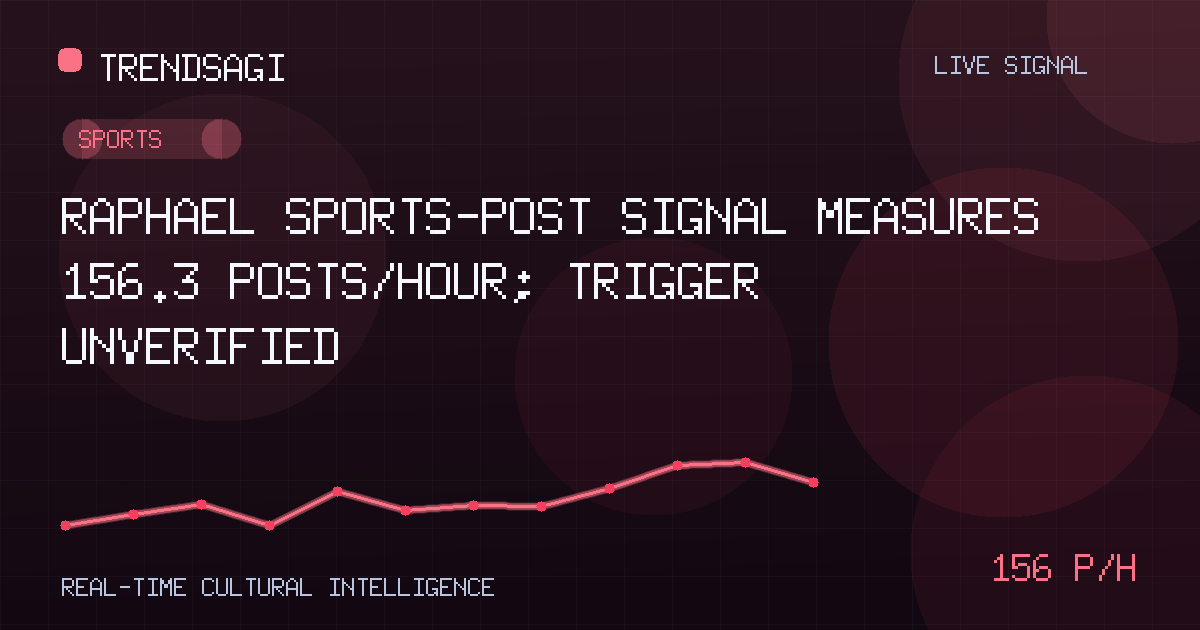
Raphael’s stored sports signal measured 156.3 posts/hour over 898 seconds, with 176 posts at the latest snapshot; the trigger remains unverified.
Automated briefing. Generated from stored signal measurements and source-backed research; it is not manually reviewed. Read the methodology and limitations.
Metrics in this briefing are a snapshot associated with its publication date and may not reflect current conditions.
What changed
The label Raphael registered a concentrated burst in the stored sports-post signal, but the available evidence does not identify which person, organization, event, or other referent it denotes. The latest snapshot contained 176 posts. At 2026-09-29T13:39:04Z, the measured snapshot rate was 156.3 posts/hour. That figure quantifies observed posting intensity, not its cause.
The rate was derived from three stored observations across an exact 898-second window. It is a retrospective snapshot measurement, not a live or current rate, forecast, reach figure, engagement count, or count of unique people. The 176 posts are a separate snapshot volume and should not be described as a rate or used to infer audience size.
| Measure | Value |
|---|---|
| Observation time | 2026-09-29T13:39:04Z |
| Measured snapshot rate | 156.3 posts/hour |
| Snapshot volume | 176 posts |
Why this topic may be moving
No verified public context establishes why the label is moving. The stored category, Sports, narrows the monitoring context but does not identify the referent or an event. A single-name label can point to different people or entities, and a truncated or ambiguous match can combine unrelated conversations. Without examining matching post text or finding a credible, contemporaneous report, linking the burst to a particular sports figure would be speculation.
Possible mechanisms to test are not established facts:
- A live result, scheduled appearance, roster change, injury update, or official announcement could prompt rapid reaction.
- A news report or search result could have widened monitoring around the label.
- Different entities sharing the label could combine unrelated conversations into one measured stream.
- Repeated, automated, or poorly classified posts could magnify activity without a corresponding rise in distinct discussion.
Until one of these is supported by matching content and credible timing, the trigger should remain explicitly unclear.
A short-window spike is a prompt to verify, not a substitute for verification. Until the referent and trigger are confirmed, the responsible description is activity around the label “Raphael,” not a claim about a named individual or event.
Why it matters
The immediate value is rapid triage: something in the monitored stream deserves attention before the label is treated as a settled story.
- Editors should resolve the entity before writing a headline, because a name collision can turn a real burst into a false attribution.
- Trend analysts need the separation between volume and rate, plus a baseline, before calling the movement unusual, sustained, or accelerating.
- Fan, community, and reputation teams should inspect surrounding language for confusion or unrelated reactions before responding.
- Measurement owners should preserve the observation window and query definition so another team can reproduce the result.
For all of them, the immediate watch item is the label-level burst; the unsupported leap would be to turn it into a verified event narrative.
What the signal can—and cannot—show
The evidence supports a deliberately narrow reading:
- The monitored stream contained 176 posts in the latest snapshot.
- The supplied observations produced a measured snapshot rate of 156.3 posts/hour over exactly 898 seconds.
- Activity was concentrated around the stored label at the stated observation time.
It does not establish:
- The topic’s cause or the identity of its referent.
- Sentiment, source credibility, organic discussion, or automation.
- Reach, engagement, unique authors, or importance relative to normal activity.
- Whether the movement will persist beyond the measured window.
Snapshot volume may also depend on collection coverage and query matching, neither of which is described here. On their own, three observations can support the stated window summary but cannot establish duration, recurrence, or a longer-term trend.
What to watch next
Verification should proceed in this order:
- Resolve the referent. Inspect a representative sample of matching posts, account biographies, exact phrases, sport context, language, and geography. Check whether the posts consistently describe the same person or entity.
- Verify the proposed trigger with Google Search only by locating a contemporaneous official announcement or reputable report that explicitly matches the same referent, sport, and time. Unrelated search results are not corroboration.
- Compare timestamps. The publication, announcement, or event should precede or align with the 2026-09-29T13:39:04Z observation; sequence alone is insufficient if the entity is wrong.
- Establish a baseline and persistence. Compare later comparable windows and a longer history to see whether the burst fades, persists, or recurs. Do not call it sustained from this window alone.
- Audit composition. Review source diversity, repeated text, account history, language, geography, and category fit. Repetition may amplify a count without adding distinct perspectives.
- Keep metrics separate. Snapshot volume, posts/hour, author count, engagement, and reach answer different questions; add only measures the underlying data can support.
Concrete watch signals are:
- An official or reputable publisher identifies the same Raphael and a specific sports event near the observation time.
- Matching posts point to one consistent referent rather than several entities sharing a label.
- The measured rate remains above an established baseline across successive comparable windows.
- Independent sources add distinct context instead of repeating the same text.
- Category or entity labels are corrected as better context arrives.
Methodology and limitations
This briefing uses the canonical stored signal observed at 2026-09-29T13:39:04Z. The latest snapshot volume is 176 posts. The measured snapshot rate is 156.3 posts/hour, based on three stored observations over exactly 898 seconds, measured at the stated observation time. No comparison period, baseline, sampling frame, author count, engagement data, sentiment distribution, or verified external trigger is supplied.
No external event was verified, so this briefing does not name a triggering athlete, team, competition, result, or announcement. A causal update should require an exact entity match, a credible publisher, and timing consistent with the snapshot. Until then, this is a short-window monitoring alert, not proof of a broader trend.
Track This Topic for New Signals
Set alerts for future velocity or sentiment changes around this topic.
Explore Tracking PlansAbout TrendsAGI research
TrendsAGI's automated research pipeline publishes dated signal snapshots, methodology notes, and practical workflows for teams evaluating cultural momentum. Read how signals are scoped, scored, and limited in our research methodology.