895-second window · 3 observations · Measured Sep 26, 2026, 6:26 AM UTC · Provider: go_recent_snapshot_v2
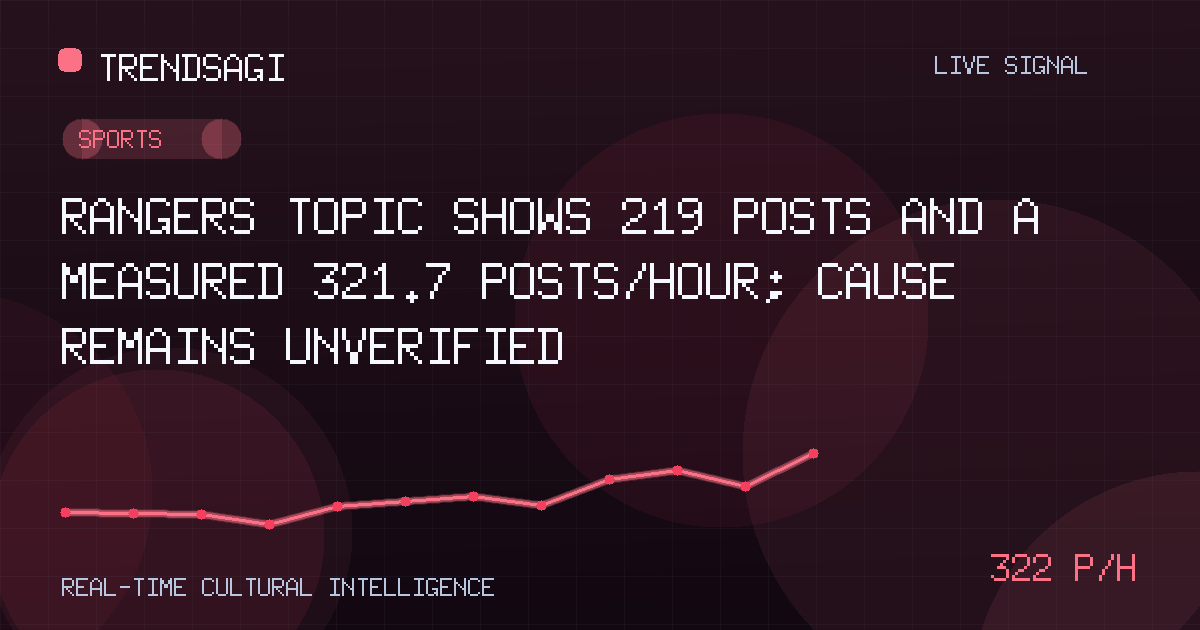
Rangers topic shows 219 posts and a measured 321.7 posts/hour; cause remains unverified
Rangers had 219 posts and a measured 321.7 posts/hour at 2026-09-26T06:26:15Z; editors should verify the entity and cause.
Automated briefing. Generated from stored signal measurements and source-backed research; it is not manually reviewed. Read the methodology and limitations.
Metrics in this briefing are a snapshot associated with its publication date and may not reflect current conditions.
What changed
At the 2026-09-26T06:26:15Z observation, the topic labeled “Rangers” had 219 posts in its latest snapshot. The label was moving quickly in the measured interval, but no verified public context establishes why, and the broad name does not identify the underlying sports entity. The defensible conclusion is a label-level posting spike requiring verification, not a confirmed event.
The measured snapshot rate was 321.7 posts/hour, based on 3 observations across an exact 895-second window measured at that time. It is not a live or current rate, forecast, reach estimate, engagement metric, or unique-person count. The 219-post value is separate: it is the latest snapshot volume, not a rate.
| Measure | Observed value |
|---|---|
| Observation time | 2026-09-26T06:26:15Z |
| Measured snapshot rate | 321.7 posts/hour |
| Latest snapshot volume | 219 posts |
Why this topic may be moving
The cause remains unclear. The Sports classification makes a sport-related development plausible, but it does not resolve the entity or establish a catalyst. A broad label may be activated by breaking team news, a match result, a personnel announcement, media coverage, or conversation about a person or organization associated with the name. It may also collect unrelated meanings, ambiguous mentions, and repeated copies of the same material.
These are hypotheses only:
- A specific sporting event or official team announcement prompts immediate reaction.
- A broadcaster or publisher brings an existing discussion back into view.
- Automated or duplicated posts repeat material faster than original posts appear.
- Classification captures unrelated uses of the same label.
No candidate should be reported as the cause until a same-window source and a review of the posts connect it to this cluster. A plausible category is not proof of a particular match, transfer, injury, controversy, or announcement.
A fast rate can make an ambiguous label feel urgent, but urgency is not identification. The measurement establishes posting speed around the label, not the entity or event behind it.
Why it matters
For editors and publishers, the immediate value is triage: a fast-moving label may deserve checking, but an ambiguous headline can attach the wrong story to a team or organization. Verification should precede explanation, especially when the name itself is the only available identifier.
For fans and ordinary readers, the key distinction is between “many posts” and “a confirmed development.” A high posting pace can reflect breaking attention, coordinated repetition, or a classification artifact; only the underlying text and verified context can separate those possibilities.
For community, communications, and reputation teams, misidentification can send a response, statement, or moderation decision toward the wrong subject. For analysts, the figures cannot be treated as audience size, organic reach, sentiment, or a sustained trend. They measure what the monitored label contained at a particular time.
What to watch next
The next useful evidence is entity resolution and temporal corroboration, rather than another unsupported explanation.
- Entity resolution: Inspect the earliest and representative posts; note exact team, organization, person, location, and contextual terms; then separate unrelated senses of the label.
- Targeted search: Use Google Search around the observation time, combining the exact label with candidate names and distinctive phrases from the posts.
- Source alignment: Look for an official statement, event record, or reputable report that predates or coincides with the burst and matches what the posts are actually discussing.
- Burst behavior: Compare later snapshots to see whether subsequent measured snapshot rates rise, fall, or jump in stages; do not describe this snapshot rate as current.
- Post composition: Distinguish original reporting from reactions, quotations, duplicates, and repeated text; apparent volume can overstate independent activity.
- Baseline: Compare the label with its longer history and with clearly separated entities, using the same counting method.
Stronger confirmation would be convergence on an identified entity, a verifiable same-window source, and original posts centered on the same concrete event. A decline after that event would be consistent with transient attention, though it would not identify the catalyst alone. Weak evidence includes conflicting entities, unrelated uses of the name, no matching public context, or a burst dominated by repeated material.
Methodology and limitations
The measurement uses 3 observations across an exact 895-second window, with the latest observation at 2026-09-26T06:26:15Z. The reported 321.7 posts/hour is the measured snapshot rate for that series. The separate 219-post figure is the latest snapshot volume. Neither number has been converted into a forecast or a claim about distinct authors.
A short window and limited observations are sensitive to where the burst begins and ends. The snapshot volume and change window may not cover the same scope, so the figures should not be combined to claim that all 219 posts arrived during those 895 seconds. Without the matching criteria, deduplication process, raw post text, account information, geography, and source-level breakdown, the signal cannot establish organic interest, coordination, sentiment, engagement, or reach. It also cannot show whether the same event explains every matching post.
No verified public context was available to assign a cause, so no match, team move, controversy, or other external event is asserted here. The narrow conclusion is that posting under the “Rangers” label was rapid in the measured interval, while the 219-post snapshot still requires entity identification and same-window corroboration before it is treated as a confirmed trend.
Track This Topic for New Signals
Set alerts for future velocity or sentiment changes around this topic.
Explore Tracking PlansAbout TrendsAGI research
TrendsAGI's automated research pipeline publishes dated signal snapshots, methodology notes, and practical workflows for teams evaluating cultural momentum. Read how signals are scoped, scored, and limited in our research methodology.