15-minute window · 3 observations · Measured Oct 5, 2026, 6:51 AM UTC · Provider: go_recent_snapshot_v2
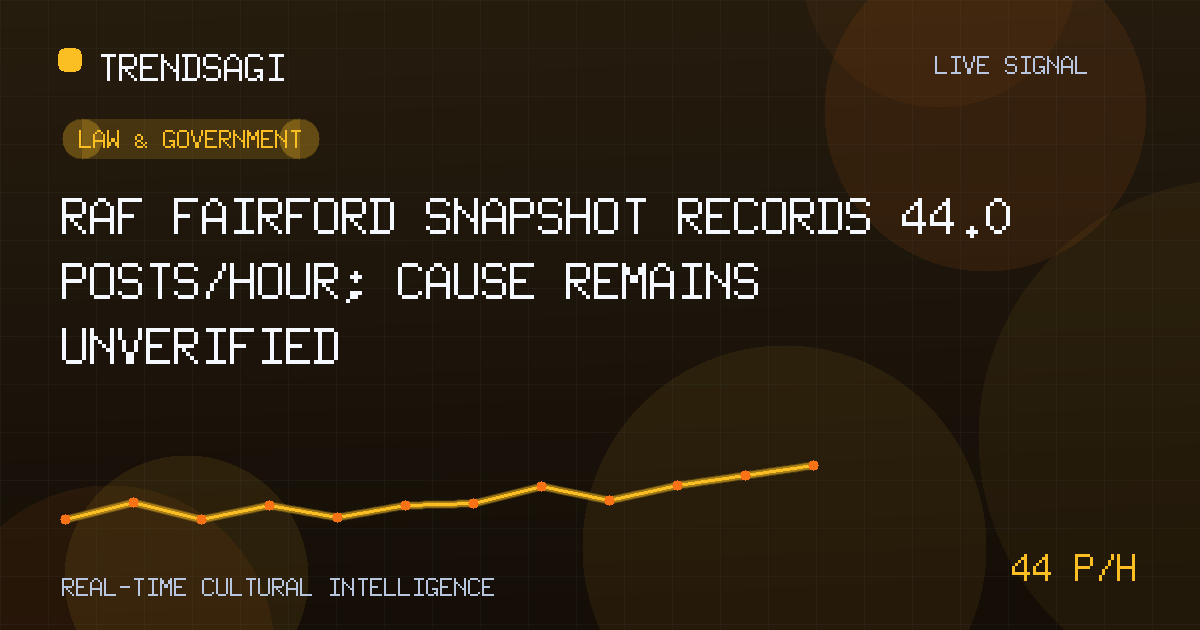
RAF Fairford snapshot records 44.0 posts/hour; cause remains unverified
RAF Fairford's timed snapshot recorded 44.0 posts/hour and 192 posts; the cause remains unverified and needs context.
Automated briefing. Generated from stored signal measurements and source-backed research; it is not manually reviewed. Read the methodology and limitations.
Metrics in this briefing are a snapshot associated with its publication date and may not reflect current conditions.
What changed
RAF Fairford is drawing concentrated posting activity, but the stored signal does not establish what triggered it. The latest snapshot contains 192 posts. That is enough to direct verification and monitoring, but not enough to identify an official action, news event or controversy as the cause.
The measured snapshot rate is 44.0 posts/hour over an exact 900-second window using 3 stored observations, measured at 2026-10-05T06:51:55Z. It describes observed posting activity in that narrow window—not a live or current rate, forecast, reach, engagement level or unique-person count.
| Observation time | Measured snapshot rate | Latest snapshot volume |
|---|---|---|
| 2026-10-05T06:51:55Z | 44.0 posts/hour | 192 posts |
Why this topic may be moving
No verified public explanation is available in the material used for this briefing, so the cause remains unclear. The topic label identifies what was monitored; the stored Law & Government category shows only how it was classified. Neither is evidence that government action, an announcement at the site or a wider controversy drove the posts.
Several mechanisms could produce a concentrated burst and should be treated as verification hypotheses, not findings:
- Official information: A newly published statement or notice could have prompted synchronized attention.
- News amplification: A breaking report could have moved the topic beyond its usual audience.
- Local or operational information: Information affecting people connected with the site could have prompted practical questions and reactions.
- Resurfaced material: Older content could have returned to prominence without a new underlying event.
- Duplicated or automated posts: Repeated wording or non-original submissions could make activity appear broader than it is.
A defensible explanation needs a public source with a publication time that aligns with the observed activity. Until that link is established, describing any of these possibilities as the trigger would exceed the evidence.
What the signal can and cannot establish
The dataset establishes that the stored snapshot associated 192 posts with RAF Fairford and produced a measured rate of 44.0 posts/hour during the specified window. It identifies a subject that warrants closer inspection. It does not reveal the substance, origin or significance of those posts.
- The volume does not establish how many different people participated.
- The posts do not show whether sentiment was positive, negative, neutral or incidental.
- No baseline is supplied, so the signal cannot show how unusual the rate is compared with normal activity.
- The narrow observation window cannot establish whether attention will continue.
- The category does not demonstrate official involvement or a government decision.
- The measurement time is not necessarily the time of the event being discussed.
A measured rate can identify where to look, but it cannot supply the missing news event. Without a time-matched public source, the responsible conclusion is activity observed; cause unconfirmed.
Why it matters
The immediate value is diagnostic. Elevated posting activity can alert editors and communicators to a developing subject, but the same rate can also reflect repetition, passing mentions or an unrelated story. The correct response is to verify the source and timing before communicating a causal interpretation.
- Editors and communicators need to avoid attaching the activity to a speculative incident or announcement.
- Teams connected with the site should distinguish verified operational information from rumor and unsupported reaction.
- Community representatives may need consistent public guidance if the discussion concerns local consequences, although no such consequence is established here.
- Researchers and analysts should preserve the distinction between volume, measured rate, unique participation and verified cause.
Misreading the signal could create a false incident narrative, amplify unverified claims or imply that routine attention represents a durable change. The activity is worth checking precisely because its explanation is missing, not because the numbers already demonstrate why it occurred.
What to watch next
- Causal source and timing: Use Google Search to locate time-matched publisher pages, then verify the relevant wording on the publisher's own page. A search-result summary alone is not confirmation.
- Post originality: Check whether the snapshot contains distinct reporting and reactions or repeated copies of the same claim.
- Persistence: Collect another observation using the same method and window. Continued activity would support monitoring; silence would not erase the original measurement.
- Independent corroboration: Look for separate publishers confirming the same underlying event rather than merely repeating the initiating post.
- Corrections and clarification: Watch for updates that narrow, retract or correct an early explanation circulating in the discussion.
- Content and geography: Determine what the posts are actually discussing and where the discussion is concentrated, rather than inferring either from the topic label.
If a verified explanation appears, it should be compared with the observation time and the measured window. If none appears, the cause should remain explicitly unknown rather than being filled with the most plausible narrative.
Methodology and limitations
This briefing uses the canonical snapshot observed at 2026-10-05T06:51:55Z. The latest snapshot volume is 192 posts. The supplied measured rate is 44.0 posts/hour, based on 3 stored observations across an exact 900-second window. No additional rate, baseline, projection or transformed metric has been introduced.
The available material does not provide post-level content, account identities, duplication data, sentiment, engagement, geographic distribution or a complete account of collection coverage. Consequently, the snapshot cannot establish audience size, authenticity, causation or persistence. It also cannot determine how the observed rate compares with a longer history of RAF Fairford discussion.
The observation timestamp marks when the signal was measured, not necessarily when any underlying event occurred. Similarly, the Law & Government classification is metadata rather than evidence that government action took place. No external causal fact is attributed because no time-matched public source available for this briefing verifies why the topic was moving.
Track This Topic for New Signals
Set alerts for future velocity or sentiment changes around this topic.
Explore Tracking PlansAbout TrendsAGI research
TrendsAGI's automated research pipeline publishes dated signal snapshots, methodology notes, and practical workflows for teams evaluating cultural momentum. Read how signals are scoped, scored, and limited in our research methodology.