901-second window · 3 observations · Measured Oct 4, 2026, 1:06 PM UTC · Provider: go_recent_snapshot_v2
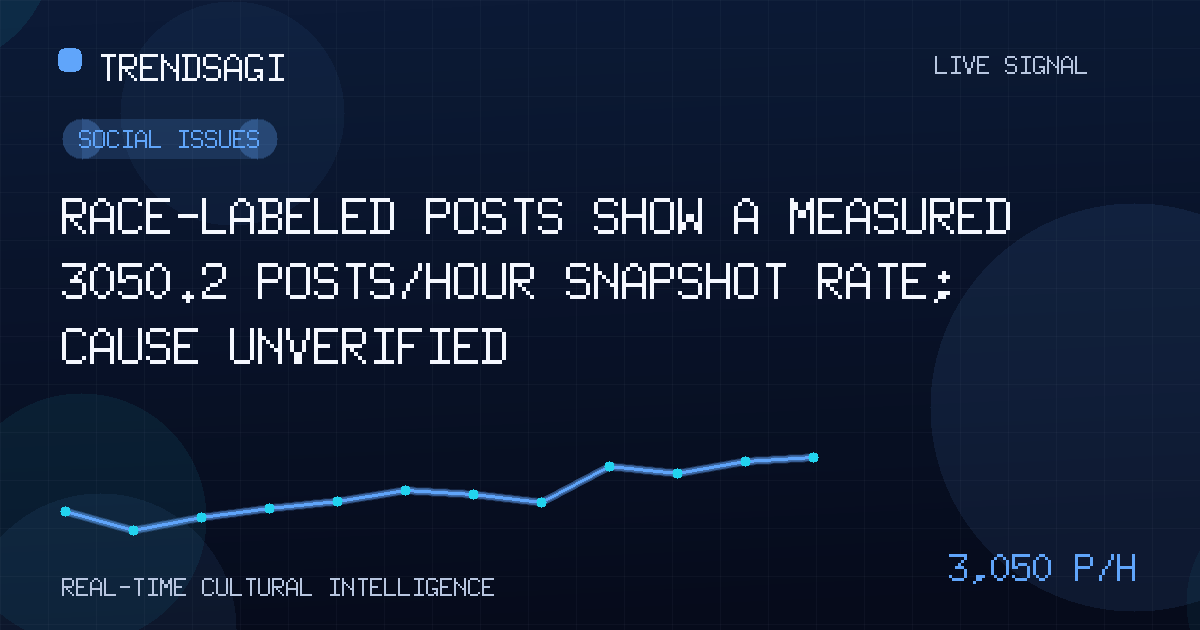
Race-labeled posts show a measured 3050.2 posts/hour snapshot rate; cause unverified
Stored “Race” signal shows a measured 3050.2 posts/hour snapshot rate; this briefing separates scale from unsupported cause, audience, and reach.
Automated briefing. Generated from stored signal measurements and source-backed research; it is not manually reviewed. Read the methodology and limitations.
Metrics in this briefing are a snapshot associated with its publication date and may not reflect current conditions.
What changed
Answer first: The stored signal labeled Race records increased posting activity, with 2880 posts in the latest snapshot at 2026-10-04T13:06:53Z. Its measured snapshot rate is 3050.2 posts/hour. The available record does not verify which event, dispute, or public development caused that increase, so this is a high-volume monitoring signal—not confirmed evidence of a reaction to a specific story.
The 3050.2 posts/hour figure is a measured snapshot rate, derived over an exact 901-second window using 3 stored observations. It is not a live or current rate, forecast, reach figure, engagement count, or unique-person count. The 2880 figure is the volume contained in the latest stored snapshot; it is not a rate.
| Observation time | Measured snapshot rate | Latest snapshot volume |
|---|---|---|
| 2026-10-04T13:06:53Z | 3050.2 posts/hour | 2880 posts |
Why this topic may be moving
No verified public context in the supplied record ties the increase to a particular cause. The stored category, Social Issues, is an editorial classification, but it does not prove that every matched post concerns racial equality, public policy, discrimination, or identity. Race is also broad enough to include unrelated uses. Without matched post text, query details, source information, or a confirmed news event, assigning the movement to one trigger would be speculation.
Several non-exclusive mechanisms could produce the measured pattern:
- A public trigger: A newly reported incident, legal or policy development, public statement, or controversy could prompt increased discussion.
- Multiple stories converging: Posts about separate events may share the same word without describing the same underlying issue.
- Conversation amplification: High-visibility accounts, repeated excerpts, reposted material, or coordinated campaigns can lift volume faster than distinct discussion.
- Collection effects: Query coverage, duplicate captures, labeling changes, automated activity, or platform-wide conversation can increase the count without equivalent growth in unique participants.
These are hypotheses, not verified explanations. The next evidentiary step is to inspect the matched content and test which context clusters account for the volume, rather than attach a plausible headline after the fact.
The stored record establishes a measured rise in posts associated with the broad Race label, but it does not establish what readers were discussing, whether the activity was organic, or why it accelerated.
Why it matters
For editors and communications teams, the immediate value is triage: the signal says the label merits attention, but not what the story is. For researchers, it identifies a period for content review. For organizations working on social issues, mistaking a broad keyword spike for a specific public reaction could distort messaging priorities. Readers should also avoid treating post volume as evidence of public consensus.
What the signal can establish
- A timestamped increase associated with the stored topic label.
- The scale of the collection at the latest stored snapshot.
- A starting point for comparable monitoring and content review.
What it cannot establish
- The event, news development, or conversation that caused the movement.
- Whether posts represent unique, organic participants; volume can include duplicates and reposts.
- The sentiment, geography, demographic composition, beliefs, or influence of participants.
- Potential reach, factual accuracy, or the prevalence of the issue in the wider population.
What to check next
Researchers, editors, and trust-and-safety teams should use the spike as a prompt for structured verification rather than a conclusion. Practical checks include:
- Audit query coverage. Inspect the exact matching text and adjacent words. Separate discussions of social issues from sports, product names, dates, places, or other uses of race.
- Rebuild comparable measurements. Collect another timed observation using the same 901-second window and preserve the raw counts before calculating a new rate.
- Cluster posts by narrative. Group content by named event, quoted phrase, source, and claim. A real event-driven spike should contain explicit textual links to the same candidate trigger.
- Check source behavior. Look for repeated wording, synchronized bursts, duplicate text, and a small set of dominant accounts. These are signals for review, not standalone proof of coordination.
- Verify a proposed cause externally. Use Google Search only to check a specific candidate trigger against dated, reputable public reporting. Search interest, an uncited snippet, or the general prevalence of a word is not proof of causation.
Concrete watch signals
- Persistence: Whether later comparable observations remain above, below, or near the reference measured snapshot rate of 3050.2 posts/hour.
- Source concentration: Whether activity is distributed across independent contributors or dominated by repeated versions from a limited set of accounts.
- Event alignment: Whether posts repeatedly name the same dated and verifiable event, rather than merely sharing a broad term.
- Topic separation: Whether the label continues to combine unrelated meanings or resolves into a distinct conversation about one issue.
- Context quality: Whether representative posts contain verifiable reporting, first-hand claims, reactions, recycled material, spam, or unrelated keyword matches.
If a public trigger is later verified, it should remain a candidate explanation until the collected posts show a clear textual connection to it. That distinction protects against assigning a real-world cause to a measurement artifact.
Methodology and limitations
The rate reported here comes from the canonical stored signal: 3 observations measured across an exact 901-second window ending at 2026-10-04T13:06:53Z. It describes the recorded snapshot rather than activity after that timestamp. The posts/hour value should not be extrapolated into a live total, longer-term forecast, or audience estimate.
The record provides a topic label and category but no underlying post text, matched-query details, baseline series, sentiment, geography, account counts, or verified external event. It therefore cannot establish whether the increase reflects a single issue, several unrelated conversations, organic activity, repetition, or automated amplification. The defensible conclusion is limited: the broad Race signal rose to a measured 3050.2 posts/hour snapshot rate, while its cause and audience composition remain unresolved.
Track This Topic for New Signals
Set alerts for future velocity or sentiment changes around this topic.
Explore Tracking PlansAbout TrendsAGI research
TrendsAGI's automated research pipeline publishes dated signal snapshots, methodology notes, and practical workflows for teams evaluating cultural momentum. Read how signals are scoped, scored, and limited in our research methodology.