899-second window · 3 observations · Measured Oct 8, 2026, 9:37 PM UTC · Provider: go_recent_snapshot_v2
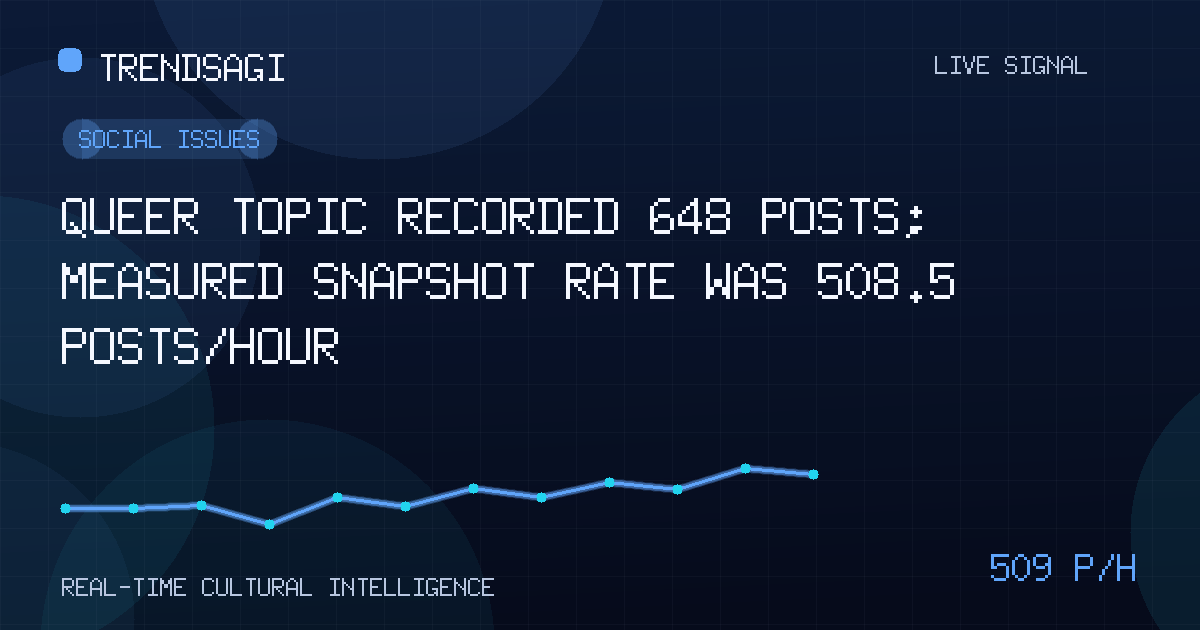
Queer topic recorded 648 posts; measured snapshot rate was 508.5 posts/hour
A monitored Queer topic snapshot recorded 648 posts and a measured snapshot rate of 508.5 posts/hour; its cause remains unverified and needs context.
Automated briefing. Generated from stored signal measurements and source-backed research; it is not manually reviewed. Read the methodology and limitations.
Metrics in this briefing are a snapshot associated with its publication date and may not reflect current conditions.
What changed
The monitored “Queer” topic shows concentrated short-window posting activity, but the available record does not establish what caused the movement. This is a narrow, measured signal—not proof of a wider social shift—and should be read alongside its exact observation time, rate, and volume.
| Observation time (UTC) | Measured snapshot rate | Snapshot volume |
|---|---|---|
| 2026-10-08T21:37:06Z | 508.5 posts/hour | 648 posts |
The measured snapshot rate is 508.5 posts/hour, measured across an exact 899-second window using three stored observations and recorded at 2026-10-08T21:37:06Z. The latest snapshot volume is 648 posts. The figures answer different questions: volume counts posts in the latest observation, while the rate summarizes change during the specified window. Neither is a live or current rate, forecast, reach, engagement figure, or unique-person count.
What the signal establishes
Three observations are enough to report the supplied measured rate, but not enough to establish a durable trend. No ordinary activity baseline is provided, so 508.5 posts/hour cannot be labeled high or low for this topic. The broad “Queer” label and its Social Issues category do not identify one subject, and the record does not include post text, account data, sentiment, reach, engagement, unique authors, geography, or platform mix.
It therefore cannot show whether participants discussed a common issue, responded to an event, or repeated the same claim.
A measured posting rate can identify a moment worth investigating; without event, source, and content context, it cannot by itself explain the moment.
Treat this as a verification lead rather than a finding about society. Aggregate volume under one label cannot establish consensus, the importance of the subject, or changes in lived experience.
Why this topic may be moving
No external event, announcement, or publisher report could be verified for this snapshot, so the cause remains unclear. The following explanations are hypotheses to test, not facts to publish.
- Breaking news or policy reaction: Check whether a specific decision or report began dominating the same time window.
- Cultural or calendar moment: Compare the activity with verified event dates, without assuming relevance in advance.
- Media or promotional release: Test whether official announcements, creators, or campaigns account for a meaningful share.
- Platform dynamics: A controversy, ranking change, hashtag convention, or moderation action could redirect discussion.
- Community response: First-person accounts, organizing, support requests, and reactions may be bundled under the same label.
- Coordinated repetition: Identical claims or unusual posting patterns may amplify a subject, but repetition alone does not establish coordination.
Until one explanation is corroborated, the defensible conclusion is only that the supplied measured snapshot rate applies to this short window and has no verified trigger.
Why it matters
This matters most to editors, researchers, community organizations, and trust-and-safety teams because each could otherwise mistake volume for evidence of a different phenomenon.
- Editors need event and source checks before describing the activity as a cultural turning point.
- Researchers need a baseline, sampling method, and coded content mix before generalizing.
- Community teams need to distinguish support and information-sharing from harassment or bad-faith targeting.
- Trust-and-safety teams need repetition and coordination checks before interpreting a possible increase.
For all of them, volume is an alert to investigate, not a causal headline. A large post count may contain repetition and narrow reactions; a smaller count may contain more varied first-person accounts. Any follow-up should preserve the distinction between activity under a topic label and evidence about the people or communities discussed.
What to watch next
The next useful step is verification rather than a stronger adjective.
- Establish a baseline. Collect comparable complete windows for the same topic and collection method, then ask whether later activity remains elevated relative to that topic’s own norm.
- Align events. Compare the 2026-10-08T21:37:06Z observation with verified news, policy, cultural, and release timelines. Reject a match if it precedes the activity or lacks substantive post references.
- Measure concentration. Compare the number of distinct contributing accounts with the 648-post snapshot, while avoiding assumptions based on profile labels or identity inference.
- Code content. Review a time-ordered sample for news reaction, personal experience, organizing, promotion, countering, and harassment; these categories may overlap.
- Test persistence. Check subsequent complete windows for the same measured rate, a decay, or renewed bursts. This narrow window and sustained interest would imply different stories.
- Separate activity from impact. Add unique authors, impressions, engagement, geography, language, and platform only where those measurements are available; do not infer them from volume.
Concrete watch signals include a named event becoming dominant, a small set of sources accounting for much of the activity, repeated phrasing across otherwise different posts, or a shift from reaction to real-world mobilization. A longer sequence of elevated windows would support a trend claim more strongly than this narrow observation. Any apparent bot activity, community mobilization, or policy impact still requires direct validation.
Methodology and limitations
This briefing describes a measured snapshot rate from three observations over an exact 899-second window, with the latest snapshot observed at 2026-10-08T21:37:06Z and containing 648 posts. The rate is not a live or current estimate, forecast, or measure of audience size.
The evidence is limited by one broad label and the absence of a baseline, source-level distribution, coded content, and verified external context. It establishes when activity was measured and the supplied measured snapshot rate, but not why it happened, who participated, what they thought, or whether the pattern persisted. Conclusions should remain provisional until event, source, and content checks converge.
Track This Topic for New Signals
Set alerts for future velocity or sentiment changes around this topic.
Explore Tracking PlansAbout TrendsAGI research
TrendsAGI's automated research pipeline publishes dated signal snapshots, methodology notes, and practical workflows for teams evaluating cultural momentum. Read how signals are scoped, scored, and limited in our research methodology.