1797-second window · 2 observations · Measured Oct 6, 2026, 6:52 AM UTC · Provider: go_recent_snapshot_v2
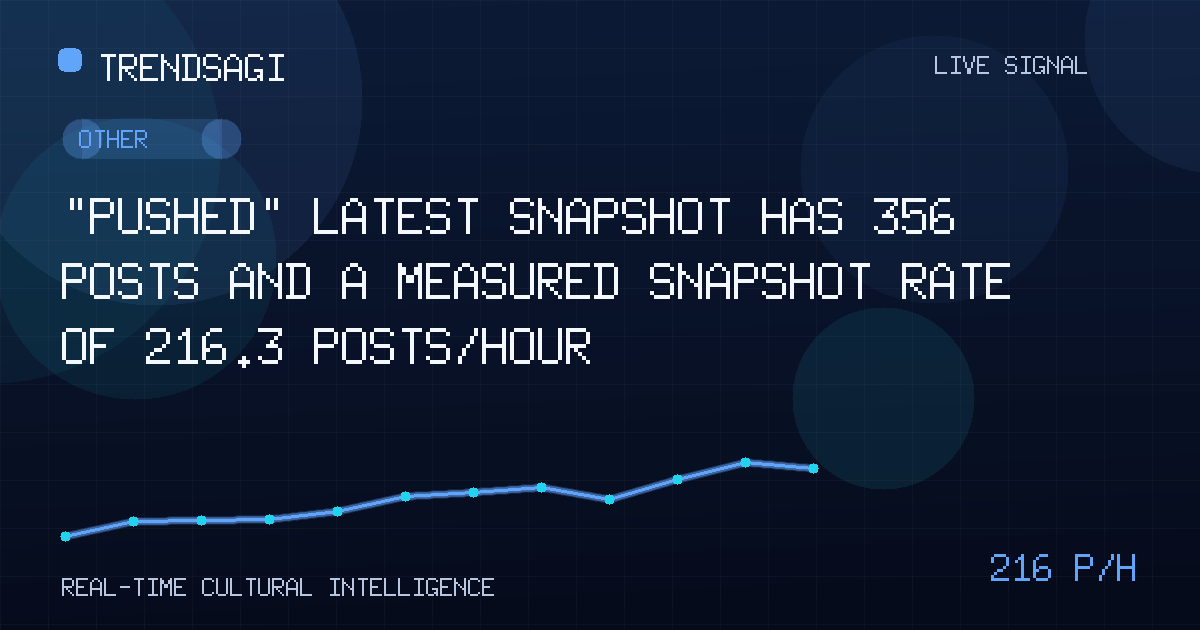
“Pushed” latest snapshot has 356 posts and a measured snapshot rate of 216.3 posts/hour
The “Pushed” snapshot contains 356 posts and a 216.3 posts/hour measured snapshot rate; its meaning, persistence, and catalyst remain unverified.
Automated briefing. Generated from stored signal measurements and source-backed research; it is not manually reviewed. Read the methodology and limitations.
Metrics in this briefing are a snapshot associated with its publication date and may not reflect current conditions.
What changed
The latest stored observation for “Pushed” contains 356 posts at 2026-10-06T06:52:10Z. Its measured snapshot rate is 216.3 posts/hour across an exact 1,797-second window based on two stored observations. That is the defensible headline: the monitored signal moved during the measured window, but neither the meaning of “Pushed” nor the reason for the movement is established.
The posts/hour figure is a measured snapshot rate, not a live or current rate, a forecast, reach, engagement, or a count of unique people. The 356 posts are the latest snapshot volume; they should not be described as 356 new posts, 356 authors, or 356 distinct events.
| Metric | Stored observation |
|---|---|
| Observation time | 2026-10-06T06:52:10Z |
| Measured snapshot rate | 216.3 posts/hour |
| Latest snapshot volume | 356 posts |
The measurement window and observation timestamp describe the stored measurement; they do not provide a historical baseline for judging whether the activity is unusual.
Why this topic may be moving
There is no verified public explanation attached to the signal, so the cause remains unclear. A topic label can become active because its underlying subject is developing, but it can also become active because a monitoring rule is catching a common word in unrelated contexts. The stored category is “Other,” and no description narrows the label.
Several explanations should be tested rather than assumed:
- Lexical ambiguity. “Pushed” may be appearing as an ordinary verb in many unrelated conversations. If so, the aggregate is linguistically broad rather than a coherent public trend.
- Entity or event use. The word could be a product name, feature, campaign label, incident term, or another proper-name-like usage. The signal does not identify which, if any.
- Source concentration or duplication. A burst may be dominated by one account, a repost cluster, or repeated wording. That would change the interpretation from broad activity to concentrated distribution.
None of these possibilities is a verified fact about the current discussion. A public catalyst should be accepted only if contemporaneous reporting from an identifiable publisher, or a relevant primary announcement, clearly aligns with the monitored posts and timing. Without that validation, stating that “Pushed is moving because of X” would be speculation.
Why it matters
For editors, the immediate value is triage, not publication. The measured movement is a reason to inspect the underlying sample, but it is not enough to frame a story about public reaction. Before assigning significance, an editor needs to know what “Pushed” denotes, which sources produced the posts, whether they were duplicated, and whether the activity persisted beyond the measured window.
For analysts and monitoring teams, the label is a warning about measurement quality. An ambiguous query can produce an apparently strong signal without a coherent subject. Comparing it with a broader keyword, a disambiguated entity query, or source-specific slices may produce a different result. Those comparisons are proposed checks, not findings from this snapshot.
For product, communications, and trust-and-safety teams, the signal could become important if entity validation connects it to a named product, service, or event. Until then, acting on the label alone risks a false alarm or the wrong kind of response. The practical next step is to resolve the subject before escalating the metric.
A measured snapshot rate of 216.3 posts/hour quantifies short-window movement in the monitored feed. It does not establish why the posts appeared, who contributed them, or whether the movement represents broad public interest.
What to watch next
Several checks would turn this signal into a more reliable briefing:
- Inspect the raw sample. Read posts from throughout the exact measurement window and record the context in which “Pushed” appears. Distinguish exact-word use from semantic matches and unrelated uses of other forms of the verb.
- Resolve the entity. Identify products, organizations, people, places, or events named by the word. Do not merge those groups unless the text provides enough context.
- Check source structure. Compare account, publisher, platform, language, and geography. Look for repeated text, shared links, or synchronized posting that could inflate apparent volume without adding independent voices.
- Build a same-definition sequence. Preserve the query, filters, and counting method, then add later stored observations. The key signal is whether measured snapshot rates persist, rise, fall, or reverse under comparable conditions.
- Verify a catalyst. Use Google Search to find reporting or a primary announcement tied to the exact term and timing. Attribute any accepted external fact to its publisher and omit claims that cannot be corroborated.
- Track concentration and spread. Watch whether activity remains concentrated in a few sources or becomes distributed across unrelated, independently authored posts. That distinction matters more than raw repetition.
Concrete warning signs would be a label definition changing between snapshots, no matching examples in the raw feed, high source concentration, or disappearance of the measured movement in the next comparable observation. Concrete confirmation would require stable measurement, coherent context, and a verified event that aligns with the post timing.
Methodology and limitations
This briefing uses the canonical snapshot observed at 2026-10-06T06:52:10Z, its latest snapshot volume of 356 posts, and the supplied measured snapshot rate of 216.3 posts/hour. The rate comes from two stored observations over an exact 1,797-second window. It is a point-in-time statistic about captured activity, not a current estimate of ongoing conversation.
The record does not include the monitoring query, collection boundary, platform mix, geographic coverage, earlier observation values, duplication controls, or a historical baseline. Those omissions prevent a representative rate estimate. With only two stored observations, the record also cannot establish acceleration, a peak, or persistence. “Pushed” is measured as “Other,” and its ambiguity is the most important constraint: the topic cannot be reliably mapped to an entity, audience, or story.
No external cause is asserted because no verified public context was available to connect the label to a specific event. The appropriate conclusion is therefore narrow but useful: a monitored signal reached 356 posts in the latest snapshot and registered a 216.3 posts/hour measured snapshot rate over the stated window; its cause, persistence, reach, and significance remain unresolved.
Track This Topic for New Signals
Set alerts for future velocity or sentiment changes around this topic.
Explore Tracking PlansAbout TrendsAGI research
TrendsAGI's automated research pipeline publishes dated signal snapshots, methodology notes, and practical workflows for teams evaluating cultural momentum. Read how signals are scoped, scored, and limited in our research methodology.


