814-second window · 3 observations · Measured Sep 26, 2026, 11:38 AM UTC · Provider: go_recent_snapshot_v2
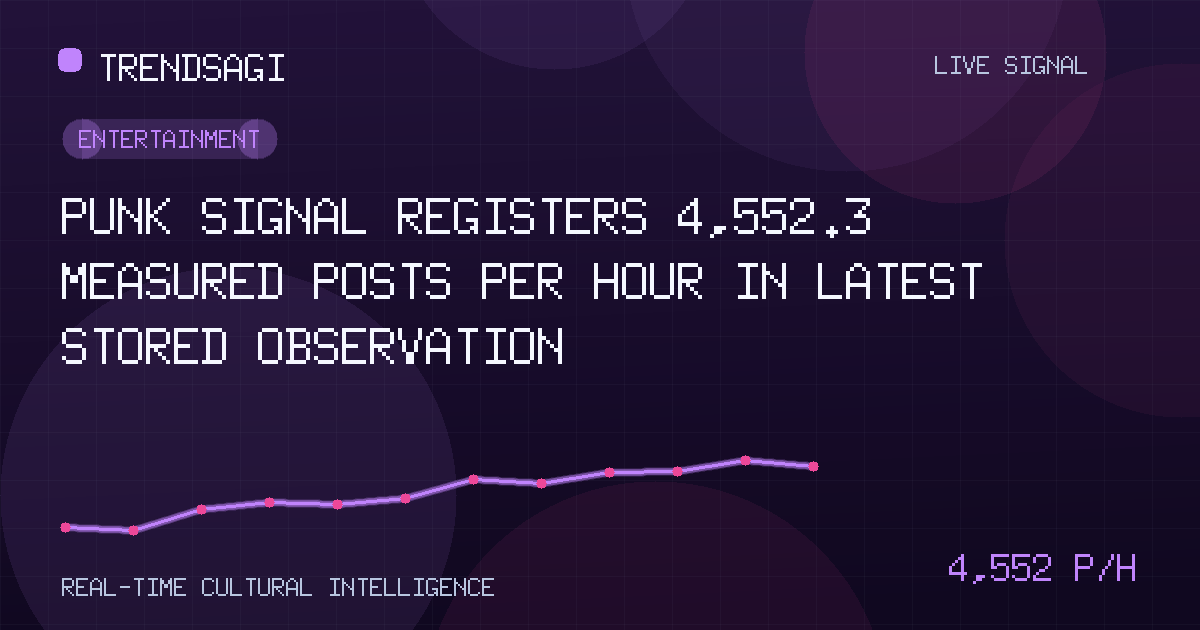
Punk signal registers 4,552.3 measured posts per hour in latest stored observation
Punk's latest stored snapshot has 2,057 posts and a measured 4,552.3 posts/hour; the trigger, baseline, and durability remain unverified.
Automated briefing. Generated from stored signal measurements and source-backed research; it is not manually reviewed. Read the methodology and limitations.
Metrics in this briefing are a snapshot associated with its publication date and may not reflect current conditions.
What changed
Punk registers 2,057 posts in the latest stored observation, while the accompanying measured change rate is 4,552.3 posts/hour. The evidence establishes activity during a specific window, but not its cause, whether it exceeds a normal baseline, or whether it will persist. No verified public context identifies a trigger.
The 4,552.3 posts/hour figure is a measured snapshot rate, not a live or current rate. It was calculated over an exact 814-second window from three stored observations, with the result reported at 2026-09-26T11:38:58Z. It is not a forecast, reach figure, engagement measure, or count of unique people.
| Measure | Stored value |
|---|---|
| Observation time | 2026-09-26T11:38:58Z |
| Measured snapshot rate | 4,552.3 posts/hour |
| Snapshot volume | 2,057 posts |
Why this topic may be moving
The most defensible answer is descriptive: the measured window captured 4,552.3 posts/hour associated with Punk. The record places the topic in Entertainment, but a category is not a cause. It provides no event description, source mix, or verified public reporting that can be tied to the timing.
Several mechanisms could produce this pattern. A release, performance, controversy, anniversary, or celebrity-related event could concentrate conversation; a recommendation cycle could increase exposure; a news reaction could amplify discussion; or repeated or automated posting could affect the count. None of those possibilities is evidenced here. The absence of a verified explanation should be reported plainly rather than filled with the most culturally plausible guess.
There is also a baseline problem. Although 4,552.3 posts/hour is supplied as a measured change rate, the available material gives no preceding level, comparator, or longer history. The number therefore describes the pace represented by this window; it does not by itself show that Punk is above its usual volume or still accelerating.
What the signal can and cannot establish
The signal can establish that the latest stored snapshot contained 2,057 posts and that the supplied calculation produced 4,552.3 posts/hour across the stated window. That is enough to justify a timely monitoring check.
- It cannot show unique authors, organic reach, sentiment, location, language, platform, or whether the activity is broad-based. A small group posting repeatedly, a recommendation loop, or duplicate content can tell a very different story from many independent participants.
- It does not identify the subject matter inside the posts. Without a content sample, the topic label alone cannot connect the activity to music, fashion, politics, sport, or another live development. Snapshot volume is a count of captured posts, not a measure of audience size.
Why it matters
For editors, the immediate risk is false causality: a time-sensitive signal can invite a familiar story even when no event has been verified. It is more useful as a reason to check than as the basis for a headline.
- Editors and reporters should seek event-level confirmation before explaining the activity.
- Community and platform teams should inspect source concentration and persistence to distinguish broad conversation from a few prolific posters.
- Researchers and trend analysts should add a prior baseline, collection coverage, and consistent query definitions before making comparisons.
Punk is worth watching as a time-sensitive conversation signal, not yet as a verified cultural event. The next useful question is not what story would fit the activity, but what evidence independently explains it and whether it persists beyond the measured interval.
What to watch next
- Persistence: Collect subsequent snapshots under the same topic definition and compare them with the present window. A new independently calculated rate would show whether the activity continues, fades, or changes pace.
- Source concentration: Review the distribution across accounts, hashtags, domains, languages, and locations. Volume dominated by one source needs a different explanation from participation spread across a community.
- Content coherence: Sample the posts and identify recurring people, works, organizations, or events. If no coherent subject connects them, describe the signal as an attention cluster rather than a topic-specific event.
- Post integrity: Check for duplicate text, repeated URLs, quote-post chains, and signs of automated or coordinated activity. These checks are necessary before treating volume as broad public participation.
- External corroboration: Look for verified reporting or a first-party announcement that clearly concerns the same Punk-related subject and aligns with the observation time. No event should be named in the trend explanation before that link is established.
- Distribution and timing: Determine which platforms and recommendation paths carry the activity, and compare the sequence of source posts with subsequent conversation. This helps distinguish an originating event from a downstream reaction.
A verified, time-aligned event followed by sustained activity would support an event-led explanation. If one account or recommendation loop dominates, the activity may be creator- or platform-led. If duplication explains much of the count, it is primarily a data-quality issue. If no coherent driver appears, the honest classification remains an unexplained attention cluster.
Methodology and limitations
The stored category is Entertainment. The latest observation is timestamped 2026-09-26T11:38:58Z and contains 2,057 posts. The supplied measured snapshot rate is 4,552.3 posts/hour, calculated over an exact 814-second window using three stored observations. Only those supplied values are reported; no percentage, projection, audience estimate, or transformed count is offered.
No verified public context accompanies the signal, so no external fact, publisher, person, title, or event is attributed as its cause. The three-observation basis is narrow, and the record does not state how posts were collected, whether duplicates were removed, or how the Punk label was applied. Those omissions limit comparisons and causal conclusions.
Posts are records rather than people. They may include repetition, automation, reactions, or copying, and they do not reveal sentiment or reach on their own. The measured rate should therefore be used as a prompt for verification and further collection, not as proof of a durable cultural trend.
Track This Topic for New Signals
Set alerts for future velocity or sentiment changes around this topic.
Explore Tracking PlansAbout TrendsAGI research
TrendsAGI's automated research pipeline publishes dated signal snapshots, methodology notes, and practical workflows for teams evaluating cultural momentum. Read how signals are scoped, scored, and limited in our research methodology.


