907-second window · 2 observations · Measured Oct 5, 2026, 2:41 PM UTC · Provider: go_recent_snapshot_v2
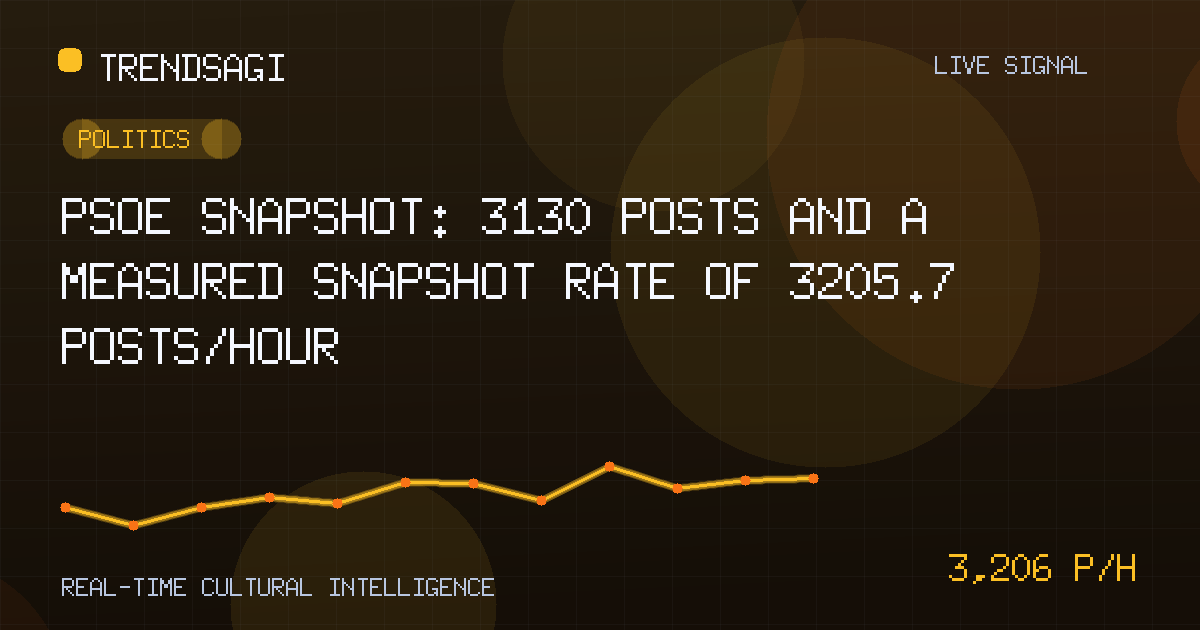
PSOE snapshot: 3130 posts and a measured snapshot rate of 3205.7 posts/hour
The PSOE snapshot contains 3130 posts and a measured snapshot rate of 3205.7 posts/hour; the reason for the movement remains unverified.
Automated briefing. Generated from stored signal measurements and source-backed research; it is not manually reviewed. Read the methodology and limitations.
Metrics in this briefing are a snapshot associated with its publication date and may not reflect current conditions.
What changed
The direct answer is that the latest stored record contains 3130 posts under the PSOE label, while the reason for the change remains unverified. At 2026-10-05T14:41:56Z, that snapshot is the latest available in the record. No public-source event has been verified as the trigger, so the movement should not yet be attributed to a specific political development.
The stored series records a measured snapshot rate of 3205.7 posts/hour over an exact 907-second window using 2 stored observations. That is a historical measured change between snapshots—not a live or current rate, forecast, reach estimate, engagement measure, or count of unique people. Separately, 3130 is the volume in the latest snapshot, not a rate.
| Measure | Stored value |
|---|---|
| Observation time | 2026-10-05T14:41:56Z |
| Measured snapshot rate | 3205.7 posts/hour |
| Measurement basis | 907 seconds using 2 stored observations |
| Latest snapshot volume | 3130 posts |
Why this topic may be moving
The available record contains no verified public-source explanation and no event attribution; its stored description is empty. A volume signal can show that the labeled post count changed, but it cannot identify the subject driving that change. Possible explanations include reaction to political news, an official communication, a controversy, coordinated amplification, or a change in data collection. These are hypotheses to check, not conclusions.
The signal establishes a measured change in posts carrying the PSOE label. It does not establish why those posts appeared, who generated them, or whether they represent meaningful political attention.
A credible catalyst needs both time alignment and independent support. An editor should look for a dated official communication or reliable reporting about PSOE that was published during or shortly before the measured window. Its timing and substance should then match a sample of the posts. Without that match, saying the label is moving because of a particular event would be speculation.
Public search results also require care: an article may recap an earlier event, and a headline may mention the label without generating the discussion. Verification should require a concrete event, a defensible timestamp, and evidence that relevant posts are responding to it rather than merely repeating the keyword.
Why it matters
The practical value is triage. The signal tells an editor when to inspect a keyword and supplies a timestamp for checking; it does not supply the explanation. That distinction matters in political coverage, where repeating an unverified catalyst can shape the story faster than reporting can establish it.
- Political editors and reporters should use the snapshot to decide what to verify, seek primary confirmation, and avoid turning correlation into a causal headline.
- Party communications and campaign teams should check whether a real statement or event exists before preparing a response. They also need to know whether the signal reflects broad discussion or a narrow burst.
- Researchers and analysts need a historical baseline, account-level duplication checks, and content labels before treating the observation as a trend in opinion or attention.
- Platform and trust teams should test for repetition, irrelevant uses of the same string, or collection anomalies before interpreting the pattern as organic political activity.
What to watch next
The next checks should distinguish a real catalyst from a short-lived or mechanical burst. Useful evidence would include:
- Persistence: Take another timestamped snapshot using the same query, time boundary, deduplication method, and counting rules. A repeat at similar levels would support persistence, while a reversal would favor a short burst. The present record cannot choose between them.
- Catalyst timing: Look for a verifiable official release, speech, interview, polling publication, campaign action, or news report tied to the measured period. Record publication times rather than relying on search rank.
- Content relevance: Review a time-stratified sample and classify posts as original commentary, reaction, quotation, repetition, or irrelevant use of the same string. This is essential before calling the activity a PSOE conversation.
- Distribution: Where the data permits, inspect unique accounts, repeated text, language, geography, and concentration. A narrow set of repeated posts and a broad mix of original comments imply very different phenomena.
- Historical comparison: Compare several equivalent earlier windows and nearby political topics. This can show whether the reading is unusual and whether it is specific to this label or part of a wider conversation.
- Collection integrity: Confirm that query rules, ingestion health, and deduplication did not change around the window. A measurement discontinuity is not evidence of a public reaction.
- Separate quality metrics: Track engagement and unique-account measures independently from post volume when available. A large post count with little independent participation should not be described as wide reach.
The strongest support for a specific catalyst would be a verified event, compatible timing, and sampled posts that discuss it. The strongest support for broad participation would be independent account distribution and original commentary, not raw volume alone. Until those checks are available, the cause should remain classified as unresolved.
Methodology and limitations
The latest observation is timestamped 2026-10-05T14:41:56Z and contains 3130 posts. The 3205.7 posts/hour figure is the supplied measured snapshot rate across an exact 907-second window based on 2 stored observations. It is a change measure between stored points, not a live or current count of publishing activity.
With only 2 observations, the series cannot establish a normal baseline, duration, peak, volatility, or persistence. The record also supplies no sentiment, geography, language, account uniqueness, engagement, source distribution, or event metadata. The stored Politics category and PSOE label help route the signal but do not validate every post’s subject.
No external explanation is included because no public fact met the verification standard. The defensible conclusion is therefore narrow: this is a timestamped prompt to investigate a measured posting change, not proof of a broader political trend, public opinion, or causal event.
Track This Topic for New Signals
Set alerts for future velocity or sentiment changes around this topic.
Explore Tracking PlansAbout TrendsAGI research
TrendsAGI's automated research pipeline publishes dated signal snapshots, methodology notes, and practical workflows for teams evaluating cultural momentum. Read how signals are scoped, scored, and limited in our research methodology.