893-second window · 3 observations · Measured Sep 25, 2026, 3:56 AM UTC · Provider: go_recent_snapshot_v2
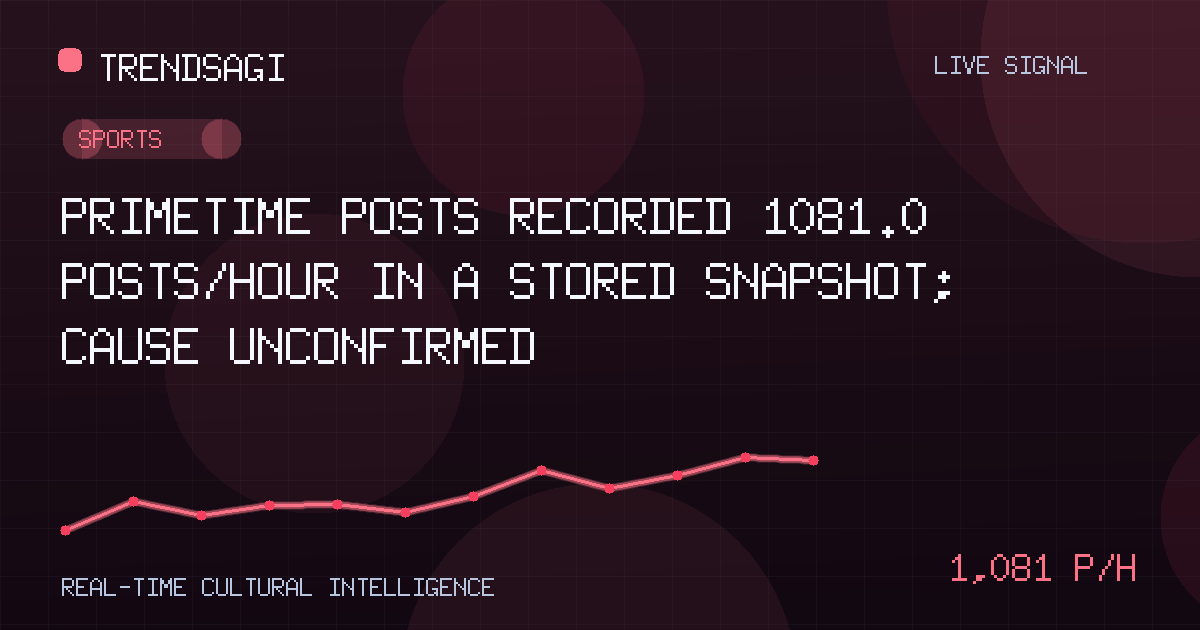
Primetime posts recorded 1081.0 posts/hour in a stored snapshot; cause unconfirmed
A stored Primetime snapshot recorded 1081.0 posts/hour; the cause is unconfirmed, with checks for attribution, persistence, and audience impact.
Automated briefing. Generated from stored signal measurements and source-backed research; it is not manually reviewed. Read the methodology and limitations.
Metrics in this briefing are a snapshot associated with its publication date and may not reflect current conditions.
What changed
The stored “Primetime” signal recorded a measured change rate of 1081.0 posts/hour over an exact 893-second window using 3 stored observations. This is a measured snapshot rate, not a live or current rate, forecast, reach, engagement, or unique-person count. The latest stored snapshot contained 648 posts.
The direct answer is increased posting activity in that stored window, but the driver is unverified. The stored category is Sports, yet the signal does not identify a match, league, team, broadcaster, or news event. Assigning the change to a particular event would go beyond the available evidence.
| Measure | Stored value |
|---|---|
| Observation time (UTC) | 2026-09-25T03:56:29Z |
| Measured change rate | 1081.0 posts/hour |
| Latest snapshot volume | 648 posts |
Why this topic may be moving
The available record contains no verified public explanation for the movement. “Primetime” is a broad label, and the Sports category alone cannot identify a sporting event or media incident. A game result, pregame discussion, broadcast change, controversy, or scheduled programming could prompt activity, but none can be connected to this signal from the information provided.
To establish a cause, an editor would need reporting or primary evidence that independently connects the activity to an event. The records do not distinguish a new event from continued discussion of an earlier result, changed posting behavior, or changed classification. The responsible conclusion is cause unconfirmed, not that a game, announcement, or broadcast decision drove the activity.
A measured rate shows that posting activity changed within the observed window. It does not identify the people involved, their views, or the cause. Event attribution, audience measurement, and interpretation of the response each require separate evidence.
Why it matters
For sports editors and fact-checkers, the change may justify checking the available posts and relevant reporting. A Sports label is not enough to select a match, team, or athlete. The immediate task is identification: establish which proper names, score references, leagues, and broadcast details actually appear.
For audience and media teams, this is a review candidate, not proof of mass interest. The 648 posts in the latest stored snapshot and the 1081.0 posts/hour change rate measure different things. Neither establishes audience size, attention earned, or whether discussion was positive, negative, or neutral. Those distinctions matter when deciding whether to commission coverage, adjust monitoring, or wait for corroboration.
For trend and platform analysts, the label needs a stable definition and comparable baseline. A change can reflect a new event, but it can also reflect differences in sampling, collection, or classification. Without consistent coverage and matching rules, another observation should be treated as a check, not as a stand-alone measure of durable attention.
What to check next
Use these checks to turn a monitoring alert into a defensible conclusion:
- Attribute the posts. Review a representative sample of the available posts for team names, players, leagues, match states, and broadcaster references. Do not rely only on the most reposted items. The test is whether an identifiable subject explains the “Primetime” label, not whether generic sports language is present.
- Verify the public driver. Check reporting close to the observation time and, where possible, a primary announcement from the identified competition or broadcaster. Record publication and event times, and confirm that the source discusses the same subject. Sharing the word “Primetime” is not corroboration. If the connection cannot be established, keep the cause marked unconfirmed.
- Separate broad-label activity from event-specific activity. Compare the “Primetime” label with terms such as team or league names. A wider label can produce rising activity without evidence of a single trigger. Watch for concentration around specific entities, repeated event references, or a shift toward generic broadcast talk; each would change how confidently the trend can be attributed.
- Recheck persistence using the same method. Preserve the observation time, collection coverage, label definition, and separation between snapshot volume and posts/hour. Watch for the measured rate to remain elevated, recede, or be replaced by event-specific language. If post-level data are available, assess distinct authors, original versus repeated posts, and reactions separately; the stored signal does not supply those measures.
- Set an explicit escalation decision. Escalate to the relevant sports or news desk if the label resolves to a verified event and a comparable follow-up confirms persistence. If attribution fails or activity recedes, close the review and document the outcome. This keeps action proportionate to the evidence rather than to posting volume alone.
Methodology and limitations
The reported change rate is 1081.0 posts/hour, measured at 2026-09-25T03:56:29Z across an exact 893-second window using 3 stored observations. The separate latest stored snapshot contains 648 posts. These are stored measurements, not a real-time total. The posts/hour figure describes change within the measurement window; the snapshot volume describes the associated stored collection.
Only 3 stored observations underpin the reported rate. The supplied information does not provide a historical time series, an explicit previous baseline, the underlying post text, author counts, engagement, geography, or audience composition. It also provides no verified explanation for the movement. “Primetime” may function as a label, a phrase, or a broadcast marker; without matching and classification rules, its scope cannot be assumed.
This establishes that the stored, labeled posting measure changed at the reported rate and merits review. It does not establish causation, sustained momentum, public sentiment, reach, or participation. Its practical value is triage: identify the subject, verify a public driver, and obtain a comparable follow-up before treating it as a confirmed news trend.
Track This Topic for New Signals
Set alerts for future velocity or sentiment changes around this topic.
Explore Tracking PlansAbout TrendsAGI research
TrendsAGI's automated research pipeline publishes dated signal snapshots, methodology notes, and practical workflows for teams evaluating cultural momentum. Read how signals are scoped, scored, and limited in our research methodology.