893-second window · 3 observations · Measured Sep 24, 2026, 4:26 AM UTC · Provider: go_recent_snapshot_v2
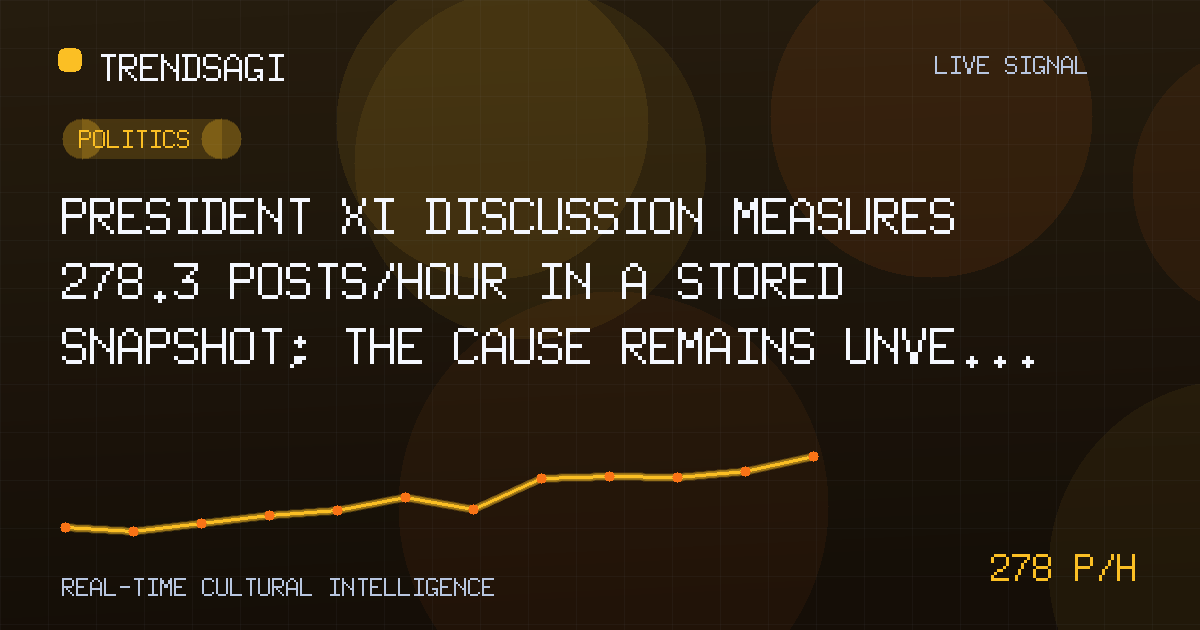
President Xi discussion measures 278.3 posts/hour in a stored snapshot; the cause remains unverified
The “President Xi” snapshot measured 278.3 posts/hour and 236 posts; the briefing explains the rise without claiming reach or a verified cause.
Automated briefing. Generated from stored signal measurements and source-backed research; it is not manually reviewed. Read the methodology and limitations.
Metrics in this briefing are a snapshot associated with its publication date and may not reflect current conditions.
What changed
Discussion grouped under “President Xi” shows a short-window acceleration in the stored Politics signal, measured at 278.3 posts/hour. The available evidence does not establish what prompted the increase. The supported conclusion is a burst of activity around the topic, not a verified reaction to a particular speech, policy, meeting, or international event.
| Observation time | Measured posts/hour | Snapshot volume |
|---|---|---|
| 2026-09-24T04:26:33Z | 278.3 posts/hour | 236 posts |
The rate was measured from 3 stored observations across an exact 893-second window, with the change measured at 2026-09-24T04:26:33Z. The latest snapshot contains 236 posts. Snapshot volume is not another rate: it is the number of collected posts at the observation time. The posts/hour figure is a measured snapshot rate, not a live or current rate, forecast, reach estimate, engagement measure, or count of unique people.
Neither figure, on its own, demonstrates a durable shift in public opinion or identifies who generated the activity.
Why this topic may be moving
The stored signal includes no accompanying description, and no attributable public reporting has been verified for this briefing. The cause is therefore unclear. The topic label identifies the person being tracked; it does not establish what the posts report, when their underlying subject matter emerged, or whether they are original, copied, supportive, critical, or incidental.
Claims that the activity reflects a new announcement, policy change, or diplomatic development would go beyond the record. A reliable explanation would need a named event, credible reporting connecting it to the discussion, and timing that fits the measured window. An attributable statement could help establish what was said; independent reporting could help establish how the subject circulated. Neither is available as verified context here.
The evidence establishes a measurable change in posting activity around “President Xi.” It does not yet establish the news event behind that change, the provenance of the posts, or their political meaning.
Why it matters
For China-focused editors and political analysts, the immediate implication is a need to inspect the conversation before interpreting it. A short-window burst may be associated with new information, but it could also involve renewed circulation of older material; the stored figures do not distinguish those possibilities. The appropriate next step is event-level verification and source inspection, not a broader conclusion about political sentiment.
For newsrooms, the signal is useful as an editorial sampling prompt: check which claims are being repeated and whether they can be traced to a primary document or established publisher. For researchers, it is a reason to add surrounding observations and a longer comparison period before studying a change in attention. For communications and policy teams, it flags a subject that may merit monitoring, but supplies no direct evidence of impact, influence, or public support.
Geography and platform also matter. A collection of 236 posts may reflect the communities and content most visible to that collection system, not a representative view of China or of people worldwide. Without collection and deduplication details, the snapshot cannot be treated as a count of distinct authors or original contributions.
What to watch next
- A named, time-stamped event. Look for verified reporting or an attributable statement that clearly connects a speech, decision, meeting, or other development to the period. Later coverage may explain the discussion, but publication time alone does not prove it caused the earlier activity.
- Consistency beyond the short window. Check whether subsequent stored observations show continued activity relative to 236 posts and the earlier observations, and whether the measured rate persists. Do not substitute snapshot volume for a rate or assume that this burst will continue.
- Content and source diversity. Review whether posts contain independent reporting, quotations from identifiable sources, commentary, or repeated material. Determine whether discussion comes from distinct accounts or is amplified by a small number of highly active contributors.
- Geographic and language spread. Compare other collections to see whether the same subject is appearing across regions and languages or is concentrated in a particular platform community. Wider spread would improve context, not automatically validate the underlying claims.
- Event-to-post timing. Compare the publication time of verified developments with the exact 893-second measurement window. Clear sequencing and a credible link to the posts would strengthen an explanation; matching subject matter alone remains circumstantial.
If those checks do not resolve the driver, the responsible description remains an unexplained rise in discussion. That is still useful for monitoring, but it is not a basis for inventing a political narrative.
Methodology and limitations
This briefing uses the canonical snapshot observed at 2026-09-24T04:26:33Z. The measured snapshot rate is 278.3 posts/hour, based on 3 stored observations over 893 seconds; the snapshot volume is 236 posts. Those quantities measure different things and have not been converted into estimates of reach, engagement, or audience size.
No verified public reporting supports a specific causal explanation, so no external event is asserted. The topic label is a tracking label, not evidence that an underlying post is accurate. The supplied signal also provides no platform coverage, geographic sampling, language mix, account-level deduplication, sentiment classification, or comparison method beyond the stated observation window. It therefore cannot establish representative opinion, unique participation, organic versus automated activity, or a continuing trend beyond the snapshot.
The practical conclusion is narrow: verify the event, inspect representative posts, and extend the time series before treating this activity as a substantive political shift.
Track This Topic for New Signals
Set alerts for future velocity or sentiment changes around this topic.
Explore Tracking PlansAbout TrendsAGI research
TrendsAGI's automated research pipeline publishes dated signal snapshots, methodology notes, and practical workflows for teams evaluating cultural momentum. Read how signals are scoped, scored, and limited in our research methodology.