901-second window · 3 observations · Measured Sep 26, 2026, 7:06 AM UTC · Provider: go_recent_snapshot_v2
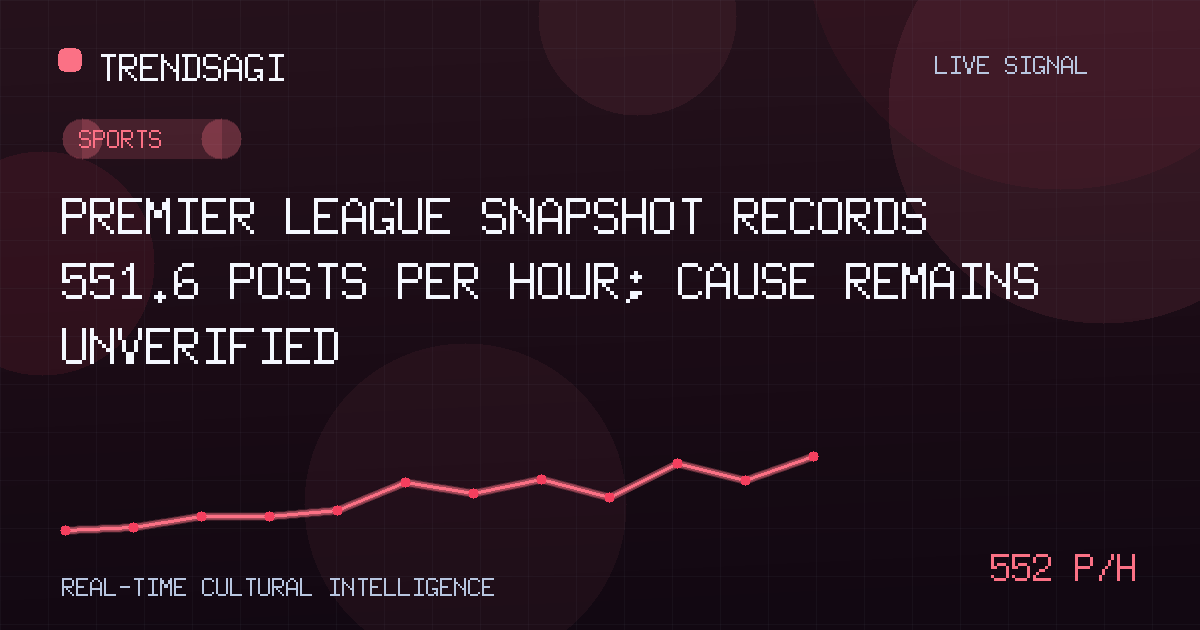
Premier League snapshot records 551.6 posts per hour; cause remains unverified
The Premier League snapshot logged 837 posts, with a measured rate of 551.6 posts per hour; the cause is unverified. It explains what to validate next.
Automated briefing. Generated from stored signal measurements and source-backed research; it is not manually reviewed. Read the methodology and limitations.
Metrics in this briefing are a snapshot associated with its publication date and may not reflect current conditions.
What changed
The stored Premier League signal contained 837 posts in the latest snapshot, while the measured snapshot rate was 551.6 posts per hour across an exact 901-second window using 3 stored observations. The defensible takeaway is that the monitored conversation was active at the recorded moment; the public catalyst behind that activity is not verified, so no match, result, transfer, injury, or controversy should be presented as the cause without evidence.
| Observation time | Measured snapshot rate | Snapshot volume |
|---|---|---|
| 2026-09-26T07:06:31Z | 551.6 posts/hour | 837 posts |
The two figures answer different questions. Snapshot volume reports how many posts were present in the stored collection; posts per hour reports the measured pace across the defined observation window. They should not be combined or reconciled without knowing how the snapshot and window were constructed. The rate is not a live or current rate, forecast, reach figure, engagement total, or count of unique people. Because the record supplies no earlier rate or historical baseline, it also cannot prove that conversation accelerated, declined, or became unusual relative to normal Premier League coverage.
Why this topic may be moving
No verified public context in the available record ties the activity to a specific announcement or event. Volume alone cannot distinguish a breaking-news reaction from scheduled football discussion, a recurring complaint, promotional posting, or many accounts repeating the same subject. These are possible explanations, not conclusions, and assigning one without timing and source evidence would turn a useful alert into a speculative narrative.
- One time-sensitive event: A result, lineup, injury update, transfer development, disciplinary matter, or managerial item could concentrate commentary. None is confirmed here.
- Several concurrent subjects: Discussion may be broad rather than driven by one incident. Separate match reaction, club news, roster speculation, and wider criticism before combining them.
- Live participation: An ongoing event may sustain concentrated posting, while a post-event reaction may produce a brief concentration. The observation window alone does not reveal which pattern occurred.
- Collection effects: Duplicate text, quoted posts, automated forwarding, or uneven source coverage can raise volume without representing equivalent independent interest. The stored data provided does not quantify any of these effects.
The practical implication is to treat the alert as an investigation lead. It says where conversation appeared in the monitored feed and how quickly it accumulated, not why readers cared, whether they agreed, or whether the same story appeared elsewhere.
Why it matters
For editors, the signal is most useful as a prompt to check whether a developing story deserves coverage. A broad topic label can combine many unrelated conversations; identifying the dominant cluster would make a newsroom response faster and reduce the risk of amplifying a minor or duplicated thread.
For clubs, competition operators, sponsors, and rights holders, the volume indicates attention within the monitored dataset, not the size or value of the audience. Customer-support teams may need to distinguish supporter reaction from operational issues, while communications teams may need to know whether conversation is concentrated on one matter. None of those decisions should use post volume as a proxy for public sentiment without reading the posts and establishing their provenance.
The strongest defensible conclusion is that the monitored feed recorded 551.6 posts per hour during the defined window; it does not yet establish that the Premier League became more popular, nor what caused the activity.
What to watch next
- Verify a public anchor. Check timestamped reputable reporting and primary announcements from the relevant competition, club, player, or other named institution. A catalyst should have a publication time that can plausibly align with the observed posting activity.
- Inspect the leading clusters. Sample the highest-volume recurring phrases, linked subjects, claims, and quoted passages. Separate original reactions from copied text and determine whether multiple conversations are being grouped under the league-wide label.
- Check timing. Compare the first appearance of important posts with the observation timestamp. A cluster that appears before the window and is repeatedly reposted may look very different from a genuinely new development inside the window.
- Test reach versus repetition. Look at how many distinct accounts participate, whether posts add new information, and whether a small set repeatedly forwards one item. Account counts and originality would need to be measured; they cannot be inferred from 837 posts.
- Establish a baseline. Compare the measured rate with earlier windows under the same collection method and at comparable times. Without that context, high activity is descriptive shorthand, not proof of a statistically meaningful surge.
- Follow subsequent observations. Check whether the rate remains comparable, fades quickly, or splits into identifiable clusters. Persistence may support a continuing conversation, while a sharp reversal after a verified event would be more consistent with a reaction burst.
Concrete confirmation would require convergence: a public catalyst with a credible timestamp, multiple post clusters that refer to it, and independent reporting or primary documentation. A topical spike without that alignment should remain described as unexplained.
Methodology and limitations
The observation time is 2026-09-26T07:06:31Z. The rate of 551.6 posts per hour was measured over an exact 901-second window from 3 stored observations; the snapshot contained 837 posts. Those values are reproduced without recalculation. The snapshot volume is a count of posts, while the rate describes the pace during the defined window.
The record does not provide a sampling frame, collection coverage, deduplication method, prior rate, historical baseline, sentiment mix, account uniqueness, geography, language distribution, or a verified explanation. The limited observations also cannot show the full shape of the spike. Consequently, this briefing can characterize the stored signal and specify checks, but it cannot infer a national or global audience, organic reach, causation, or a change in unique attention.
Until those checks are completed, the cause of the Premier League activity remains unclear. The appropriate next step is not to invent a news angle, but to validate the event, inspect the content, compare the collection with its normal baseline, and then reassess the trend.
Track This Topic for New Signals
Set alerts for future velocity or sentiment changes around this topic.
Explore Tracking PlansAbout TrendsAGI research
TrendsAGI's automated research pipeline publishes dated signal snapshots, methodology notes, and practical workflows for teams evaluating cultural momentum. Read how signals are scoped, scored, and limited in our research methodology.