877-second window · 3 observations · Measured Oct 7, 2026, 3:56 PM UTC · Provider: go_recent_snapshot_v2
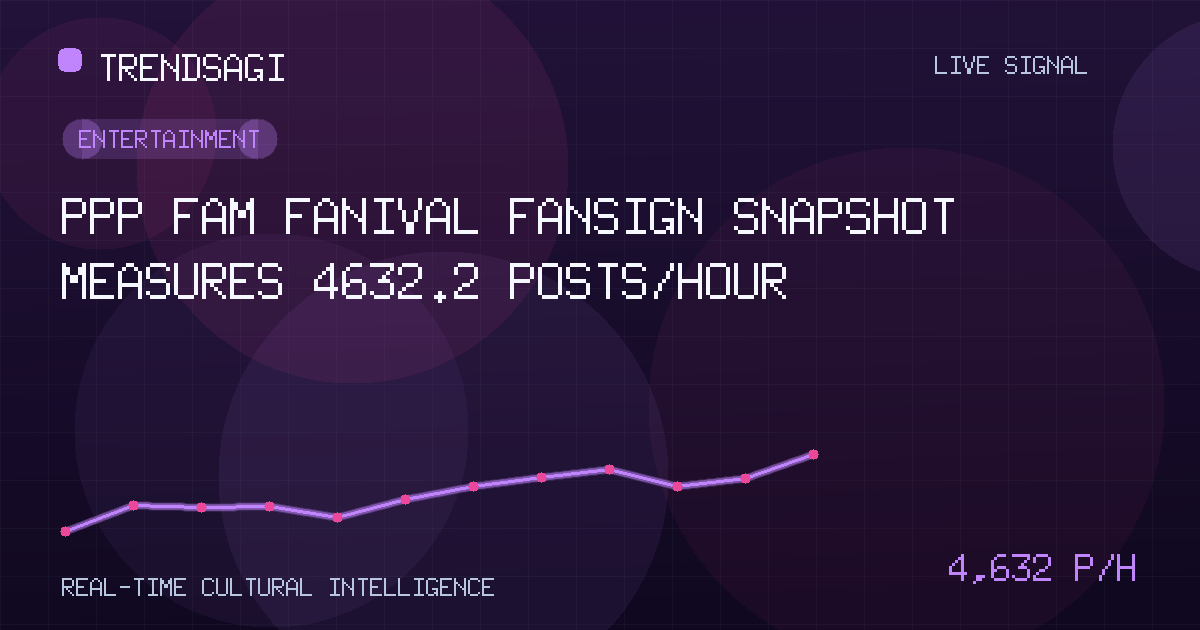
PPP FAM FANIVAL FANSIGN snapshot measures 4632.2 posts/hour
Stored observations show a PPP FAM FANIVAL FANSIGN burst measuring 4632.2 posts/hour, while the event catalyst remains unverified.
Automated briefing. Generated from stored signal measurements and source-backed research; it is not manually reviewed. Read the methodology and limitations.
Metrics in this briefing are a snapshot associated with its publication date and may not reflect current conditions.
What changed
Answer: The stored record captures a concentrated posting burst around PPP FAM FANIVAL FANSIGN, but it does not establish why the topic moved. The latest stored snapshot contains 1894 posts, while the measured snapshot rate is 4632.2 posts/hour. That is evidence of high posting activity during the measurement, not proof of an announcement, crowd size, organic growth, or wider public reach.
The measured change covers an exact 877-second window based on 3 stored observations and is timestamped 2026-10-07T15:56:51Z. The posts/hour figure is a retrospective, measured snapshot rate—not a live or current rate, forecast, engagement total, or unique-person count. The 1894-post snapshot volume and the 4632.2 posts/hour rate are separate measures and should not be substituted for one another.
| Measure | Stored value |
|---|---|
| Observation time | 2026-10-07T15:56:51Z |
| Measured snapshot rate | 4632.2 posts/hour |
| Latest snapshot volume | 1894 posts |
Why this topic may be moving
The label contains fandom and fan-event language, particularly the terms fanival and fansign, but it does not identify an organizer, performer, venue, location, event date, or announcement. Treating those words as proof of a particular event would go beyond the record. The available public context does not independently establish a catalyst, so the reason for the increase remains unclear.
Several mechanisms could plausibly produce this pattern, but none is confirmed:
- Event information: Registration, ticketing, participation, lineup, or schedule news may have prompted fans to publish reactions and reminders.
- Event lifecycle: A scheduled fansign or fanival may have moved conversation toward arrival, queues, check-ins, photographs, merchandise, or post-event reactions.
- Community amplification: Active fan accounts may have relayed the same label through reposts, quote posts, hashtags, screenshots, or coordinated reminders.
- Measurement collision: Unrelated uses of a broad or ambiguous label, repeated content, or automated posting could contribute to the observed volume.
A verified explanation should connect the timestamp to dated public evidence and identify the event being discussed. Until that connection is made, event-related chatter is a working hypothesis rather than an established fact.
The signal establishes synchronized posting activity around a label, not the identity of the event, the reason attention rose, or the number of people involved.
Why it matters
The stored Entertainment classification indicates the category assigned to the signal; it does not verify the underlying story. The immediate value of the burst is therefore operational: it identifies a topic that warrants rapid fact-checking and closer monitoring.
- Fans and event teams: Sudden discussion can increase demand for accurate schedules, access information, queue guidance, and safety notices. Those teams should act on confirmed event details, not on the posting rate itself.
- Publishers and platforms: High volume can encourage quick coverage, but an ambiguous label creates a risk that unrelated events will be conflated or an unsupported catalyst will be repeated as fact.
- Trend analysts: The rate is useful for deciding what to investigate next, provided it is kept separate from audience size, sentiment, engagement quality, and event attendance. It is a trigger for analysis, not a conclusion about it.
What to watch next
Useful follow-up should separate event identification, cause, persistence, and audience quality. Concrete checks include:
- Resolve the label: Use Google Search for the exact phrase PPP FAM FANIVAL FANSIGN. Look for a dated page from an identifiable organizer, venue, or participating account that supplies the missing event identity. Corroborate any claimed catalyst with reputable reporting before treating it as confirmed.
- Identify the content phase: Determine whether posts are anticipatory, such as registration or schedule reminders; operational, such as travel or queue discussion; first-hand, such as check-ins or photographs; or retrospective. A transition between those phases would help explain the burst.
- Check whether volume persists: Collect fresh, timestamped observations using the same collection method and window. A sustained sequence would support a continuing event cycle; a rapid fall would be more consistent with a temporary announcement or repost wave.
- Test content integrity: Review duplicate wording, repeated images, repost ratios, account overlap, and geographic signals. These checks can reveal whether the measured rate reflects broad discussion, coordinated fan behavior, or collection overlap.
- Watch for concrete confirmation: The strongest follow-up signals are an official event page, consistent details across reputable coverage, growing use of a specific event hashtag, and an increase in first-hand posts. None of those signals is present in the stored figures alone.
Methodology and limitations
The reported rate was measured over the exact 877-second window from 3 stored observations, with the latest observation recorded at 2026-10-07T15:56:51Z. It is presented as a measured snapshot rate because the record does not establish that the same level continued afterward. The 1894 posts are the latest stored snapshot volume, not a rate and not a total derived from the rate.
No earlier baseline, percentage change, raw post text, account-level data, sentiment breakdown, location distribution, or unique-author count is provided. Consequently, the signal cannot establish organic audience growth, the number of participants, the direction of opinion, whether posts were unique, or whether activity was automated. It also cannot show that every post using the label referred to the same event.
External verification has not established an announcement, appearance, venue, schedule, attendance milestone, or other causal event. The defensible conclusion is therefore narrow: the topic registered substantial posting activity in the measured stored window, while its cause and public significance remain unresolved.
Track This Topic for New Signals
Set alerts for future velocity or sentiment changes around this topic.
Explore Tracking PlansAbout TrendsAGI research
TrendsAGI's automated research pipeline publishes dated signal snapshots, methodology notes, and practical workflows for teams evaluating cultural momentum. Read how signals are scoped, scored, and limited in our research methodology.