902-second window · 3 observations · Measured Oct 1, 2026, 7:22 PM UTC · Provider: go_recent_snapshot_v2
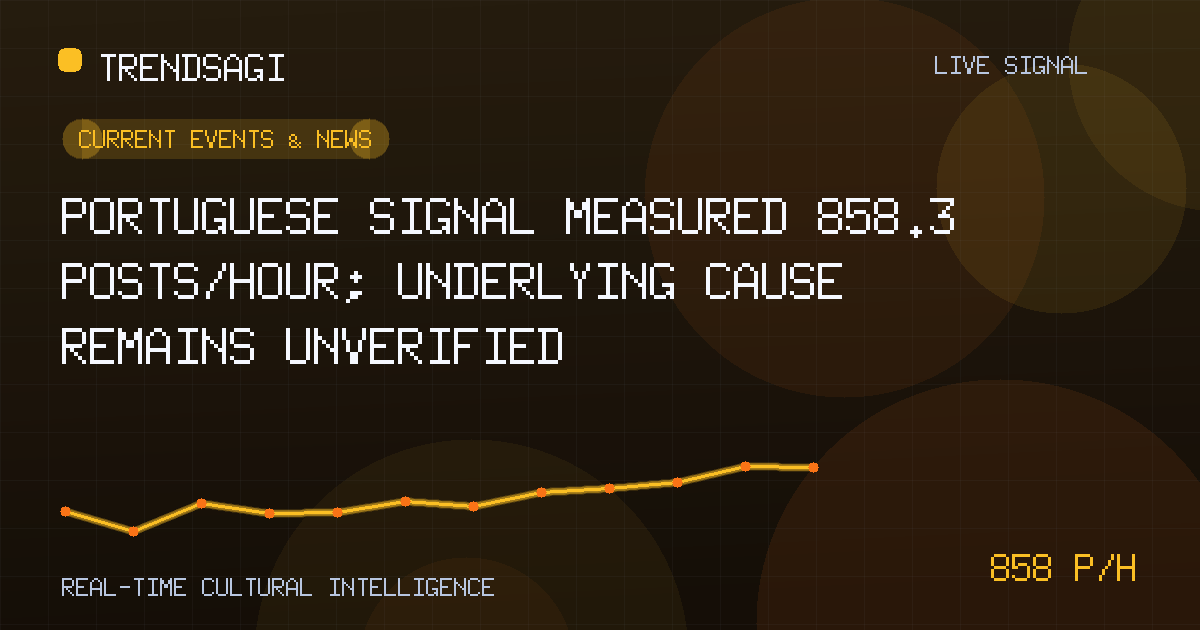
Portuguese signal measured 858.3 posts/hour; underlying cause remains unverified
The Portuguese signal showed 654 posts in the latest snapshot and 858.3 posts/hour in the measured window; its cause remains unverified.
Automated briefing. Generated from stored signal measurements and source-backed research; it is not manually reviewed. Read the methodology and limitations.
Metrics in this briefing are a snapshot associated with its publication date and may not reflect current conditions.
What changed
The monitored topic labeled Portuguese registered a measured snapshot rate of 858.3 posts/hour over an exact 902-second window, based on 3 stored observations at 2026-10-01T19:22:09Z. The latest snapshot volume was 654 posts. The defensible conclusion is that the monitored stream recorded a short-window burst around this label; why it occurred remains unverified.
The 858.3 posts/hour figure is a measured snapshot rate, not a live or current rate, forecast, reach estimate, engagement total, or unique-person count. The stored category is Current Events & News, but it does not identify a news event. Portuguese may denote the language, people or nationality, a place, or another context. Without post-level review or verified public context, assigning one cause would be speculation.
| Metric | Stored value |
|---|---|
| Observation time | 2026-10-01T19:22:09Z |
| Measured snapshot rate | 858.3 posts/hour over 902 seconds, based on 3 stored observations |
| Latest snapshot volume | 654 posts |
Why this topic may be moving
No verified trigger is established in the available record. The stored category, Current Events & News, describes the bucket, not the subject. Because the label is broad and the underlying posts are not shown, several mechanisms remain possible. These are hypotheses to test, not causal findings.
- Label ambiguity. Portuguese can identify a language, a nationality, a geographic reference, or a token appearing in another story. Each would imply a different editorial interpretation and a different set of source checks.
- Classifier scope. A keyword or topic classifier may group loosely related mentions without proving that they describe one event. No classification method or confidence information is supplied, so that possibility cannot be evaluated.
- Amplification. Reposting, syndicated text, automated activity, or repeated links can increase post counts without an equal increase in distinct discussion. The aggregate record cannot distinguish those patterns.
- News-cycle clustering. If an event did trigger the signal, relevant coverage might converge around the same facts and sources. That pattern is not visible here and should not be assumed.
A velocity signal can justify a faster verification workflow; it cannot substitute for evidence about the underlying event.
Why it matters
Newsrooms and editors should care because a fast aggregate label can be mistaken for a confirmed breaking story. The safe response is to inspect sampled posts, identify their named entities, and locate primary evidence before choosing a headline or issue framing.
Organizations serving Portuguese-speaking audiences, language teams, and community managers should care because a broad tag can blur distinct conversations. A language-related discussion, a story about people, or an unrelated keyword hit should not be summarized as the same trend.
Researchers, communications teams, and market watchers should care because the signal is useful for prioritizing verification, not for estimating demand, public opinion, or reputational impact. The same count can reflect heavy repetition and broad attention, which are different conditions requiring different responses.
What to watch next
Before escalating the signal, turn the aggregate into an auditable chain of checks.
- Inspect a representative sample. Record post text, named entities, language, timestamp, source, and links. This will show whether the label points to a coherent subject or several unrelated conversations.
- Measure duplication. Compare repeated phrases, identical links, quoted text, and syndicated copies. A burst dominated by one repeated item indicates amplification; diverse original posts provide stronger evidence of broad discussion.
- Test source convergence. Look for multiple independent credible publishers or accounts referring to the same claim. A primary statement or document would be more useful for causation than another volume update.
- Resolve the label. Separate Portuguese as a language from its use as a nationality, place name, or keyword. Check whether translations and non-Portuguese commentary are being folded into the same topic.
- Establish a baseline. Compare adjacent and longer windows from the same stream using the same collection and deduplication method. That will show whether the observed pace is sustained, recurring, or a short anomaly.
- Watch what changes next. Relevant signals include persistence across later snapshots, a shift toward one entity, increasing source diversity, or a rapid fall after the spike. Also watch for unsupported causal claims appearing before the underlying posts can be verified.
Methodology and limitations
The reported rate is the supplied measured change across 3 observations within the exact 902-second window, presented here as a measured snapshot rate. Snapshot volume—654 posts—describes the latest collection instead. The two measures are not interchangeable: the record does not provide the observation sequence, inclusion rules, or deduplication rules needed to reconstruct one from the other.
The signal can establish label-level velocity within this monitored stream. It cannot establish platform-wide prevalence, unique authors, sentiment, geography, authenticity, factual accuracy, or the reason for the movement. No post text, account data, source links, or verified public account was available to support a causal explanation, so none is asserted. Treat the result as a trigger for faster checking, not as evidence that the public broadly believes or experienced a particular event.
Track This Topic for New Signals
Set alerts for future velocity or sentiment changes around this topic.
Explore Tracking PlansAbout TrendsAGI research
TrendsAGI's automated research pipeline publishes dated signal snapshots, methodology notes, and practical workflows for teams evaluating cultural momentum. Read how signals are scoped, scored, and limited in our research methodology.