901-second window · 3 observations · Measured Sep 25, 2026, 6:37 AM UTC · Provider: go_recent_snapshot_v2
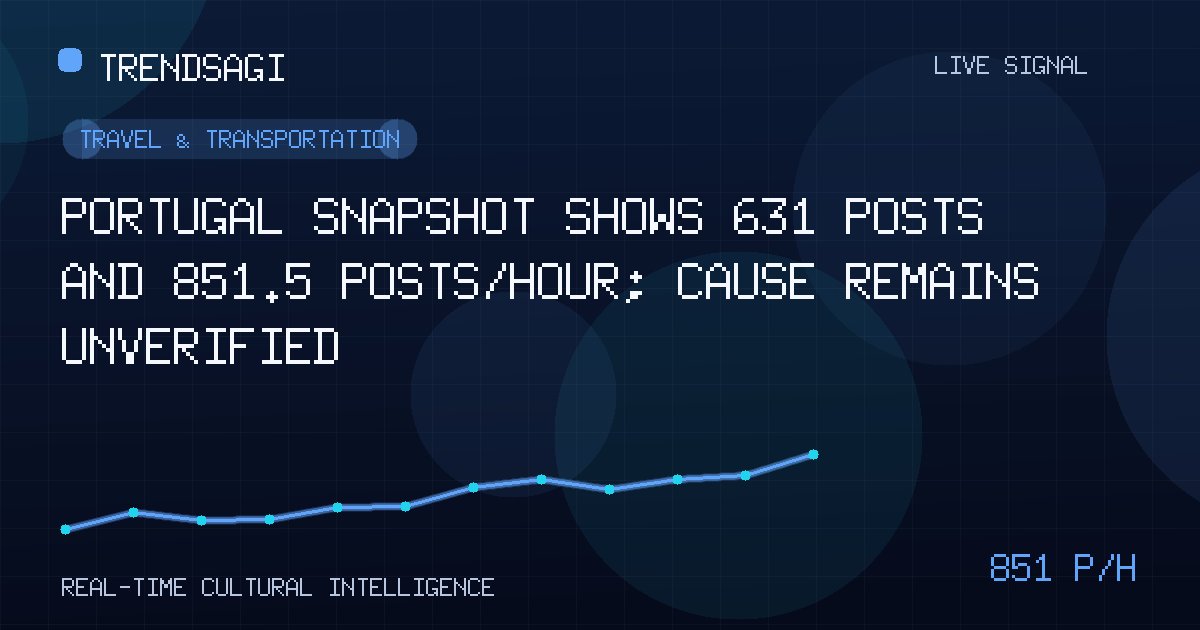
Portugal snapshot shows 631 posts and 851.5 posts/hour; cause remains unverified
Portugal’s snapshot contains 631 posts at a measured rate of 851.5 posts/hour; the cause, significance, and next verification checks remain clear.
Automated briefing. Generated from stored signal measurements and source-backed research; it is not manually reviewed. Read the methodology and limitations.
Metrics in this briefing are a snapshot associated with its publication date and may not reflect current conditions.
What changed
Portugal’s latest recorded conversation shows a short-window increase, but its cause is unconfirmed. The snapshot contains 631 posts, and the measured change rate is 851.5 posts/hour. Although the stored category is Travel & Transportation, the country label alone does not establish a travel-related trigger or an event in Portugal.
The 851.5 posts/hour figure is a measured snapshot rate, recorded at 2026-09-25T06:37:09Z from 3 stored observations across an exact 901-second window. It describes the change within that measured period; it is not a live or current rate, a forecast, reach, engagement, or a count of unique people. The 631 posts are the latest snapshot volume, not an hourly total or a measure of audience size.
| Observation time (UTC) | Measured snapshot rate | Snapshot volume |
|---|---|---|
| 2026-09-25T06:37:09Z | 851.5 posts/hour | 631 posts |
Why this topic may be moving
The reason for the increase remains unclear. No verified public context in the record connects the rise to a specific news report, travel disruption, policy announcement, or seasonal event. It would be speculative to name any of those as the cause.
The travel classification makes travel a sensible area to check, not a proven explanation. A discussion increase can accompany a destination update, itinerary or transport question, or broader country news. It can also reflect changes in the composition of the sampled conversation. Those are hypotheses to test, not established drivers of this signal.
There is no event description to establish which subject the posts concern. Portugal can denote a destination, an origin, a stop, a country of origin, or a topic in general news. Until that context is checked, the signal should be treated as a change in conversation around a geographic label, not as sufficient evidence of a change in tourism or transport activity.
Why it matters
The immediate finding is a rapid increase in the monitored conversation, which makes Portugal a priority for verification rather than a confirmed travel story. For destination, airline, rail, hospitality, and tourism teams, the practical question is whether the discussion contains questions or operational issues that require a response.
A measured rise in posts is a reason to investigate. It is not, by itself, evidence of a new travel event, higher bookings, altered transport capacity, or changed conditions for visitors.
- Travel and tourism readers: use the signal to identify subjects for rapid fact-checking, not to revise forecasts or make operational decisions from this record alone.
- Local organizations and residents: check whether attention is tied to a time-sensitive issue, but do not treat a country-level increase as proof that local conditions have changed.
- Media and communications teams: examine the claims and language being repeated before responding, distinguishing useful answers from unsupported assumptions.
What to watch next
- Establish the trigger and chronology. Look for the earliest credible, time-stamped public report, official notice, event announcement, or travel update associated with the increase. Match its timing to the recorded observations. Without that link, retain an explicitly unknown cause; do not promote a plausible story simply because it concerns Portugal.
- Determine what Portugal represents in the conversation. Review a representative sample of the 631 posts and classify references by destination, origin, transit point, general country news, or ambiguous geography. Identify the travel-specific share. The category assignment is not enough to quantify how many posts concern transport or tourism.
- Separate substantive discussion from measurement effects. Check for repeated content, coordinated posting, a dominant source, or a monitoring or category change that could affect counts. These are checks, not findings. The record does not establish that any of them occurred, and the measured rate cannot resolve the question by itself.
- Test persistence with comparable observations. Compare subsequent stored snapshots using the same topic definition and counting method. Record each timestamp, observation count, window length, and volume separately. Later windows may show whether the increase persists or recedes, but this measurement should not be extrapolated beyond its exact window.
- Verify operational significance if travel relevance is established. Compare the conversation with verified transport notices, airport or rail operational information, official destination guidance, and an operator’s own booking or service data. Those checks can establish operational context; posting volume alone cannot establish cancellations, demand, capacity, or visitor numbers.
- Prioritize concrete corroboration. Watch for a credible event explanation, a rising travel-specific share, a repeated source dominating discussion, or independently confirmed operational changes. If none appears, keep the cause unknown. Another country-level volume snapshot would not, by itself, prove the original trigger.
Methodology and limitations
This briefing separates the stored observation from its interpretation. The 631-post figure is the snapshot volume at 2026-09-25T06:37:09Z. The 851.5 posts/hour figure is a measured snapshot rate over an exact 901-second window using 3 stored observations, also measured at that time. It is not a live or current rate and should not be projected forward.
Post counts do not establish unique authors, original content, or independently verified experiences. The record does not provide a prior comparison baseline, post-level sample, geographic breakdown, language breakdown, or source composition. Consequently, the signal cannot identify a cause, audience segment, or travel outcome. The defensible conclusion is that Portugal-tagged posting increased at the measured rate within the specified window; what triggered it and whether it matters operationally remain open questions.
Track This Topic for New Signals
Set alerts for future velocity or sentiment changes around this topic.
Explore Tracking PlansAbout TrendsAGI research
TrendsAGI's automated research pipeline publishes dated signal snapshots, methodology notes, and practical workflows for teams evaluating cultural momentum. Read how signals are scoped, scored, and limited in our research methodology.