901-second window · 3 observations · Measured Oct 9, 2026, 5:51 PM UTC · Provider: go_recent_snapshot_v2
Polanski signal records 327 posts and a 639.1 posts/hour measured snapshot rate
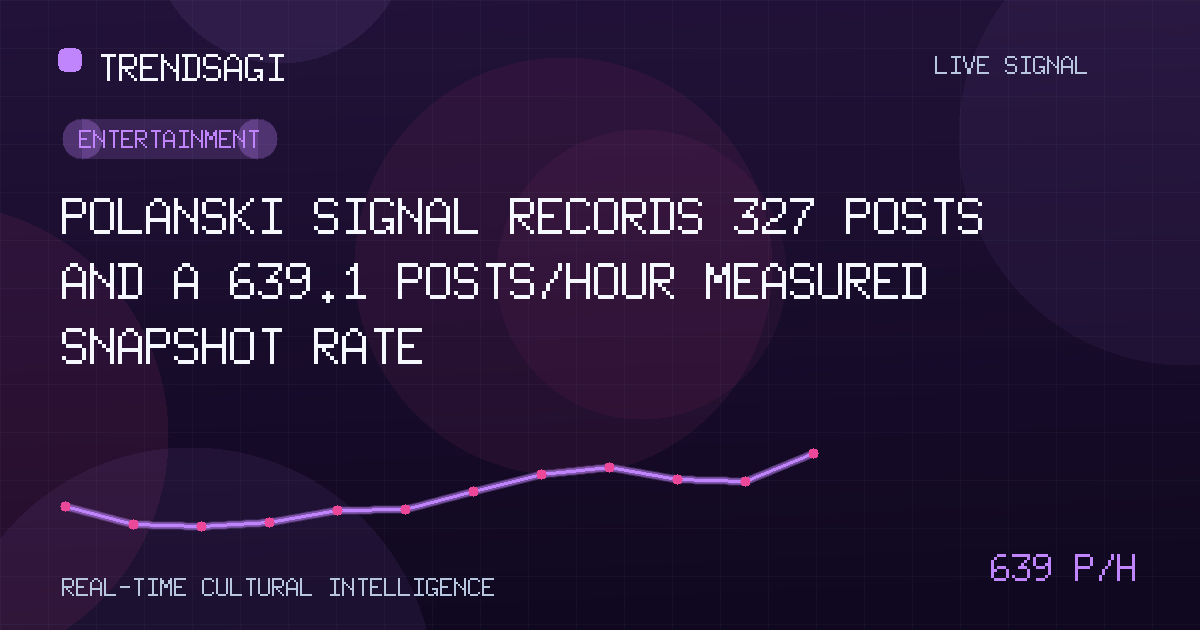
The Polanski signal contained 327 posts and a 639.1 posts/hour measured snapshot rate; the trigger and whether activity continued remain unverified.
Automated briefing. Generated from stored signal measurements and source-backed research; it is not manually reviewed. Read the methodology and limitations.
Metrics in this briefing are a snapshot associated with its publication date and may not reflect current conditions.
What changed
The stored entertainment-category signal for “Polanski” captured 327 posts at the latest observation, with a measured snapshot rate of 639.1 posts/hour. The direct conclusion is that the label was associated with a short-window burst of recorded posting activity, but the reason for the movement is not established. No public catalyst is verified in the available record, so linking the burst to a particular event would be speculative.
The measured rate covers an exact 901-second window using 3 stored observations and ends at 2026-10-09T17:51:34Z. It is a historical snapshot, not a live or current rate, forecast, reach, engagement, or unique-person count. The 327 figure is snapshot volume, not a rate.
| Measure | Stored observation |
|---|---|
| Observation time | 2026-10-09T17:51:34Z |
| Measured snapshot rate | 639.1 posts/hour |
| Snapshot volume | 327 posts |
What the signal can establish
Two facts are supported: the collection associated this topic label with 327 captured posts, and the short-window measurement was 639.1 posts/hour. That is enough for editorial triage because it identifies a point where posting clustered within the captured data. It is not enough to show how many people saw or authored the posts, how they reacted, or whether the label was applied consistently.
The measured rate marks a cluster of posting activity; it does not supply the event behind that cluster. Until the posts and a public trigger are checked, Polanski is an activity signal, not a confirmed news event.
The distinction matters because several different patterns can produce the same volume-only result. Independent reactions, repeated distribution of an item, automated copying, and a mismatched label can all raise post counts. The entertainment category provides broad context, but it does not prove that every post referred to the same person, work, or event.
Why this topic may be moving
No verified trigger accompanies the signal, so the cause remains unclear. Several mechanisms could create this pattern, and each would require different evidence.
- News response: A newly published report, announcement, interview, review, or promotional item could prompt contemporaneous discussion. None is identified here as the trigger.
- Social amplification: A visible post or clip could be copied and discussed faster than conventional reporting. That mechanism remains a hypothesis, not a finding.
- Label ambiguity: Posts sharing the same label could refer to different people or subjects, or to unrelated uses of the term. A rise in counts could then combine separate conversations.
- Collection effects: Duplicate content, reposting, or changes in collection behavior could lift raw counts without a comparable rise in distinct authors.
A follow-up should use Google Search only to locate public pages capable of verifying a trigger, such as a timestamped report, original announcement, or post from a confirmed relevant account. The result must match the entity and precede or overlap the 901-second window. Unrelated search interest is not evidence of the cause, and no matching catalyst is established here.
Why it matters
For entertainment editors, this signal is a prompt to inspect the underlying posts, not a sufficient basis for a news alert or headline. The responsible next step is to resolve the label, find the earliest accessible item, and corroborate any claimed catalyst before describing the activity as a reaction to news.
For researchers and media planners, the figures illustrate why volume, spread, and audience size must remain separate. A measured 639.1 posts/hour can guide monitoring, but it cannot establish unique participants, exposure, sentiment, or public importance. A short burst may disappear as quickly as it appeared.
For programmers, publishers, and communications teams, the useful question is whether the pattern persists and broadens beyond a concentrated source. A durable trend would need repeated observations and evidence of activity across distinct posts or channels.
What to watch next
Concrete follow-up checks would separate a possible event-driven trend from a measurement or labeling artifact:
- Resolve the referent. Inspect a representative sample for full names, matching entities, and contextual terms. If the posts divide among different subjects, split the counts rather than treating them as one conversation.
- Locate the origin. Review the earliest accessible posts and any cited links. Record what source they reference, when it appeared, and whether later posts add independent reporting or merely repeat it.
- Test continuation. Compare subsequent observation windows with the 639.1 posts/hour measured snapshot rate and 327-post snapshot volume. Report whether activity rises, recedes, or remains similar without presenting any one measurement as the current rate.
- Check concentration. Look for repeated wording, common source domains, coordinated timing, or many accounts posting identical material. These patterns can indicate amplification rather than many independent reactions.
- Verify distribution. Determine whether discussion spans different platforms, source types, or locations, where those fields are available. Concentration around one origin should be described as a burst around that source, not necessarily broad public reach.
- Separate response from copying. Count original posts separately from reposts, replies, and quoted material when the dataset permits. Also keep engagement measures distinct; a post total does not show clicks, reactions, or active audiences.
Methodology and limitations
The rate was measured from 3 stored observations over the exact 901-second window ending at the stated timestamp. This provides a precise short-window measure, but no earlier baseline, comparison topic, or subsequent observation is supplied. The signal therefore cannot establish that Polanski was statistically abnormal, already accelerating, or guaranteed to continue.
Snapshot volume may include repeated content and says nothing by itself about unique authors, views, engagement, geography, sentiment, authenticity, or completeness. The topic label and entertainment classification may organize the collection, but they do not validate every underlying post. Because no public catalyst could be verified from Google Search for this briefing, the analysis makes no causal claim beyond the measured activity.
Track This Topic for New Signals
Set alerts for future velocity or sentiment changes around this topic.
Explore Tracking PlansAbout TrendsAGI research
TrendsAGI's automated research pipeline publishes dated signal snapshots, methodology notes, and practical workflows for teams evaluating cultural momentum. Read how signals are scoped, scored, and limited in our research methodology.


