877-second window · 3 observations · Measured Oct 9, 2026, 2:55 PM UTC · Provider: go_recent_snapshot_v2
#PlsLoveรักได้ไหมEP5: 9000 snapshot posts and a 4103.6 posts/hour measured snapshot rate
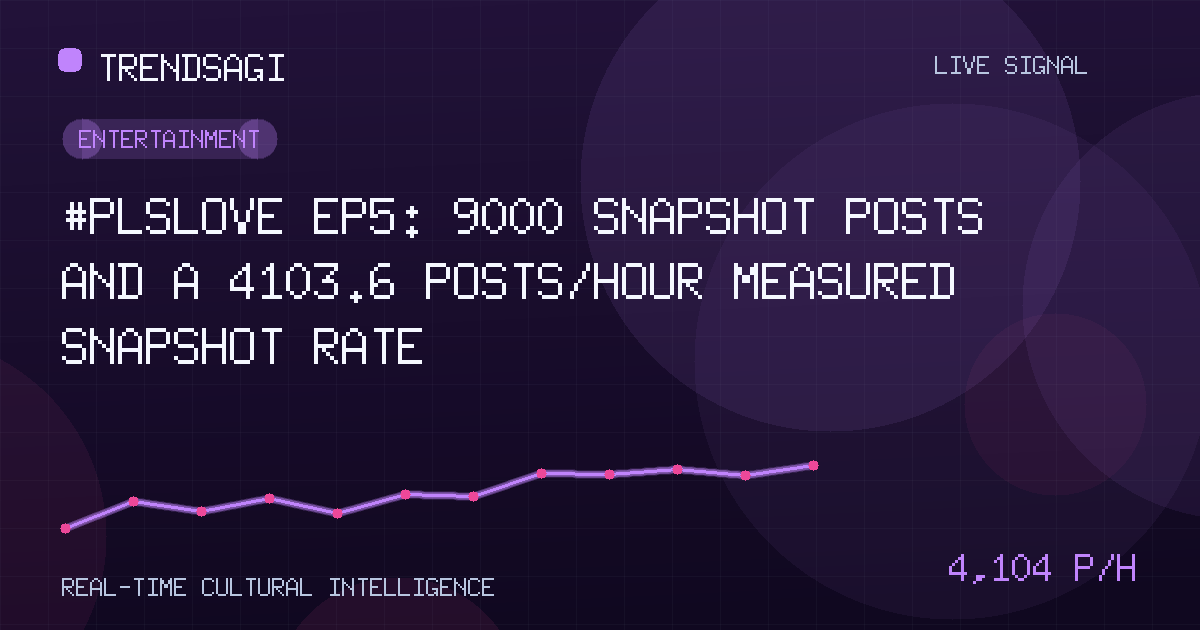
Latest #PlsLoveรักได้ไหมEP5 snapshot has 9000 posts and a 4103.6 posts/hour measured snapshot rate; checks test the unverified cause.
Automated briefing. Generated from stored signal measurements and source-backed research; it is not manually reviewed. Read the methodology and limitations.
Metrics in this briefing are a snapshot associated with its publication date and may not reflect current conditions.
What changed
The latest stored snapshot for #PlsLoveรักได้ไหมEP5 contains 9000 posts. Across an exact 877-second window using 3 stored observations, the measured snapshot rate was 4103.6 posts/hour. The direct read is a rapid concentration of recorded conversation, but it does not establish why the topic moved.
The cause remains unclear: no verified official announcement, publisher report, or other public context ties the signal to a release, appearance, controversy, or promotion. The EP5 wording may indicate installment-related discussion, but the label alone does not prove that a new installment was released at the observation time. Editors and social-listening teams should treat this as a time-bounded monitoring signal with an unresolved trigger, not as evidence of a launch effect.
| Metric | Stored value |
|---|---|
| Observation time | 2026-10-09T14:55:57Z |
| Measured snapshot rate | 4103.6 posts/hour |
| Exact rate window | 877 seconds, using 3 stored observations |
| Latest snapshot volume | 9000 posts |
Why this topic may be moving
Several mechanisms could produce this pattern, but none can be selected from the stored totals alone. These are checks, not findings:
- Release or promotion: Check whether an official episode page, clip, trailer, recap, or event post has a timestamp before or inside the measured interval. A recap could be user-generated; it should not be treated as official without verification.
- Creator or cast amplification: Look for a verified initiating post and subsequent sharing. An account’s participation could amplify discussion, but would not alone show why it began.
- Scene-specific response: Inspect posts for identifiable scenes, dialogue, characters, or critical reactions. That would connect the chatter to content; generic episode check-ins would not.
- Discovery exposure: Check whether a platform visibly placed the tag in recommendations or trend surfaces at the relevant time. Without a timestamped placement record, this remains speculative.
- Repetition and data quality: Separate original posts from copies, templates, automated-looking material, and unrelated uses of the same words. Repetition can affect volume, but the snapshot does not prove manipulation.
The distinction matters because an event-driven explanation, creator amplification, platform discovery, and repetition have different implications. The current record supports none over the others.
The signal establishes that posting activity changed quickly within the recorded window. It does not establish who initiated the activity, what the content was, or what caused it.
Why it matters
For entertainment editors, the value is an editorial lead, not a finished explanation. The timestamp and rate make the signal easy to prioritize; a verified trigger is still needed before describing it as episode-driven or promotional.
For audience researchers, 9000 is a post count, not an audience estimate. Likewise, 4103.6 posts/hour is a measured snapshot rate, not reach, interaction, sentiment, or a count of distinct people. It can guide sampling, but it cannot replace post-level review.
For marketing and brand-safety teams, the same volume can mean different things depending on whether posts are original reactions, official amplification, recap content, or duplication. A campaign or product conclusion would therefore exceed what the stored signal establishes.
What to watch next
Use the next observations to test, rather than merely repeat, the headline:
- Cause: Find the earliest verified official item tied to the tag and compare its timestamp with the measured interval. Priority goes to an item that precedes the recorded activity, not one published only afterward.
- Comparable volume: Check the next like-for-like snapshot against 9000 posts while preserving query, language, and collection boundaries. A higher or lower count is informative only if the measurement method is unchanged.
- Comparable rate: Require a new exact-window rate based on stored observations, then compare it with 4103.6 posts/hour. Reproducing a similarly high rate would support persistence; one new point would not.
- Post mix: Review a time-ordered sample for original reactions, quotations, links, recaps, complaints, praise, and unrelated text. Concrete shifts among those categories are more useful than a single overall sentiment label.
- Diffusion: Map the earliest substantive posts, their cited sources, and later repost chains. Separate official accounts, likely participants, and spectators; account volume is not the same as human reach.
- Persistence: Watch whether activity remains centered on this tag, spills into related tags, or gives way to another verified event. A sustained burst and a one-window spike imply different editorial interpretations.
- Integrity: Record exact duplicates, near-duplicates, templated posts, and broken or recycled media. Treat them as data-quality signals, not automatically as genuine distinct reactions.
Methodology and limitations
The canonical observation is timestamped 2026-10-09T14:55:57Z. The rate covers an exact 877-second interval and uses 3 stored observations. It is a measured snapshot rate—a historical summary, not a live or current rate, forecast, reach, engagement, or unique-person count. The 9000 latest snapshot volume is a separate count, not another rate.
Three observations provide limited resolution. They do not expose the full within-window path, source distribution, account duplication, sentiment, geography, platform placement, or an official event timeline. No publisher claim is made because no external trigger has been verified. Any stronger explanation should wait for dated official context and comparable measurements.
Bottom line
The responsible conclusion is that #PlsLoveรักได้ไหมEP5 generated a timestamped posting burst, with 9000 posts in the latest stored snapshot and a 4103.6 posts/hour measured snapshot rate, while its cause remains unconfirmed. The next decisive evidence is a verified initiating item, a comparable follow-up rate, and a representative mix of post-level content.
Track This Topic for New Signals
Set alerts for future velocity or sentiment changes around this topic.
Explore Tracking PlansAbout TrendsAGI research
TrendsAGI's automated research pipeline publishes dated signal snapshots, methodology notes, and practical workflows for teams evaluating cultural momentum. Read how signals are scoped, scored, and limited in our research methodology.


