1039-second window · 3 observations · Measured Oct 1, 2026, 12:11 PM UTC · Provider: go_recent_snapshot_v2
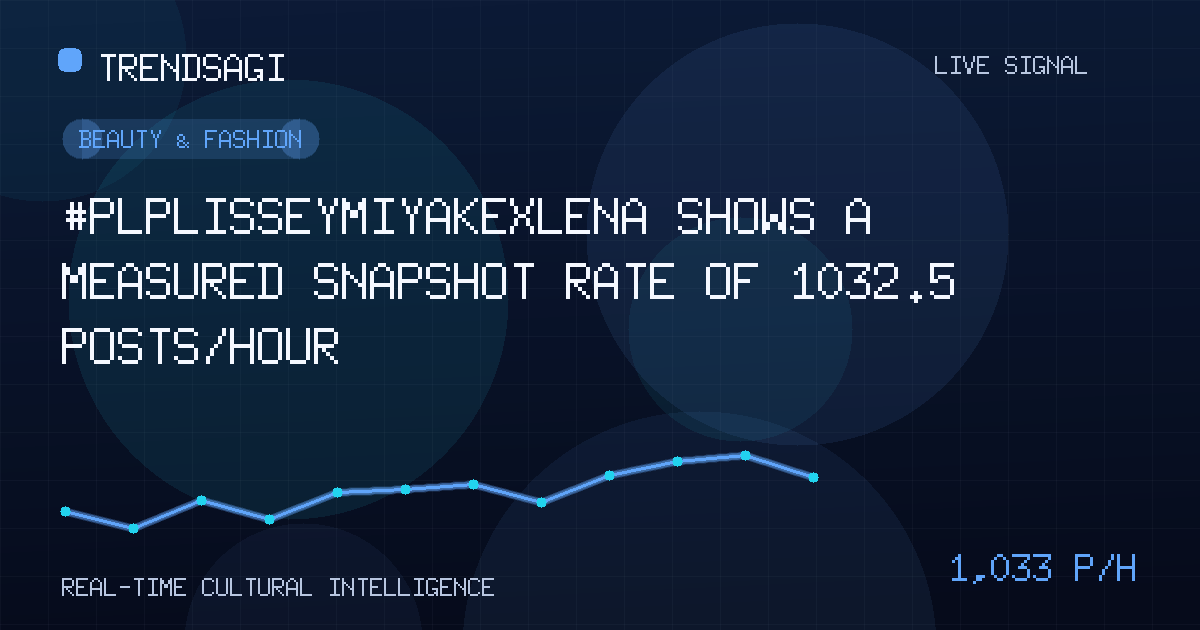
#plplisseymiyakexLena shows a measured snapshot rate of 1032.5 posts/hour
The exact hashtag showed a measured 1032.5 posts/hour snapshot rate; this briefing explains what changed, what remains unverified, and what to check next.
Automated briefing. Generated from stored signal measurements and source-backed research; it is not manually reviewed. Read the methodology and limitations.
Metrics in this briefing are a snapshot associated with its publication date and may not reflect current conditions.
What changed
#plplisseymiyakexLena was associated with a measured snapshot rate of 1032.5 posts/hour in the stored signal. That is the clear observed result: posts using the exact label accumulated rapidly during the measured window. The reason for the movement is not verified, so the signal is not by itself evidence of a launch, collaboration, endorsement, news event, or controversy.
The measure covers an exact 1039-second window using 3 stored observations and was reported at 2026-10-01T12:11:39Z. The latest snapshot contained 847 posts. Because no earlier rate is supplied, the record does not show whether activity increased, decreased, or stayed stable against a prior period. The rate is a measured snapshot rate—not a live or current rate, forecast, reach estimate, engagement measure, or unique-person count—and 847 is snapshot volume, not another rate.
| Measure | Stored value | Interpretation |
|---|---|---|
| Observation time | 2026-10-01T12:11:39Z | Stored snapshot timestamp |
| Measured snapshot rate | 1032.5 posts/hour | Exact 1039-second window using 3 stored observations |
| Snapshot volume | 847 posts | Latest snapshot only; not a rate |
What the signal establishes
This alert is useful because it gives editors a precise label, timestamp, volume, and velocity with which to open a verification queue. It shows that the exact string was present in the monitored stream and accumulated at the reported pace. It can support a timely check for source posts and possible links among the activity.
It cannot establish what the label means. The string should not be auto-corrected, split into names, or expanded into a brand, person, campaign, or partnership without primary-source confirmation. The stored category is Beauty & Fashion, but category assignment is a classification, not verification of the entities or event implied by the text.
A measured snapshot rate can justify a verification queue; it cannot justify a causal headline on its own.
Post totals also do not reveal how many distinct people contributed, whether posts were original, whether content was duplicated, or how activity was distributed across the 3 observations. The aggregate therefore supports an alert, not audience size, market penetration, sentiment, or organic reach.
Why this topic may be moving
No verified public context is attached to the stored signal, so the cause remains unclear. A primary announcement, a directly relevant report, a platform-distribution effect, and a burst of repeated sharing are different possible explanations, but none can be selected from the aggregate record. Treating one as the cause would turn a detection signal into an unsupported narrative.
A defensible causal brief would need evidence aligned to the measured period, ideally with primary material before or during the window:
- An original public post from an identifiable account that uses the exact label and states what prompted it.
- Reputable coverage that explicitly connects its event to the exact label, rather than merely mentioning similar names.
- A post sample showing whether activity consists of distinct original contributions, quotes, reposts, or repeated copies.
- Comparable timestamped observations that reveal persistence and provide the missing baseline.
Absent that evidence, the accurate description is an exact-label snapshot with rapid measured posting velocity and no verified cause.
Why it matters
For fashion and beauty editors, the main risk is confusing attention with meaning. A monitoring system can show that a label is moving quickly, but an editor still needs to learn what is being discussed, whether the label is used consistently, and whether the underlying material is relevant to the assigned category. Only then can the signal support a specific trend story, social report, or editorial alert.
Brand, community, and social-listening teams should care for a different reason: ambiguous spellings and close names can cause unrelated conversations to be merged. Before acting, they should preserve the exact string, verify its intended identity, and separate original posts from mentions, quotes, reposts, and duplicates. That discipline reduces the chance of reporting or responding to the wrong phenomenon.
The signal is also a prompt for measurement quality. It identifies where the current record is strong—the aggregate rate is explicit—and where it is weak: no prior baseline, raw-post sample, verified catalyst, audience breakdown, or engagement data is provided.
What to watch next
The next update should add evidence rather than repeat the same headline. Useful checks include:
- Repeat the measurement. Capture a new snapshot with its own observation time, volume, rate, window, and observation count. Keep it separate from this historical reading rather than describing it as the current rate.
- Trace origin and spread. Review accessible posts in timestamp order. Record whether the exact label appears in original text, captions, quoted posts, or reposts, and note repeated media without treating repeats as distinct participation.
- Verify the label. Use a time-bounded Google Search for the exact string, then confirm any identity or event through a primary source. Do not silently normalize the label based on a likely spelling.
- Test timing. Check whether a verified announcement or report predates or overlaps the measured window. Close timing is a clue; a direct link to the exact label is stronger evidence.
- Sample composition. Examine the mix of original posts, replies, quotes, reposts, media types, sentiment, and apparent geography or language. Label unavailable fields as unavailable rather than inferring them from volume.
- Look for persistence. Add a comparable prior snapshot and later snapshots so the next brief can distinguish a short burst from sustained activity and can report direction without inventing a baseline.
A useful threshold for escalation is not another dramatic adjective but verified linkage: a primary source, time alignment, and evidence that distinct posts are using the same label. If those checks fail, retain the alert and state plainly that the cause remains unknown.
Methodology and limitations
This briefing uses the canonical stored values: 847 posts in the latest snapshot and a measured snapshot rate of 1032.5 posts/hour, calculated from 3 stored observations over an exact 1039-second window and reported at 2026-10-01T12:11:39Z. The rate and volume are reported separately and are not converted into reach, engagement, or audience estimates.
The record does not provide raw posts, a prior rate, account-level data, geography, sentiment, platform breakdown, or a verified external explanation. As a result, the signal can establish measured exact-label activity at the stated snapshot, but not its cause, authenticity, direction versus a baseline, or significance. No external fact is attributed without verification.
Track This Topic for New Signals
Set alerts for future velocity or sentiment changes around this topic.
Explore Tracking PlansAbout TrendsAGI research
TrendsAGI's automated research pipeline publishes dated signal snapshots, methodology notes, and practical workflows for teams evaluating cultural momentum. Read how signals are scoped, scored, and limited in our research methodology.