1131-second window · 3 observations · Measured Sep 25, 2026, 2:55 PM UTC · Provider: go_recent_snapshot_v2
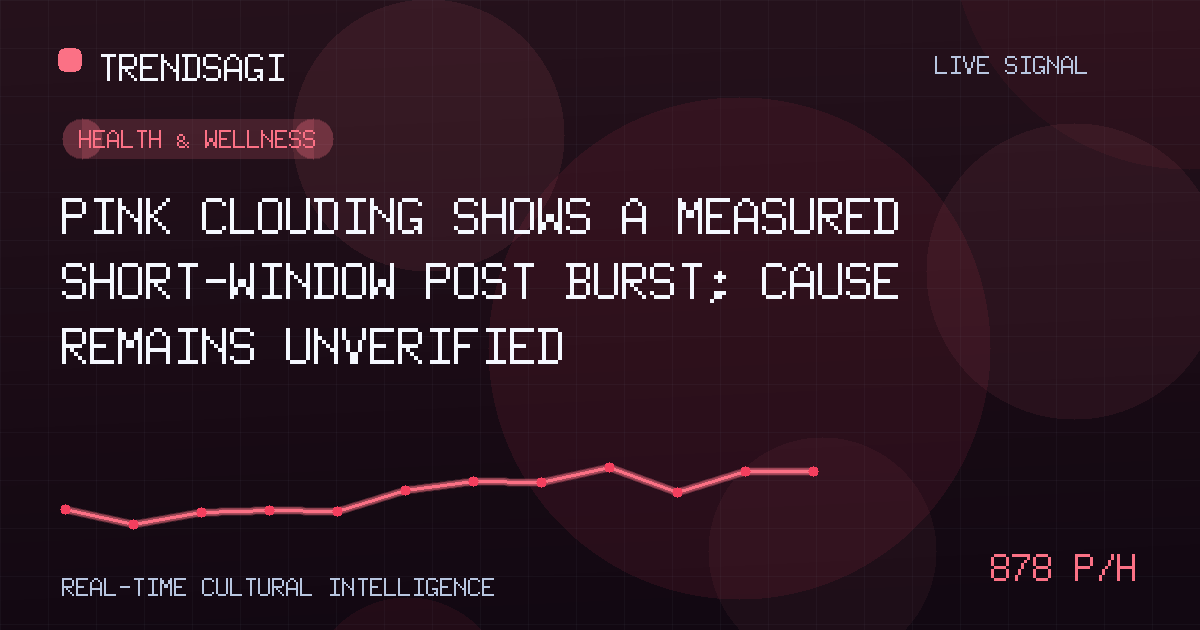
Pink Clouding shows a measured short-window post burst; cause remains unverified
Pink Clouding shows a measured snapshot rate of 878.3 posts/hour and an 847-post snapshot, signaling a watch item—not a verified health trend.
Automated briefing. Generated from stored signal measurements and source-backed research; it is not manually reviewed. Read the methodology and limitations.
Metrics in this briefing are a snapshot associated with its publication date and may not reflect current conditions.
What changed
Pink Clouding shows a rapid measured change in the stored social-post signal, but its meaning and cause remain unverified. The measured snapshot rate was 878.3 posts/hour over an exact 1131-second window using 3 stored observations. This is a historical monitoring result, not a live rate, forecast, reach estimate, engagement metric, or unique-person count.
At 2026-09-25T14:55:34Z, the latest snapshot contained 847 posts. In practical terms, the signal says the monitored term had concentrated captured activity during that interval. It does not establish what Pink Clouding means, why it appeared, or whether the activity represents a health event. The responsible conclusion is to watch and verify, not to diagnose or generalize.
| Metric | Stored observation |
|---|---|
| Observation time | 2026-09-25T14:55:34Z |
| Measured snapshot rate | 878.3 posts/hour over an exact 1131-second window using 3 stored observations |
| Snapshot volume | 847 posts |
What the signal can and cannot establish
The count and the rate answer different questions. The 847-post figure describes the contents of one stored snapshot; 878.3 posts/hour describes movement during the supplied window. Neither can be read as a count of people, accounts, reactions, or outcomes. The reported rate is operationally useful because it flags the label for review, but 3 observations alone do not establish how the topic developed before or after that window.
The signal can support a narrow descriptive statement: posts associated with the monitored label were captured at the supplied rate during the measured interval. It cannot yet support a causal or clinical statement. In particular, it does not show:
- that the phrase has one stable meaning across posts;
- whether the posts are original, reposted, promotional, or duplicated;
- which platforms, regions, or communities produced them;
- whether sentiment, concern, or advertising intensity changed;
- whether any health condition or behavior increased in the population.
Why this topic may be moving
The cause is currently unclear. No verified public context accompanies the signal to connect the burst to a specific news event, research finding, health guidance, product launch, or platform change. The record is assigned to Health & Wellness, but the category label and missing topic description do not establish its medical referent. Any proposed cause at this stage would be speculation.
A useful investigation must separate the alert from its explanation. Review sampled posts for exact wording and nearby variants, identify the earliest credible public item, and determine whether the conversation consists of personal accounts, media, brands, sellers, reposts, or other material. This step is necessary because a combined count can hide several unrelated uses of the same phrase.
A rapid posting rate is an invitation to investigate the label, not proof that the label describes a real or worsening health condition.
The key semantic question is whether people are using Pink Clouding to name the same thing. If not, posts should be grouped by context before totals are interpreted. A defensible explanation would require a verified source, close in time to the observation, that directly discusses the relevant usage. Repetition elsewhere is not enough; it can reflect copying rather than cause.
Why it matters
For health readers, premature interpretation can create unnecessary worry or lead people to treat an undefined label as a symptom, diagnosis, or treatment. Social conversation may prompt questions, but it does not replace individualized professional advice. If the phrase is being used to describe concerning symptoms, readers should seek qualified medical guidance rather than make treatment decisions from an aggregate post count.
For researchers and editors, misclassification can distort the picture. Pink Clouding may be a wellness metaphor, beauty language, product term, typo, campaign phrase, or unrelated expression, but the aggregate does not show which. For businesses and content teams, the count is not proof of demand or safety. In each case, the label needs a verified definition and a reliable source mix before it supports a decision.
What to watch next
The next checks should be concrete:
- Definition convergence: Determine whether sampled posts use the same referent. Separate the exact phrase, spelling variants, hashtags, and phrases merely quoted in another discussion.
- Source mix: Compare personal accounts, health professionals, media, brands, sellers, and reposts. Note whether a small set of sources dominates or the material is broadly distributed.
- Credible anchor: Find a verified publication, official health guidance, research paper, product announcement, or platform event that predates the snapshot and directly explains the relevant use.
- Ongoing spread: Check later snapshots for continued new posts across platforms, rather than repeated copies of an earlier burst.
- Context and harm: Record co-occurring claims and symptoms without endorsing them. Flag unsupported treatment advice, recommendations that could delay care, or distress in first-person posts.
- Shifting meaning: Watch whether the label remains specific, becomes a general metaphor, or is absorbed into product and promotional language.
Move from a watch item to deeper trend analysis only if activity persists, the meaning stabilizes, and independent sources corroborate it. If activity fades, contexts split, or duplication dominates, it should remain a low-confidence signal. Corroboration across content, sources, and time is more informative than the headline count alone.
Methodology and limitations
This briefing uses a stored social-post signal categorized as Health & Wellness. The observation time is 2026-09-25T14:55:34Z; the latest snapshot volume is 847 posts; and the measured snapshot rate is 878.3 posts/hour over an exact 1131-second window using 3 stored observations. The rate applies only to that stored window. It is not a live or current rate, forecast, reach, engagement, or unique-person count.
The supplied record does not include the underlying post text, baseline history, collection rules, term-matching design, platform split, geography, sentiment, or duplicate controls. Those omissions prevent firm conclusions about medical meaning, cause, prevalence, audience, and durability. No external event is asserted because no verified public context accompanies the signal. Any future causal account should define the term, align its timing with the observations, and cite direct evidence rather than mere repetition.
Track This Topic for New Signals
Set alerts for future velocity or sentiment changes around this topic.
Explore Tracking PlansAbout TrendsAGI research
TrendsAGI's automated research pipeline publishes dated signal snapshots, methodology notes, and practical workflows for teams evaluating cultural momentum. Read how signals are scoped, scored, and limited in our research methodology.