1795-second window · 3 observations · Measured Sep 30, 2026, 3:56 PM UTC · Provider: go_recent_snapshot_v2
Pilots topic records 1181.1 posts/hour in latest Sports snapshot
The Pilots signal measured 1181.1 posts/hour over 1795 seconds; here is what is known, what remains unclear, and what editors should check next.
Automated briefing. Generated from stored signal measurements and source-backed research; it is not manually reviewed. Read the methodology and limitations.
Metrics in this briefing are a snapshot associated with its publication date and may not reflect current conditions.
What changed
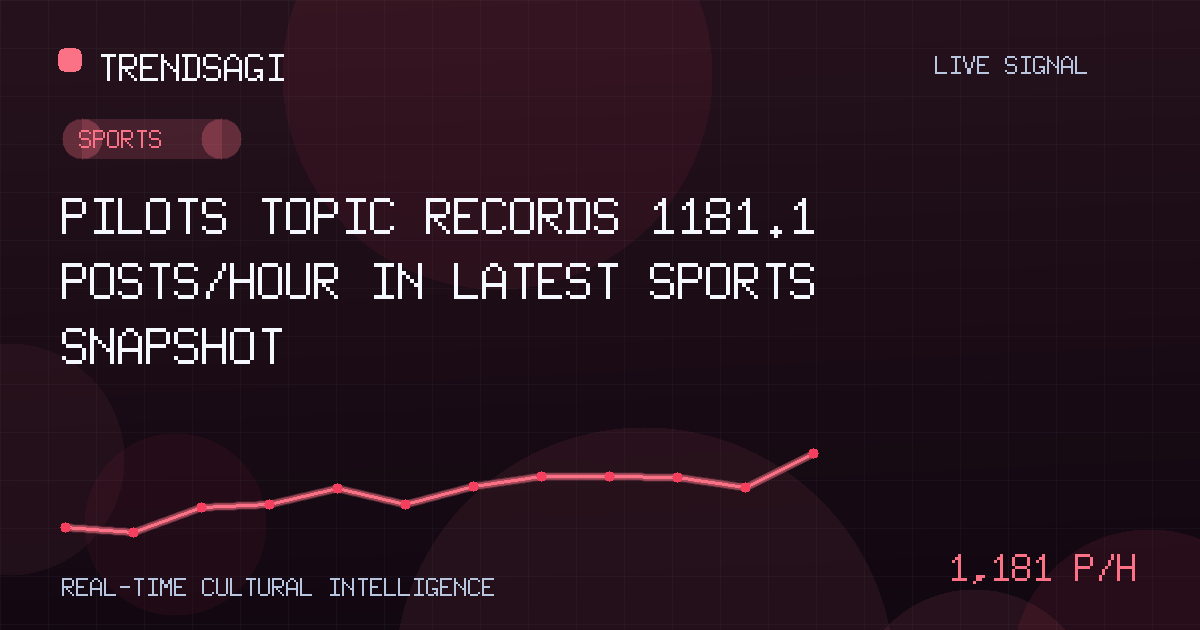
The topic labeled “Pilots,” stored in the Sports category, showed a concentrated burst of posting activity. The measured change was a snapshot rate of 1181.1 posts/hour at 2026-09-30T15:56:49Z, and the latest snapshot contained 2000 posts. The stored metric merits a rapid editorial check, but it does not identify the event behind the activity.
That rate was calculated from 3 stored observations over an exact 1795-second window. It should be read only as a measured snapshot rate—not a live or current rate, forecast, reach figure, engagement count, or count of unique people. No earlier comparison rate is supplied, so the data does not support a percentage increase, an all-time high, or a claim that the burst persisted.
| Measure | Stored value |
|---|---|
| Snapshot observation time | 2026-09-30T15:56:49Z |
| Measured snapshot rate | 1181.1 posts/hour |
| Latest snapshot volume | 2000 posts |
Why this topic may be moving
The cause remains unclear because no verified public context accompanies the stored signal. The word “Pilots” is also not self-resolving: it could denote a named sports entity, be part of a larger phrase, or collect conversations that a category system has grouped under Sports. The stored category narrows the classification, but it does not prove which referent dominated.
Several explanations are testable, but none should be reported as the cause yet:
- A team, athlete, organization, or other entity named “Pilots” became the focus of a scheduled announcement, result, roster matter, or controversy.
- A broader phrase containing “Pilots” crossed into the sports conversation from another domain.
- Reposting, duplicated text, or automated publishing magnified apparent activity without an equivalent rise in original discussion.
- Several unrelated uses of the word were combined by a broad matching rule.
Post-level examples and independent public context are needed to distinguish these possibilities. Until then, the defensible description is an unattributed “Pilots” posting burst in the Sports category.
What the signal can—and cannot—establish
The strongest finding is temporal and operational: the stored record associated the label with 1181.1 posts/hour during the specified measurement window and held 2000 posts in its latest snapshot. That makes the topic eligible for monitoring or triage.
It does not establish:
- which entity or event people were discussing;
- whether the activity was organic, automated, or duplicated;
- how many unique authors participated or how far the posts traveled;
- whether sentiment was positive, negative, or neutral;
- whether the rate was high relative to this topic’s normal baseline; or
- whether another comparable snapshot would show persistence or decay.
A measured posting burst is a reason to investigate, not evidence of the story that caused it.
Why it matters
For sports editors, the immediate risk is misattribution. Publishing “Pilots” as a team-specific or event-specific trend without checking the underlying posts could attach a real story to the wrong entity. A category label and the measured rate alone are not enough to clear that risk.
The signal can still serve as a triage trigger. Social, community, and trend teams can inspect the content, determine whether discussion is original and diverse, and then decide whether a briefing, monitoring update, or rapid response is warranted. Measurement and data teams should check for duplicate or automated behavior before treating the rate as audience demand.
What to watch next
The next useful update is not another headline in isolation; it is a sequence of checks that can confirm or weaken the apparent signal:
- Persistence: Compare the next timestamped snapshot using the same topic definition and window. A similar rate would support persistence; a lower rate would indicate decay, though neither alone proves an event.
- Entity resolution: Inspect representative posts to identify the dominant referent, named participants, and any shared event terms. Resolve whether “Pilots” is a standalone label or only part of another phrase.
- Originality: Separate original posts from copies, quote-post chains, likely promotional material, and templated text. Check whether apparent activity is concentrated in a small set of accounts.
- Context alignment: Look for verified public reporting whose entity, topic, and timing match the post sample. Do not use a generic Pilots result as evidence for a sports-specific catalyst.
- Audience and geography: Compare language, location fields where available, and account types to determine whether the discussion is broad or confined to one community.
- Category quality: Review a sample against the Sports classification and flag mixed-sense uses, ambiguous matching, or spam.
A practical status rule is straightforward: keep the item marked unattributed until post-level evidence identifies the referent; call it event-driven only when the content and verified public context align. That sequence reduces the chance that a fast metric becomes a false narrative.
Methodology and limitations
The reported 1181.1 posts/hour is a measured snapshot rate derived from 3 stored observations over the exact 1795-second window associated with 2026-09-30T15:56:49Z. The 2000-post figure is the volume in the latest snapshot; it is not a rate and should not be substituted for one. The records also do not supply a previous baseline, the distribution of posts inside the window, the matching rule, collection coverage, account data, or a text sample.
Those omissions prevent conclusions about statistical significance, cause, authenticity, sentiment, reach, or trend duration. The appropriate next data release should retain the same observation time, window, observation count, topic definition, and category, then add a post sample and source-concentration checks. Until those are available, this briefing reports the measured activity and leaves the cause explicitly unresolved.
Track This Topic for New Signals
Set alerts for future velocity or sentiment changes around this topic.
Explore Tracking PlansAbout TrendsAGI research
TrendsAGI's automated research pipeline publishes dated signal snapshots, methodology notes, and practical workflows for teams evaluating cultural momentum. Read how signals are scoped, scored, and limited in our research methodology.