898-second window · 3 observations · Measured Oct 7, 2026, 4:56 PM UTC · Provider: go_recent_snapshot_v2
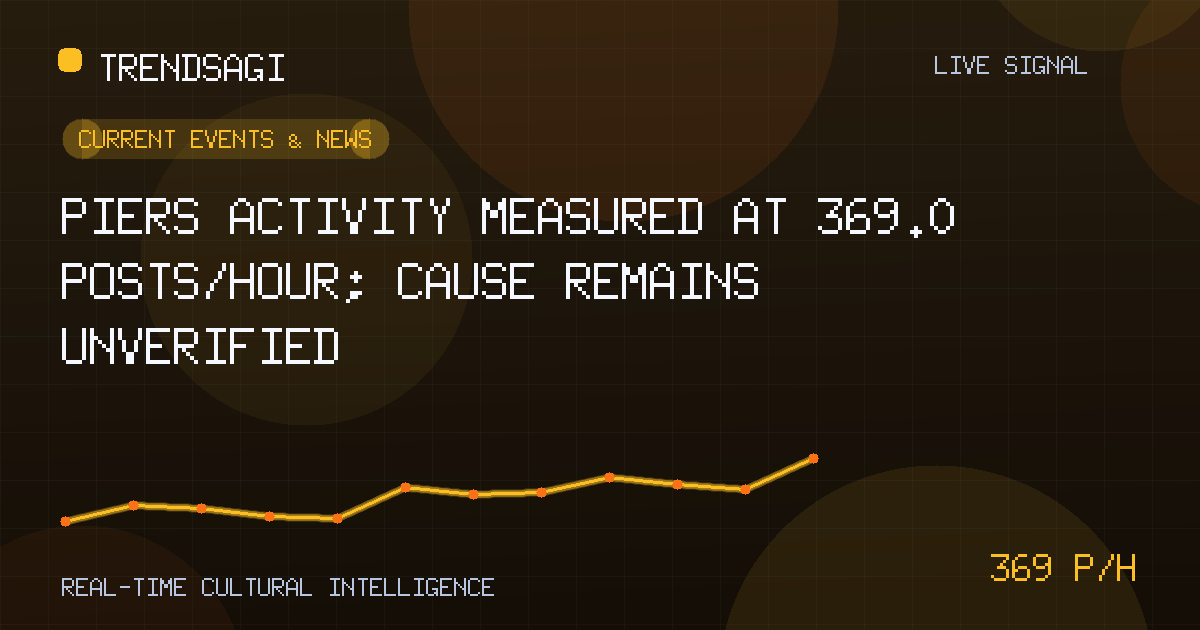
Piers activity measured at 369.0 posts/hour; cause remains unverified
Piers drew 470 posts in the latest snapshot, with a measured 369.0 posts/hour change over 898 seconds; the cause remains unverified.
Automated briefing. Generated from stored signal measurements and source-backed research; it is not manually reviewed. Read the methodology and limitations.
Metrics in this briefing are a snapshot associated with its publication date and may not reflect current conditions.
What changed
The clearest defensible read is that “Piers” generated a concentrated burst of 470 posts in the latest snapshot, while the available record does not establish which person, place, object, or story those posts concern.
The measured change is 369.0 posts/hour over an exact 898-second window, based on three observations, with the result recorded at 2026-10-07T16:56:38Z. This is a measured snapshot rate, not a live rate, forecast, reach estimate, engagement measure, or count of unique people.
| Observation time | Measured snapshot rate | Latest snapshot volume |
|---|---|---|
| 2026-10-07T16:56:38Z | 369.0 posts/hour | 470 posts |
Why this topic may be moving
No verified public context is available for this signal to establish why it may be moving. “Piers” is too broad to treat as a self-explanatory news label, and the record contains no description that resolves the reference.
Several different patterns could sit behind the same label. The posts could concern an individual or surname; they could use the word for waterfront structures; or they could apply it to an organization, place, account, or another entity whose name is not supplied here. A misspelling or shortened form is also possible. Without representative post text, each interpretation remains a hypothesis. Selecting one would turn a monitoring signal into a news claim without adequate evidence.
The 369.0 posts/hour figure quantifies the observed change, but it does not reveal whether the activity was organic, coordinated, automated, syndicated, or amplified by repeated copying. A genuine development can also generate many posts while much of the response reacts to earlier coverage rather than an original source. The measurements cannot separate those possibilities. Volume alone also does not establish public importance.
Why it matters
This matters most to editors, communications teams, researchers, and organizations that may be named or affected. The immediate risk is not only missing a trend; it is also publishing an explanation the evidence does not support.
For an editor, the first decision is whether the label represents a verifiable event worthy of coverage. A fast label can create a feedback loop: an ambiguous item prompts reporting, reporting produces more posts, and monitoring mistakes downstream reaction for independent confirmation. Representative original posts and primary material should come before a headline assigns a cause.
For communications teams, the useful question is relevance rather than volume alone. If a person, organization, or place is involved, persistent activity may justify verification and preparation. If the label is mostly generic or ambiguous, effort should go toward classification first. Researchers should preserve the distinction between the 470-post snapshot and the 369.0 posts/hour measurement.
The signal establishes the speed of mention, not the identity or importance of the subject. Until the entity and cause are verified, “Piers is moving” should be treated as a monitoring alert rather than a news finding.
What to watch next
The next useful checks are designed to resolve identity, provenance, and persistence rather than simply collect more volume.
- Resolve the entity. Inspect representative original posts and note what “Piers” denotes in each cluster. Separate person, place, physical-object, organization, and typo or shorthand uses before combining their counts.
- Measure source concentration. Check whether a single account or publisher dominates the activity. A surge dominated by repeated material has a different interpretation from broad discussion across independent originals.
- Find primary evidence. Look for a named statement, filing, announcement, incident record, or other original material consistently linked to the same entity. A verified primary record would provide a defensible reason for the movement; an unsupported repost would not.
- Test spread. Compare source concentration, geography, language, and time of posting. Independent activity across several communities is a stronger persistence signal than simultaneous repetition in one stream.
- Track comparable windows. Record subsequent measured posts/hour values against the 369.0 benchmark and subsequent snapshot volumes against 470, using the same collection method. This tests persistence without converting either figure into a forecast.
- Watch for competing explanations. A verified event, a correction, an institutional reference, or a spelling ambiguity could produce different clusters under the same label. Reclassify if the dominant referent changes.
Methodology and limitations
The measurement covers an exact 898-second window and uses three observations, with the result recorded at 2026-10-07T16:56:38Z. The latest snapshot contains 470 posts. The measured change rate is 369.0 posts/hour. These are distinct measures and should not be treated as interchangeable.
The short interval and small observation count limit conclusions about persistence. No baseline, longer history, post text, account-level distribution, geography, language, engagement, or audience data is provided. The rate therefore cannot establish unique participants, authenticity, sentiment, causation, or importance. It also cannot show whether posts were original or copies.
Most importantly, the topic label is ambiguous and its cause is unverified. That does not prove that no relevant event exists; it means the available evidence is insufficient to identify one. Responsible coverage should wait for representative posts, a stable referent, and a primary source.
Bottom line: Piers shows a noteworthy measured burst, not yet a verified news event. The immediate opportunity is to identify what the posts refer to and whether the activity persists, not to invent a narrative from the label alone.
Track This Topic for New Signals
Set alerts for future velocity or sentiment changes around this topic.
Explore Tracking PlansAbout TrendsAGI research
TrendsAGI's automated research pipeline publishes dated signal snapshots, methodology notes, and practical workflows for teams evaluating cultural momentum. Read how signals are scoped, scored, and limited in our research methodology.


