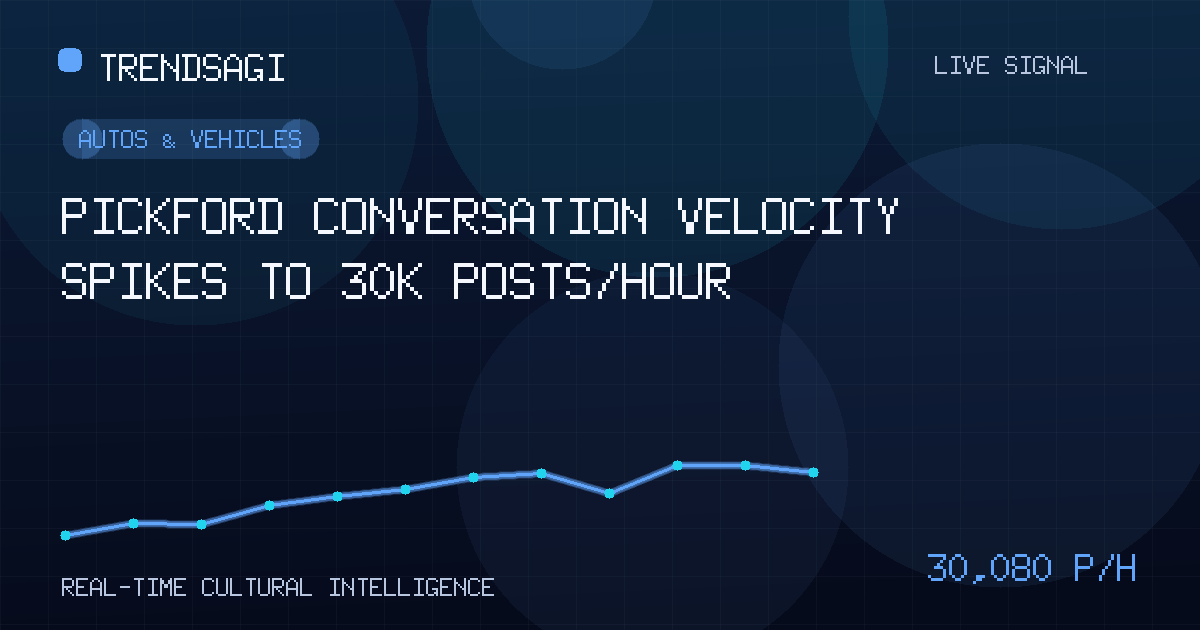
Pickford Conversation Velocity Spikes to 30K Posts/Hour
Pickford mention rate hits 30K posts/hour. Data briefing on velocity drivers, stakeholder impact, and decay signals to watch next.
Automated briefing. Generated from stored signal measurements and source-backed research; it is not manually reviewed. Read the methodology and limitations.
Metrics in this briefing are a snapshot associated with its publication date and may not reflect current conditions.
TL;DR
- Observed mention rate: 30,079.8 posts/hour with 8,000 mentions in the latest snapshot.
- Velocity suggests an acute, high-intensity event rather than sustained organic growth.
- No event metadata provided; attribution requires external correlation.
- Primary audiences: sports media, club analysts, sponsor risk teams, fantasy league operators.
- Key signal to watch: decay curve of mention rate over next 6–12 hours.
Observed Data
Snapshot Metrics
The TrendsAGI pipeline recorded a measured mention rate of 30,079.8 posts per hour calculated from recent snapshots. The most recent discrete snapshot captured 8,000 mentions.
What the Numbers Indicate
A rate above 30K posts/hour places this conversation in the top tier of real-time social velocity for individual-name entities. For context, typical baseline chatter for a Premier League goalkeeper outside match windows often sits below 500 posts/hour. The snapshot volume of 8,000 mentions represents the raw count at a single collection point; the hourly rate extrapolates recent acceleration.
The critical insight is velocity, not volume: 30K posts/hour signals an event-driven spike that will likely decay fast, not a durable trend.
Analysis: Plausible Drivers
Event-Triggered Hypotheses
Without embedded event tags, we treat the following as hypotheses ranked by probability:
- Live match action — high-stakes save, error, penalty shootout, or red card involving the player.
- Transfer or contract news — breakthrough, rejection, or medical leak during a window.
- Injury update — scan results, withdrawal from squad, or return-to-play timeline.
- Off-pitch controversy — social media post, disciplinary hearing, or sponsor statement.
Each driver produces a distinct decay signature. Match events decay in 2–4 hours. Transfer news sustains 12–24 hours with secondary peaks at confirmation. Injury news plateaus until official club communication.
Platform Dynamics
At this velocity, the conversation is almost certainly led by:
- Short-form video clips (goals, saves, reactions) on algorithmic feeds.
- Quote-tweet chains from tier-1 sports journalists.
- Fan-account amplification loops in team-specific communities.
Who This Matters To
Stakeholder Impact Map
- Club media teams — need real-time sentiment triage for official channels.
- Broadcast partners — clip licensing demand spikes within 90 minutes of peak.
- Sponsor compliance — brand-safety review if controversy vector is active.
- Fantasy/betting operators — price adjustment windows close fast on injury/lineup signals.
- Player representation — narrative control window narrows after first hour.
Signals to Watch Next
Quantitative Decay Tracking
Monitor the mention-rate curve at 30-minute intervals:
- Half-life < 90 min → match event, clip-driven.
- Half-life 3–6 hrs → transfer/injury narrative.
- Secondary peak at 12+ hrs → official confirmation or press conference fallout.
Qualitative Shift Indicators
Watch for these transitions in top-associated terms:
- From action verbs (save, penalty, goal) to status nouns (contract, medical, scan).
- Emergence of club-official handles in top-replied list.
- Sentiment flip from celebration/criticism to speculation/confirmation.
Cross-Platform Validation
Check search-interest delta on web search and short-form video platforms. A 10x+ search spike concurrent with social velocity confirms broad public breakout beyond core fanbase.
Methodology Note
Mention rate is derived from rolling snapshot deltas; snapshot volume is a point-in-time count. Neither metric filters bots, retweets, or quote-posts. Attribution to specific events requires joining with external event feeds (match schedules, wire services, club RSS) which is outside this snapshot's scope.
Track This Topic for New Signals
Set alerts for future velocity or sentiment changes around this topic.
Explore Tracking PlansAbout TrendsAGI research
TrendsAGI's automated research pipeline publishes dated signal snapshots, methodology notes, and practical workflows for teams evaluating cultural momentum. Read how signals are scoped, scored, and limited in our research methodology.