908-second window · 2 observations · Measured Oct 6, 2026, 1:56 PM UTC · Provider: go_recent_snapshot_v2
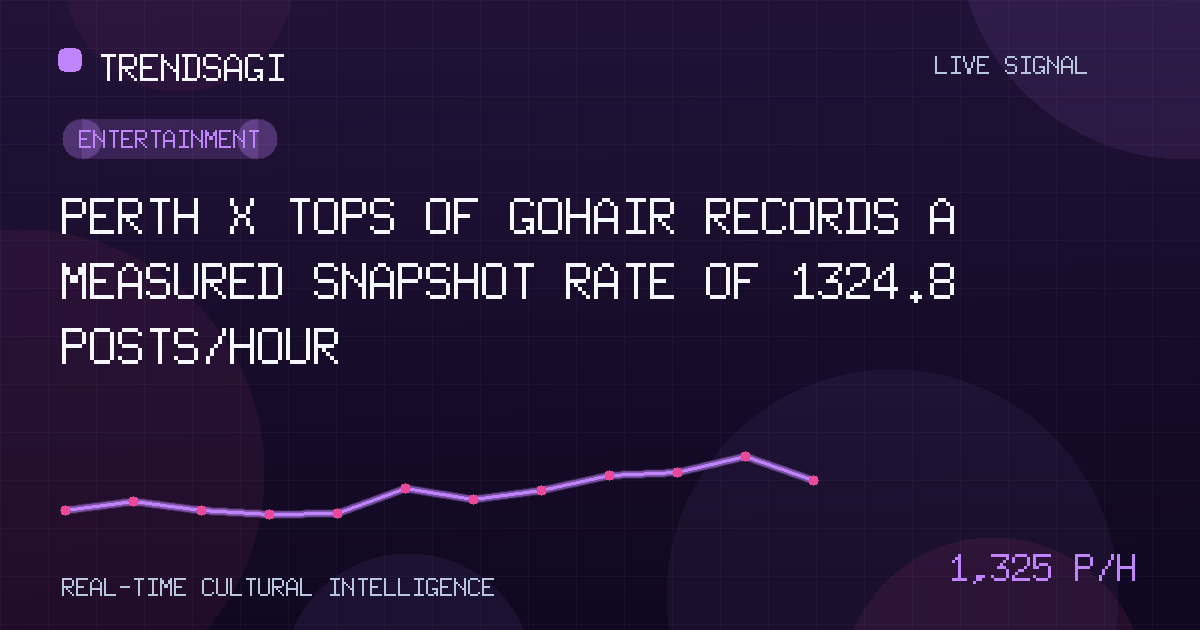
PERTH X TOPS OF GOHAIR records a measured snapshot rate of 1324.8 posts/hour
The Perth x Tops of Gohair signal measured 1324.8 posts/hour over 908 seconds; its cause, reach, and persistence remain unverified.
Automated briefing. Generated from stored signal measurements and source-backed research; it is not manually reviewed. Read the methodology and limitations.
Metrics in this briefing are a snapshot associated with its publication date and may not reflect current conditions.
What changed
The monitored “PERTH X TOPS OF GOHAIR” signal shows a rapid increase in captured posting activity, but its cause is not verified. At 2026-10-06T13:56:25Z, the latest stored snapshot contained 3000 posts. The defensible read is that activity accelerated within this monitored sample; it is not yet evidence of a confirmed event, campaign, or broader public reaction.
The measured snapshot rate was 1324.8 posts/hour over an exact 908-second window using 2 stored observations. This is a historical measurement at the observation time, not a live or current rate, forecast, total reach, engagement figure, or count of unique people. It should not be projected beyond that timestamp.
| Observation time | 2026-10-06T13:56:25Z |
|---|---|
| Measured snapshot rate | 1324.8 posts/hour |
| Snapshot volume | 3000 posts |
The distinction matters because 3000 is the latest snapshot volume, while 1324.8 posts/hour is the separately supplied windowed rate. Neither number, without collection details and corroborating public context, explains who posted, where they posted, or why.
Why this topic may be moving
There is no verified public context in the stored material to identify an originating post, event, announcement, or report. The cause therefore remains unclear. Any account of why the topic moved should be treated as a hypothesis until an attributable source and matching post timestamps are found.
Without matched post examples, the label is ambiguous. “Perth” could denote a place, name, account label, or campaign geography; “Tops of Gohair” is not self-explanatory; and “X” may be a separator, collaboration marker, or literal character. None of those readings can be preferred from the label alone.
- A time-sensitive entertainment item—such as a release, appearance, performance, or controversy—could produce a short burst, but no specific item has been verified.
- Cross-posting or repeated excerpts from one public-facing account could lift post volume without representing broad participation.
- A keyword collision or labeling error could place unrelated posts under the same topic, especially if the phrase is ambiguous rather than a stable event name.
- Coordinated or automated amplification could also increase volume; that possibility requires evidence about author diversity, timing, and repetition and should not be assumed.
These are explanations to test, not findings. The most useful next step is to identify the earliest substantive post, its author, and the matching rule used by the monitor rather than inventing a narrative around the label.
A high posting rate can identify a change in captured activity without identifying the event behind it, the people producing it, or whether the activity is organic.
Why it matters
This matters because a fast-moving entertainment signal can prompt coverage before its meaning is clear. For editors, the immediate risk is repeating an unverified explanation. For creators and rights holders, it may flag a burst worth reviewing; for advertisers, it may flag a possible brand-safety issue. None of those implications proves who caused the activity.
Volume is not the same as significance. A monitor can register 3000 captured posts without showing that the material is original, truthful, geographically relevant to Perth, or consequential. The stored Entertainment classification makes the signal relevant to entertainment monitoring, but it does not independently verify what the posts concern.
- Editors and reporters tracking Perth entertainment.
- Creators, talent teams, and rights holders seeking the source.
- Audience and social-listening researchers testing diffusion.
- Brand-safety and platform-integrity teams checking repetition or manipulation.
What the signal can and cannot establish
The signal can establish a limited set of facts: a snapshot was taken at the stated time; it contained 3000 posts; and the supplied change measurement was 1324.8 posts/hour over 908 seconds from 2 observations. It can therefore support a claim about the pace of change inside the monitored data.
It cannot establish total posts elsewhere, the number or identity of authors, sentiment, authenticity, platform coverage, or persistence. It also cannot show that “Perth” describes participants’ location. A causal conclusion requires matched public evidence that is not supplied in the record.
What to watch next
Useful follow-up should test persistence, provenance, and composition rather than merely collect more volume.
- Persistence: Take subsequent observations using the same 908-second window, matching query, and collection boundary. Recurrence would support a sustained pattern; a brief cluster would remain a short-lived burst.
- Source trail: Find the earliest substantive matched post, its original publisher or account, any linked material, and the first credible pickup. Attribution should come from the source itself, not an unsourced repost.
- Authorship and duplication: Separate original posts from quotations, copies, and media recirculation; inspect distinct-account concentration and account-creation patterns. Post volume should not be converted into an audience estimate.
- Phrase matching: Determine whether records use the full label or only its components. Test the ambiguous terms independently rather than assuming a connection to Perth or an entity called Tops of Gohair.
- Coverage: Check the source platform, public location fields, and whether comparable activity appears elsewhere. Cross-platform corroboration would strengthen an event interpretation; isolated concentration could instead indicate a collection or labeling issue.
- Content and safety: Classify the subject, factual claims, sentiment, spam or coordinated behavior, and rights or safety concerns. Volume alone cannot answer those questions.
Until source, uniqueness, and persistence are checked, the safest editorial description is: “Monitored posting activity rose to a measured snapshot rate of 1324.8 posts/hour; the cause and current relevance remain unverified.”
Methodology and limitations
The observation time is 2026-10-06T13:56:25Z, the latest snapshot volume is 3000 posts, and the measured change is 1324.8 posts/hour over an exact 908-second window from 2 stored observations. These values describe monitoring output, not the topic’s complete lifetime volume.
The record does not identify source platforms, geographic scope, query syntax, collection limits, deduplication methods, underlying per-observation counts, or how the Entertainment category was assigned. No verified external explanation accompanies the signal, so the cause remains unassigned. This briefing supports a description of the measured change and its editorial implications, but not identification of a cause, audience, motive, authenticity, or continuation after the snapshot.
Track This Topic for New Signals
Set alerts for future velocity or sentiment changes around this topic.
Explore Tracking PlansAbout TrendsAGI research
TrendsAGI's automated research pipeline publishes dated signal snapshots, methodology notes, and practical workflows for teams evaluating cultural momentum. Read how signals are scoped, scored, and limited in our research methodology.