901-second window · 3 observations · Measured Oct 9, 2026, 9:22 AM UTC · Provider: go_recent_snapshot_v2
Pentagon topic recorded 391.5 posts per hour; catalyst remains unverified
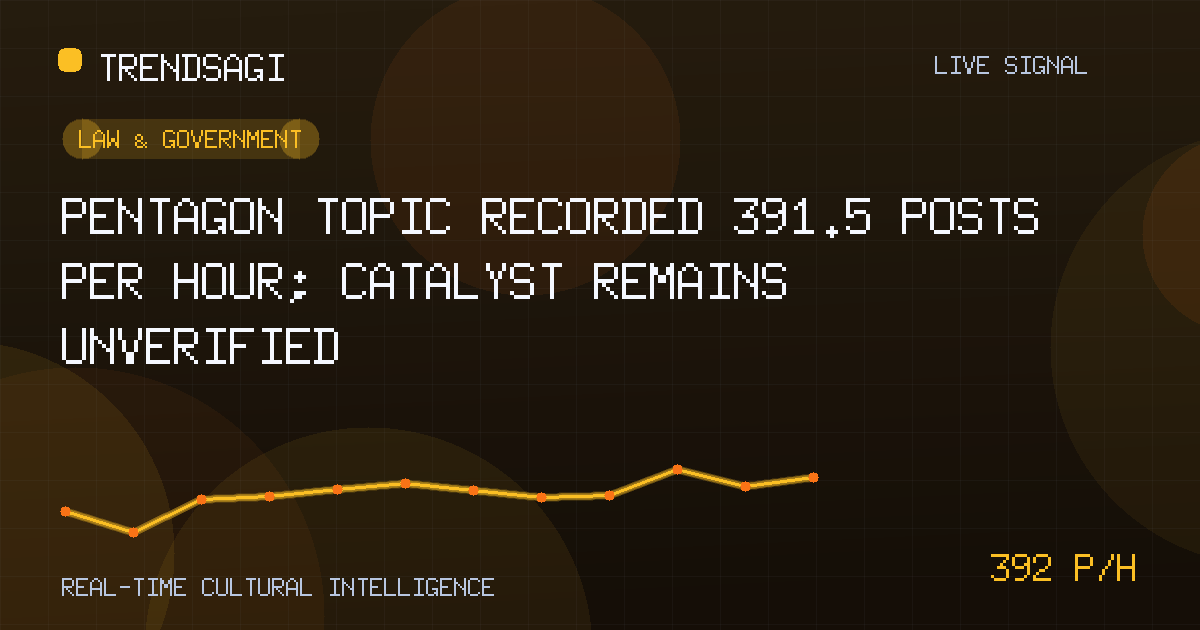
Pentagon discussion recorded 391.5 posts per hour over 901 seconds; the catalyst is unverified, with clear checks for editors and analysts.
Automated briefing. Generated from stored signal measurements and source-backed research; it is not manually reviewed. Read the methodology and limitations.
Metrics in this briefing are a snapshot associated with its publication date and may not reflect current conditions.
What changed
The monitored “Pentagon” conversation shows a concentrated burst of attention: the latest snapshot contains 356 posts at 2026-10-09T09:22:13Z. No verified public catalyst has been established for that movement, so the responsible conclusion is narrow: tracked discussion accelerated in the measured window, but the reason remains unclear.
The measured change was 391.5 posts/hour over an exact 901-second window ending at the snapshot time, using 3 stored observations. This is a measured snapshot rate for that historical interval—not a live or current rate, forecast, reach figure, engagement count, or unique-person count. The 356-post snapshot is a separate volume observation and should not be treated as a rate.
| Metric | Latest observation |
|---|---|
| Observation time | 2026-10-09T09:22:13Z |
| Measured snapshot rate | 391.5 posts/hour |
| Measurement basis | Exact 901-second window using 3 stored observations |
| Latest snapshot volume | 356 posts |
Why this topic may be moving
Only one explanation is supported directly: posts carrying the “Pentagon” label became more concentrated in the monitored interval. Several mechanisms could produce that pattern, but none should be presented as the established cause without further verification.
- A time-sensitive public development may be prompting reaction. A credible catalyst would need a verifiable publication time and details repeatedly reflected in the discussion. No reliable match between a public development and the start of the measured movement has been established.
- Several stories may be converging under one broad label. Posts mentioning the Pentagon could concern policy, personnel, legal proceedings, procurement, political criticism, or another subject. Without reviewing post-level text, it is impossible to tell whether this is one event or multiple conversations.
- The signal may include incidental or unrelated uses of the word. A place reference, quoted phrase, headline term, or automated repetition could contribute to the count without representing substantial new institutional news.
- Collection effects remain possible but unproven. Changes in monitoring coverage or duplicate capture can affect a keyword count. The available record does not show that this occurred, so it should be checked rather than assumed.
Why it matters
For defense-policy reporters, government-accountability specialists, and editors, the movement is best treated as a verification trigger. It identifies where attention may be gathering, but it does not establish what happened, whether the underlying claim is true, or whether the development is consequential. A keyword increase should not be converted into a headline about a new policy, confrontation, legal action, or institutional crisis without corroboration.
Public officials, communications teams, and monitoring organizations also need to distinguish meaningful participation from incidental mentions. Volume alone does not reveal sentiment, geography, source reliability, or whether posts are original, reposted, or automated. Even a sustained burst could reflect broad discussion of an unrelated story rather than direct engagement with the institution named by the label.
A keyword surge is evidence of attention, not yet evidence of a new event. A defensible causal account requires a verifiable source, a coherent timeline, and post-level evidence that people are reacting to the same development.
The immediate value is therefore operational: the signal tells analysts where to investigate, while the missing context tells them what not to conclude.
What to watch next
- Find the earliest relevant timestamps. Determine whether a specific statement, document, report, hearing, filing, or other item appeared before the discussion accelerated. A catalyst published only after the peak cannot explain the initial movement.
- Classify what “Pentagon” means in the posts. Separate direct institutional references from incidental uses, quotations, and broader political commentary. Group posts by the person, document, action, or controversy they mention.
- Look for convergence around shared facts. A stronger explanation would emerge if many posts referred to the same identifiable development in similar ways. Similar wording alone is not enough if it can be traced to one copied source.
- Check persistence in later complete windows. A brief burst may reflect a passing reaction. Continued elevation would indicate a larger information event, while a quick reversal would favor a short-lived or poorly differentiated keyword effect.
- Seek independent and primary confirmation. Compare the discussion with relevant official material and reporting from multiple reputable publishers. Attribution should follow the publisher that actually reports each fact.
- Watch for authoritative clarification. A response, correction, denial, or follow-up document tied closely to the same timestamp would help identify the subject and distinguish verified information from speculation.
Concrete signs that the signal represents a substantive event would include a verifiable item predating the rise, diverse posts linking to the same specific development, independent corroboration, and sustained follow-up. A rapid decline, dispersed topics, heavy repetition, or failure to identify a shared referent would point in the opposite direction.
Methodology and limitations
The reported 391.5 posts/hour is a measured snapshot rate calculated across an exact 901-second window from 3 stored observations ending at 2026-10-09T09:22:13Z. Those observations characterize that interval, but they do not provide a long-run baseline. Without the underlying earlier values, no absolute increase, percentage change, or claim about a sustained trend can be responsibly stated.
The 356 posts represent the latest snapshot volume. They are not a count of unique people, an engagement total, an audience estimate, or a rate. The signal also does not supply post text, source identities, sentiment, geography, platform coverage, collection consistency, or duplicate-control results. It therefore cannot establish who participated, what they believed, or whether the activity was organic.
Most importantly, the cause remains unclear. No specific announcement, leak, proceeding, military development, or policy action is asserted as the trigger because none could be verified from the available evidence. The 391.5 posts/hour figure should remain the factual headline, paired with the 356-post snapshot and an explicit verification queue—not an unsupported explanation.
Track This Topic for New Signals
Set alerts for future velocity or sentiment changes around this topic.
Explore Tracking PlansAbout TrendsAGI research
TrendsAGI's automated research pipeline publishes dated signal snapshots, methodology notes, and practical workflows for teams evaluating cultural momentum. Read how signals are scoped, scored, and limited in our research methodology.


