902-second window · 3 observations · Measured Oct 5, 2026, 12:56 PM UTC · Provider: go_recent_snapshot_v2
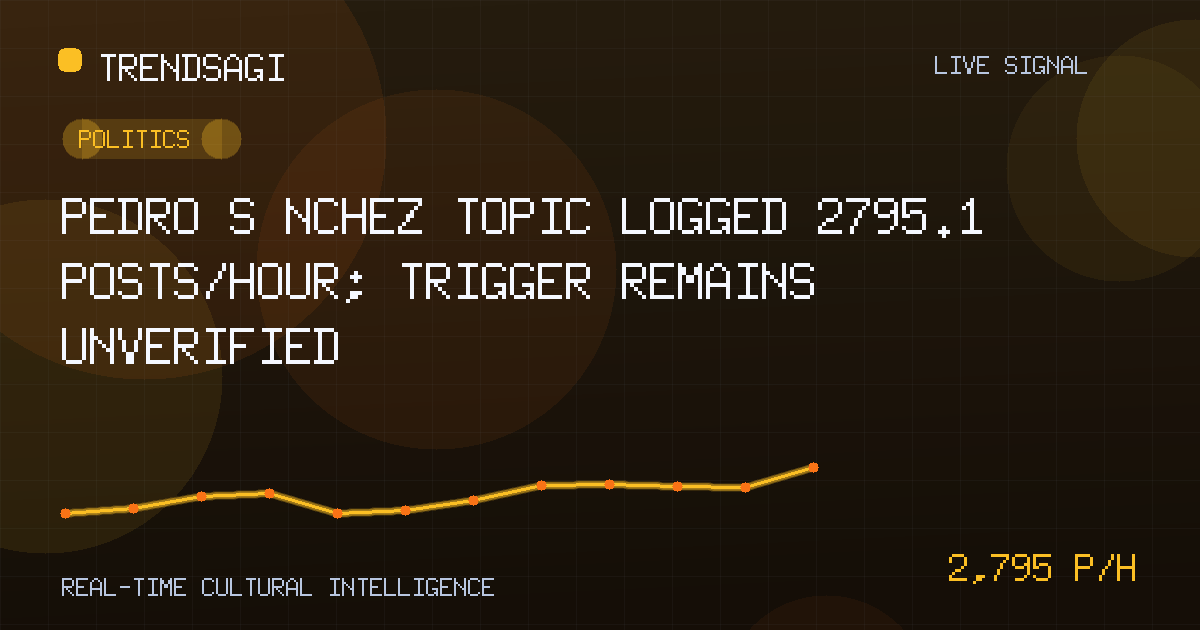
Pedro Sánchez topic logged 2795.1 posts/hour; trigger remains unverified
Pedro Sánchez topic activity logged 2795.1 posts/hour in a 1714-post snapshot; the trigger is unverified, with practical checks for editors.
Automated briefing. Generated from stored signal measurements and source-backed research; it is not manually reviewed. Read the methodology and limitations.
Metrics in this briefing are a snapshot associated with its publication date and may not reflect current conditions.
What changed
The tracked Pedro Sánchez topic showed a concentrated burst of activity in the latest stored snapshot. At 2026-10-05T12:56:48Z, the feed contained 1714 posts and registered a measured snapshot rate of 2795.1 posts/hour. The supported conclusion is narrow: the monitored feed was registering the reported rate at the observation time. The signal does not establish what triggered the movement or whom it represents.
| Observation time | Measured snapshot rate | Snapshot volume |
|---|---|---|
| 2026-10-05T12:56:48Z | 2795.1 posts/hour | 1714 posts |
The rate comes from an exact 902-second window using 3 stored observations ending at the timestamp above. It is a historical snapshot measure, not a live or current rate, forecast, reach figure, engagement measure, or count of unique people. No verified public context was available to connect the movement to a specific event, so the cause remains unclear.
What is established
The signal directly establishes the observation time, the latest snapshot volume, and a measured rate across a defined window. Those fields make it useful as an alert: they show that the topic feed warranted monitoring and provide a benchmark for later snapshots. They do not show whether the activity was organic, representative, or consequential.
The 1714 posts and 2795.1 posts/hour should be read as different measures. One is the volume present in the latest snapshot; the other is the measured snapshot rate over the exact observation window. The available definitions do not support converting either into audience size, influence, or expected future volume.
Why this topic may be moving
The cause cannot be responsibly assigned from the stored signal alone. A short burst can be associated with a new event, renewed attention to older news, a concentrated community response, or coordinated amplification, but none of those explanations is verified here.
A topic spike is an editorial alert, not an explanation: an event should be verified before it becomes the story's cause.
That distinction matters because a topical label and a Politics category are classification fields, not evidence that a particular speech, interview, campaign development, controversy, or policy announcement caused the movement. Naming any of those as the trigger without a source connected to the timing would turn a monitoring alert into an unsupported news claim.
Why it matters
A political-topic surge matters first as a verification and resource-allocation signal. Newsrooms may need to check breaking sources; campaign teams may need to identify what claims are circulating; researchers and trust-and-safety teams may need to test whether the burst is broad or concentrated. The right response depends on the cause, which remains unresolved.
- News editors: Prioritize the earliest substantive posts and compare them with primary records and reputable reporting.
- Campaign and party teams: Separate mentions of the person from evidence of policy impact or public support.
- Researchers: Preserve timestamps, source mix, and duplication because a short-window total can overstate independent activity.
- Trust-and-safety teams: Examine account overlap and posting cadence before inferring coordination.
- Fact-checkers: Identify the most repeated claim and test whether the burst is amplifying misinformation, without assuming it is.
None of these groups should read post volume as a poll. It is neither a vote count nor a representative measure of public opinion, and the signal supplies no sentiment or engagement breakdown.
What to watch next
The next checks should move from persistence to causation, with each step tied to observable evidence.
- Persistence: Compare later stored observations over comparable exact windows. A comparable window at or above 2795.1 posts/hour would indicate continuation of the latest measured pace; a lower rate would indicate that it did not sustain. This is a comparison, not a forecast.
- Origin: Inspect the earliest substantive posts, their timestamps, and the sources they cite. Determine whether they introduce a new claim or recycle an older item.
- Public trigger: Use Google Search to find a primary statement, transcript, filing, live-event record, or reputable report tied to the observation time. Do not infer a trigger merely because search results share the same topic.
- Distribution: Measure original posts separately from copies, quotations, and reactions, and count distinct accounts where the dataset allows. Compare independent sources rather than treating repeated text as multiple confirmations.
- Context: Review language, geography, and source categories only if those fields are collected consistently. A concentrated burst among a small set of accounts has a different interpretation from varied discussion across independent sources.
- Follow-through: Track subsequent snapshot volume, the measured snapshot rate, primary-source activity, and reputable follow-up reporting. If no external trigger can be verified, continue to label the development an unexplained topic-volume spike rather than manufacturing certainty.
Methodology and limitations
The figures come from the topic-level observation. The measured snapshot rate of 2795.1 posts/hour uses 3 stored observations across an exact 902-second window ending at 2026-10-05T12:56:48Z. The latest snapshot volume is 1714 posts. These are monitoring metrics, not estimates of unique authors, people reached, engagement, or impact.
A short window can be sensitive to a brief cluster and should not be treated as a normal baseline. No long-run comparison, sentiment, account-level distribution, geography, language, engagement, confidence interval, or source-quality assessment was supplied. Posts may also include duplicates or coordinated repetition.
No external fact is used to explain the movement because no public-source connection was verified. The defensible finding is therefore the observed volume and measured snapshot rate; the causal interpretation remains open pending the checks above.
Track This Topic for New Signals
Set alerts for future velocity or sentiment changes around this topic.
Explore Tracking PlansAbout TrendsAGI research
TrendsAGI's automated research pipeline publishes dated signal snapshots, methodology notes, and practical workflows for teams evaluating cultural momentum. Read how signals are scoped, scored, and limited in our research methodology.