899-second window · 3 observations · Measured Sep 28, 2026, 5:41 AM UTC · Provider: go_recent_snapshot_v2
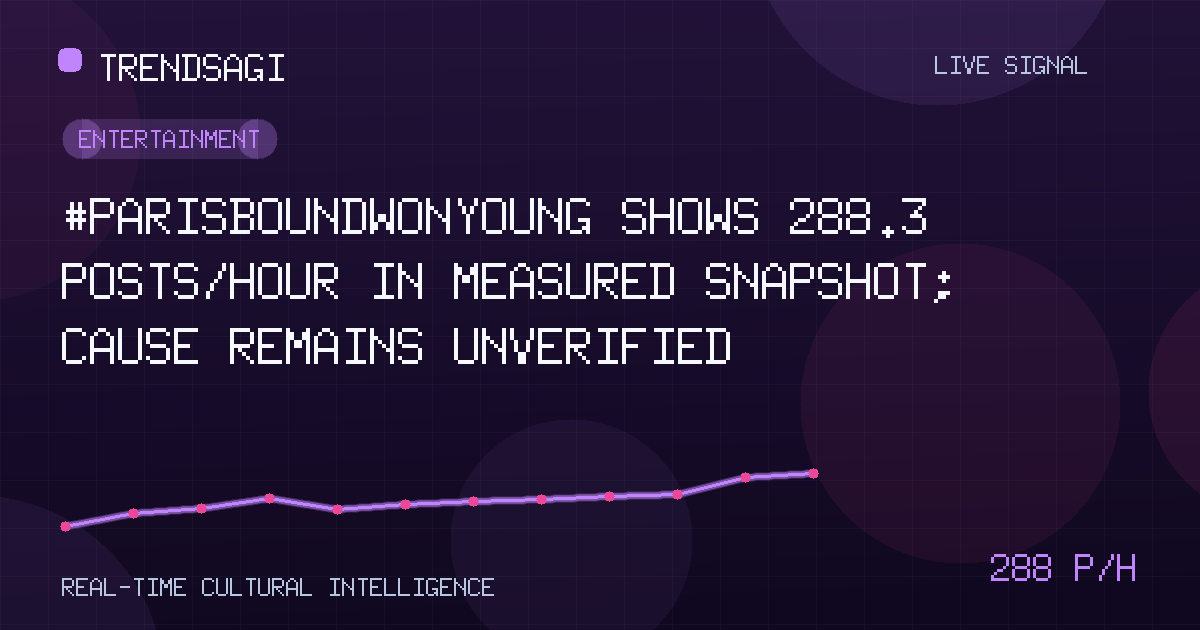
#ParisBoundWonyoung shows 288.3 posts/hour in measured snapshot; cause remains unverified
#ParisBoundWonyoung recorded 288.3 posts/hour over 899 seconds; the measured snapshot shows scale, not a confirmed cause.
Automated briefing. Generated from stored signal measurements and source-backed research; it is not manually reviewed. Read the methodology and limitations.
Metrics in this briefing are a snapshot associated with its publication date and may not reflect current conditions.
What changed
At the recorded observation, #ParisBoundWonyoung showed a concentrated burst in the stored feed: the latest snapshot contains 324 posts. That makes the tag an editorial lead, but the available evidence does not identify a confirmed event, appearance, trip, release, or controversy behind it. The cause remains unclear.
The measured snapshot rate was 288.3 posts/hour over an exact 899-second window using 3 stored observations, recorded at 2026-09-28T05:41:34Z. This is a historical, measured snapshot pace—not a live rate, forecast, reach figure, engagement total, or count of unique people.
| Observation time | Measured snapshot rate | Latest snapshot volume |
|---|---|---|
| 2026-09-28T05:41:34Z | 288.3 posts/hour | 324 posts |
Why this topic may be moving
The stored record contains no verified public context tying the cluster to a specific event. Its Entertainment classification and the wording of the hashtag are useful labels, but they are not evidence that Wonyoung was traveling to Paris or that a Paris-related event occurred. The word “ParisBound” could reflect fan shorthand, an erroneous label, or a broader travel narrative; none of those interpretations is confirmed here.
Several mechanisms could produce this pattern and should be treated as hypotheses to test:
- A time-sensitive sighting, public appearance, or scheduled event involving Wonyoung, if independently confirmed.
- A photograph, video, outfit, or airport-style observation that was easy for fans to repost quickly.
- Fan communities reenergizing around a travel rumor, schedule, or fan project.
- Quoting, repetition, or platform amplification increasing post volume without an equivalent amount of original reporting.
- Hashtag misuse, mistaken identity, or unrelated content being folded into the same conversation.
None of these drivers is established by the stored signal. Without a corroborated public event connected to the observed window, reporting a specific explanation would go beyond the evidence.
What the signal can and cannot establish
The signal establishes that the stored system captured 324 posts in its latest snapshot and calculated a measured snapshot rate of 288.3 posts/hour from 3 observations across the stated 899-second window. It also shows that the topic was relevant enough within that collection to warrant review. These are measurements of the recorded feed, not direct measurements of the entire public internet.
A measured posting pace shows where attention clustered in the observed record; it does not identify what happened, who created the attention, or whether the activity was organic.
The signal cannot establish:
- Whether activity was higher than a normal baseline for this topic.
- How many unique people posted, viewed, or interacted.
- Whether participants were located in Paris or anywhere else.
- Whether the posts were positive, negative, neutral, original, or automated.
- Whether a particular public figure or organization caused the cluster.
- Whether the pace persisted after the observation window.
The 324-post snapshot and the 288.3 posts/hour figure are separate measures. The snapshot volume should not be described as a rate, and the measured rate should not be presented as the number of posts collected during the 899-second window.
Why it matters
For entertainment editors, this is a verification lead rather than a ready-made story. The immediate question is not simply why people are posting, but whether any post contains timely, original evidence of a reportable development. A Paris connection should not be added to a headline until it is supported by reliable, time-stamped public context.
Social-listening teams should examine the composition of the cluster before declaring a broad trend. A large share of quoting accounts, repeated captions, or low-information reposts would point to concentrated amplification rather than many independent reactions. Fashion, travel, and pop-culture desks may also need to determine whether the conversation is about a verified event or is being driven by fan interpretation and itinerary speculation.
Community managers and brand-safety teams can use the signal to monitor whether discussion is expanding, narrowing, or changing subject. Researchers should preserve it as a timestamped observation, but should not generalize from it without the underlying posts, collection boundaries, deduplication status, and a comparable baseline.
What to watch next
Practical follow-up should proceed from provenance to persistence:
- Inspect the raw posts around the observation timestamp and identify the earliest recurring claims or media.
- Separate original posts from quotes, copies, reactions, and automated behavior where that is possible.
- Check official accounts, event records, and credible reporting for a time-stamped development that predates or overlaps the cluster.
- Compare later stored snapshots using the same collection method to see whether activity persists, fades, or shifts to another subject.
- Track whether independent contributors add consistent details or merely repeat the same unsupported framing.
Concrete signs that would strengthen the briefing would include primary confirmation of a Paris-related event, multiple independent pieces of original evidence, migration from a niche fan conversation into broader entertainment coverage, or a credible correction that changes the interpretation. Warning signs would include near-identical wording across many accounts, unsupported claims spreading faster than verification, sudden changes in the dominant subject, or a rapid decline after the initial cluster.
Methodology and limitations
This briefing uses the canonical stored observation supplied for #ParisBoundWonyoung. The record provides an observation time of 2026-09-28T05:41:34Z, a latest snapshot volume of 324 posts, and a measured snapshot rate of 288.3 posts/hour over an exact 899-second window using 3 stored observations. The figure is not recomputed, extended, or converted into another metric here.
No stored narrative description accompanies the signal, and no verified public event has been established as its cause. The record also does not specify the collection universe, platform coverage, sampling boundaries, deduplication rules, poster distribution, sentiment, or engagement. Because 3 observations form the basis of the reported rate, a short-lived burst could materially affect the result. The latest snapshot is a separate volume measure and should not be merged with the rate.
The defensible conclusion is therefore narrow: #ParisBoundWonyoung generated a measurable cluster in the stored observation, but neither the triggering event nor the authenticity, reach, and likely persistence of that activity can be determined from the supplied signal alone.
Track This Topic for New Signals
Set alerts for future velocity or sentiment changes around this topic.
Explore Tracking PlansAbout TrendsAGI research
TrendsAGI's automated research pipeline publishes dated signal snapshots, methodology notes, and practical workflows for teams evaluating cultural momentum. Read how signals are scoped, scored, and limited in our research methodology.