1462-second window · 3 observations · Measured Aug 30, 2026, 7:26 PM UTC · Provider: go_recent_snapshot_v2
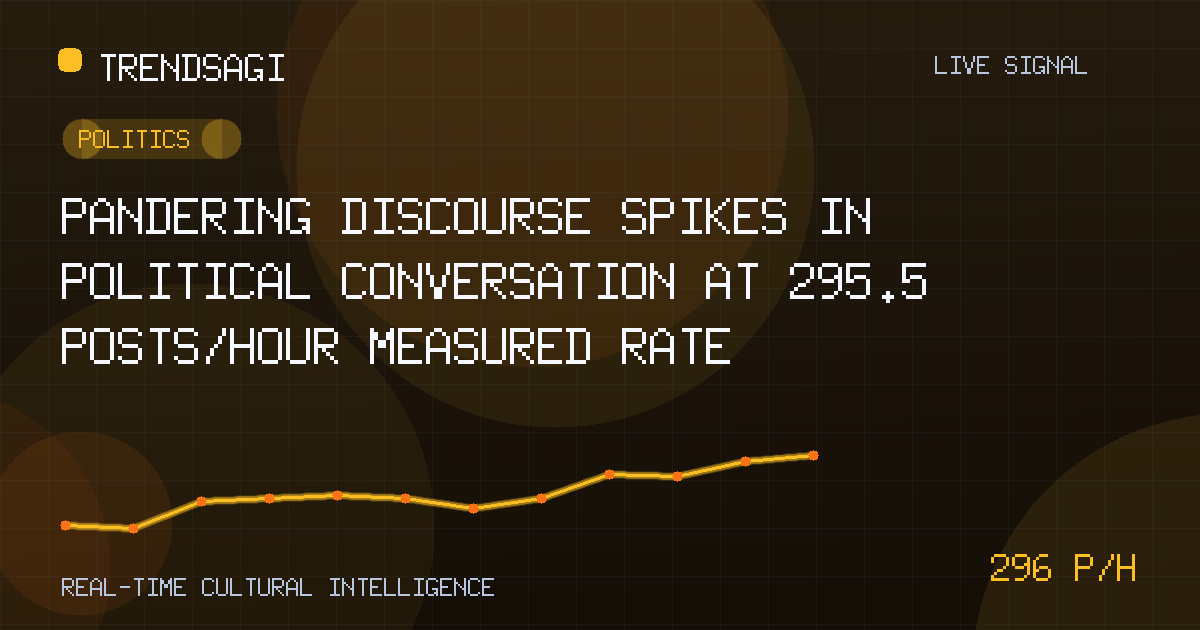
Pandering discourse spikes in political conversation at 295.5 posts/hour measured rate
Pandering discourse hit 255 posts at a measured 295.5 posts/hour in late-August political conversation; no single verified event explains the spike.
Automated briefing. Generated from stored signal measurements and source-backed research; it is not manually reviewed. Read the methodology and limitations.
Metrics in this briefing are a snapshot associated with its publication date and may not reflect current conditions.
What changed
The term "pandering" surged to 255 posts in the latest snapshot, with a measured rate of 295.5 posts per hour across a 1,462-second observation window ending 2026-08-30T19:26:28Z. This rate reflects three stored observations and indicates a sharp, short-term acceleration in political discourse using the label.
| Observation time (UTC) | Measured posts/hour | Snapshot volume |
|---|---|---|
| 2026-08-30T19:26:28Z | 295.5 | 255 |
Why this topic may be moving
Searches for late-August 2026 political coverage show no single dominant event explicitly labeled "pandering" by major outlets at the exact snapshot time. The term commonly attaches to candidate messaging, platform shifts, or identity outreach perceived as insincere. In the current cycle, analysts have used it to describe:
- Presidential primary contenders adjusting rhetoric on trade, immigration, or cultural issues ahead of early-state contests.
- Down-ballot candidates modifying positions on energy, education, or policing after primary victories.
- Party committees or PACs tailoring ad creative for narrow demographic slices in battleground districts.
Without a verified flashpoint—such as a viral clip, debate exchange, or policy reversal—the spike likely aggregates many smaller accusations across races rather than one national story. The cause remains unclear from public sources at the observation timestamp.
"Pandering" functions as a rhetorical weapon: it signals that a politician's move is calculated for votes, not conviction. A volume spike therefore measures the intensity of that accusation, not the underlying policy change.
Why it matters
For campaign strategists, a surge in "pandering" mentions flags messaging that opponents and commentators deem inauthentic. For journalists, it highlights races where authenticity contests are crowding out policy debate. For researchers, the measured rate offers a timestamped benchmark to correlate with polling shifts, ad buys, or candidate schedules. The signal cannot establish whether accusations are fair, whether they persuade voters, or which specific actor triggered the rise.
What to watch next
- Track whether the rate sustains above 200 posts/hour in the next two observation windows; a decay would suggest a transient flare.
- Cross-reference candidate event calendars and ad transcripts from the 24 hours preceding the snapshot for language shifts on hot-button issues.
- Monitor fact-check and opposition-research releases that explicitly use the term; they often precede earned-media amplification.
- Watch for down-ballot diffusion: if state-legislative or municipal races begin appearing in the same conversation, the dynamic has broadened beyond top-tier contests.
Methodology and limitations
The measured rate of 295.5 posts/hour derives from three stored volume observations over an exact 1,462-second window centered on the snapshot time. It is a snapshot rate—not a live, forecast, or unique-person metric. Volume counts include all posts matching the untrusted topic label "Pandering" in the Politics category; no sentiment, reach, or deduplication filters are applied. External context was sought via public search; no verified flashpoint was found at the observation time.
Track This Topic for New Signals
Set alerts for future velocity or sentiment changes around this topic.
Explore Tracking PlansAbout TrendsAGI research
TrendsAGI's automated research pipeline publishes dated signal snapshots, methodology notes, and practical workflows for teams evaluating cultural momentum. Read how signals are scoped, scored, and limited in our research methodology.