1683-second window · 2 observations · Measured Oct 9, 2026, 6:53 PM UTC · Provider: go_recent_snapshot_v2
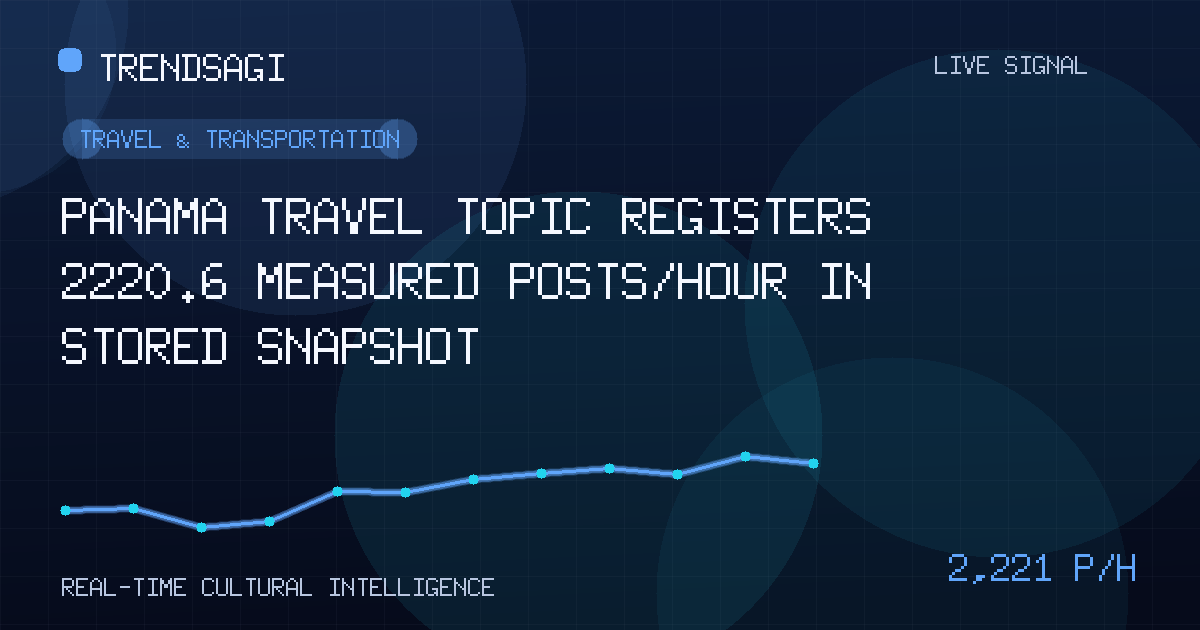
Panama travel topic registers 2220.6 measured posts/hour in stored snapshot
Panama’s stored travel signal registered 2220.6 posts/hour; here is what is verified, what remains unclear, and what editors should check next.
Automated briefing. Generated from stored signal measurements and source-backed research; it is not manually reviewed. Read the methodology and limitations.
Metrics in this briefing are a snapshot associated with its publication date and may not reflect current conditions.
What changed
The Panama topic in the stored Travel & Transportation category registered a measured snapshot rate of 2220.6 posts/hour at 2026-10-09T18:53:51Z. That figure comes from 2 stored observations across an exact 1683-second window, while the latest snapshot volume was 5538 posts. The defensible conclusion is that posting activity increased between the observations; the record does not identify a verified cause.
| Observation time | 2026-10-09T18:53:51Z |
|---|---|
| Measured snapshot rate | 2220.6 posts/hour |
| Snapshot volume | 5538 posts |
For editors, this is a verification trigger rather than a ready-made story. The 2220.6 figure is a measured snapshot rate, not a live or current rate, forecast, reach, engagement, or unique-person count. The 5538 figure is the size of the latest stored post set, not the hourly rate. Together they show momentum worth checking, but not whether the increase reflects a genuine news event, duplicated content, or a broad mix of unrelated uses of “Panama.”
Why this topic may be moving
No verified public context establishes a catalyst, so the cause remains unclear. The category and label provide a useful filing frame, but they do not prove that every post concerns tourism or transport. Several explanations remain hypotheses to test, not findings:
- Event-driven attention: Specific announcements, disruptions, scheduled events, or other developments may pull discussion; no such catalyst is established here.
- Destination or transport planning: Travelers and operators may be comparing routes, costs, availability, or conditions. That interpretation requires post-level evidence.
- Broader news spillover: A story using “Panama” may attract attention without being primarily about the destination or transport system.
- Platform or collection effects: Retries, duplicated syndication, spam, or collection changes could affect observed volume. None can be inferred from aggregate data alone.
Until timestamps, representative posts, and an independent public explanation align, the briefing should describe the cause as unresolved rather than attach the increase to a guessed event.
The strongest supported statement is not that a particular Panama event occurred, but that the stored Panama topic registered increased posting activity during the measured window.
What the signal can—and cannot—establish
The signal is a useful screening tool, but its scope is narrow. It supports statements about the stored topic label, the observed count at a fixed time, and the direction and measured pace between the supplied observations.
- A positive measured change of 2220.6 posts/hour occurred during the supplied window.
- The latest snapshot contained 5538 posts at the stated observation time.
- The series provides a reference point for checking whether subsequent observations persist, slow, or reverse.
It does not establish:
- Why activity changed or whether any specific event occurred.
- Whether posts were organic, duplicated, automated, or spam.
- How many distinct authors or people were involved.
- Audience sentiment, travel intent, commercial demand, or economic impact.
- That every post concerned Panama as a destination or transport topic despite the stored category.
- Where authors were located or which geographic meaning of “Panama” dominated.
Why it matters
A fast change around a broad place name creates an editorial timing problem: a verified event may deserve immediate coverage, while an ambiguous increase can waste reporting effort or distort a destination narrative. Validation should therefore come before amplification.
- Travel and transportation editors can use the signal to locate a precise subtopic, verify public facts, and avoid vague “Panama is trending” framing.
- Destination organizations and operators can distinguish traveler questions from unrelated mentions before adjusting schedules, messaging, or staffing.
- Public-safety and communications teams can check for service disruptions or misinformation, but only from corroborated, location-specific posts.
- Researchers and analysts can preserve the distinction between count and rate and test whether the movement is broad, concentrated, or duplicated.
What to watch next
The next useful evidence is not another unsupported headline. Editors should run this verification sequence:
- Re-sample the same topic. Inspect the next comparable stored observations and record whether the measured change remains positive, slows, or reverses. Keep snapshot volume separate from posts/hour.
- Review representative posts near the observation time. Identify recurring entities, routes, locations, event names, and factual claims; broad references alone do not establish the subject.
- Check source concentration. Repeated text, shared domains, coordinated posting, or collection retries can increase an observed topic count without representing independent attention.
- Seek time-aligned corroboration. Check relevant public authorities, local reporting, operators, or event organizers. A catalyst should be independently verifiable, not merely repeated in the feed.
- Separate travel and transport mentions from other uses of “Panama.” Classify posts by explicit geography and subject before drawing conclusions about tourism activity.
- Watch for a concrete transition in the conversation. Dominant location names, route questions, service updates, cancellation language, or a clearly identified event would narrow the story. Without that transition, retain “cause unclear.”
- Add comparative context. Compare the signal with other destination topics and established platform baselines before characterizing the rate as unusually high or low.
Methodology and limitations
The measured rate is based on exactly 2 stored observations over 1683 seconds and is attributed to the 2026-10-09T18:53:51Z snapshot. It describes change within that window; it is not a live or current rate or a forecast. The snapshot volume of 5538 is a separate count and should not be presented as hourly activity. With only 2 observations, the series cannot show the shape of activity inside the window, a normal baseline, persistence, or volatility. The record also supplies no sampling method, language mix, geography, platform mix, deduplication status, sentiment, or account-level data. Those omissions limit causal, demographic, and market interpretation. A follow-up should preserve the original observation time, window, and count-versus-rate labels so that the apparent increase can be tested rather than merely repeated.
Track This Topic for New Signals
Set alerts for future velocity or sentiment changes around this topic.
Explore Tracking PlansAbout TrendsAGI research
TrendsAGI's automated research pipeline publishes dated signal snapshots, methodology notes, and practical workflows for teams evaluating cultural momentum. Read how signals are scoped, scored, and limited in our research methodology.