906-second window · 3 observations · Measured Sep 25, 2026, 7:56 AM UTC · Provider: go_recent_snapshot_v2
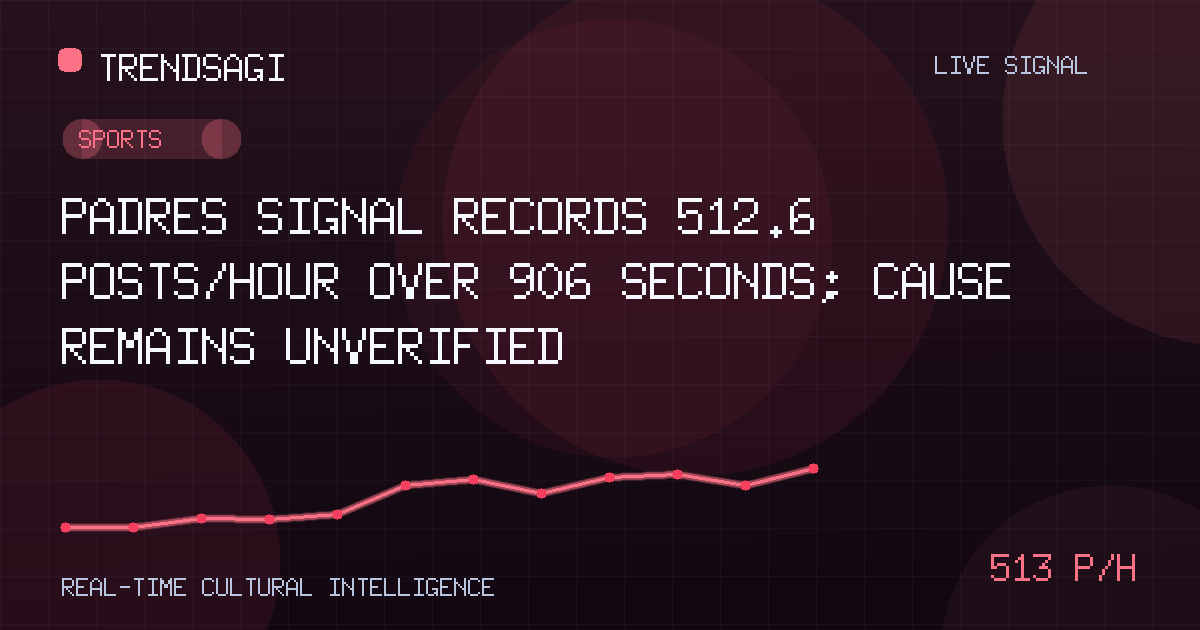
Padres signal records 512.6 posts/hour over 906 seconds; cause remains unverified
The Padres signal measured 512.6 posts/hour over 906 seconds; here’s what the 483-post snapshot means, what remains unverified, and what to check next.
Automated briefing. Generated from stored signal measurements and source-backed research; it is not manually reviewed. Read the methodology and limitations.
Metrics in this briefing are a snapshot associated with its publication date and may not reflect current conditions.
What changed
“Padres” is moving in the stored signal, but the reason is not established. The measured snapshot rate is 512.6 posts/hour over an exact 906-second window, measured at 2026-09-25T07:56:39Z from three stored observations. That establishes an observed rate during the interval. Without a supplied comparison baseline, it does not show how unusual the rate is, whether activity was accelerating, or whether the pattern continued afterward.
The latest stored snapshot contains 483 posts. This is a count captured at the observation, not a rate, reach, engagement, or a count of unique people. The posts/hour figure is a measured snapshot rate, not a live or current rate or a forecast. The practical reading is narrow: investigate the topic, but do not yet attach a confident event explanation or broad trend claim.
| Observation time | 2026-09-25T07:56:39Z |
|---|---|
| Measured snapshot rate | 512.6 posts/hour |
| Measurement window | 906 seconds |
| Stored observations | 3 |
| Latest snapshot volume | 483 posts |
What the signal can establish
The signal is a monitoring lead: it identifies a topic and timeframe worth checking. It is not, by itself, an explanation or a measure of the size or diversity of the audience.
- Observed rate: The monitored dataset recorded 512.6 posts/hour during the specified 906-second window. That rate does not extend to an entire day, match, or season.
- Snapshot volume: The 483 posts were captured at the latest observation. The total does not identify unique authors, original versus copied content, or sentiment.
- Limited resolution: Three observations and no supplied historical comparison do not establish persistence, a normal baseline, or a causal link.
Why this topic may be moving
The cause remains unclear because no specific public report has been verified here. The topic name is also insufficient by itself: the sports category narrows the possibilities but does not identify a particular team, match, transaction, or controversy.
A timed announcement, search curiosity, repeated circulation of an item, or unrelated uses of the same term could all contribute. These are hypotheses, not findings. Topic identity and timing must both be checked before the measured rate is attributed to a trigger.
Nothing available establishes how broad participation is, the posts’ sentiment, or whether activity is organic, coordinated, or manipulated.
Why it matters
For sports editors, the immediate risk is attaching a dramatic explanation to a topic whose referent has not been checked. A fast rate can invite a newsroom to mistake conversation volume for evidence of a major event. The better response is to verify the subject, timing, and original reporting first.
- Newsrooms and fan communities: Separate a confirmed update from rumors, recurring discussion, or duplicated posts before adding context.
- Audience and community teams: Check whether volume comes from many contributors or repeated content from a smaller set.
- Researchers and communicators: Use the signal as a monitoring lead, not a proxy for popularity, market interest, or campaign performance.
A measured rate tells you where to investigate, not what happened or how widely the attention is shared.
What to watch next
For researchers, the useful next step is to turn a rate alert into a verifiable timeline rather than extrapolate it.
- Identify the subject. Inspect a representative sample of post text for team or organization names, player names, match references, and direct quotations. The category alone should not decide what “Padres” means here.
- Align the clock. Compare the start of the measured interval with verified public reporting, official statements, and the first substantive posts. A time match narrows the explanation; it does not prove causation.
- Check participation. Where records permit, distinguish original posts from reposts and count distinct accounts separately from post volume. Look for repeated content driving apparent momentum.
- Test persistence. Take additional fixed-interval snapshots using the same query and counting rules. Record totals and separately calculated rates; a single follow-up cannot establish a durable trend.
- Look for confirmation. A verified event announcement, relevant official update, or sustained cluster of independent posts would strengthen an explanation. None is confirmed in the available material.
Concrete watch signals are timestamped reporting that precedes the burst, participation expanding across distinct accounts, and continued activity under consistent collection rules. A lower next measured rate would weaken a sustained-trend story, but it would not identify what caused the original burst.
Methodology and limitations
This briefing uses the supplied observation at 2026-09-25T07:56:39Z, its 483-post snapshot, and the measured 512.6 posts/hour over 906 seconds from three observations. The rate is a measured snapshot statistic, not a live/current rate, forecast, reach, engagement, or unique-person count.
The dataset’s collection method, query coverage, historical baseline, geographic reach, language handling, and account deduplication are not provided. Those omissions limit conclusions about typicality, audience breadth, sentiment, and causation.
The rate and total describe different things. A short-window rate can exceed a snapshot total without either figure being wrong: one characterizes change during the interval, while the other counts posts present in the stored snapshot. No external event attribution is made without a verified publisher source.
Track This Topic for New Signals
Set alerts for future velocity or sentiment changes around this topic.
Explore Tracking PlansAbout TrendsAGI research
TrendsAGI's automated research pipeline publishes dated signal snapshots, methodology notes, and practical workflows for teams evaluating cultural momentum. Read how signals are scoped, scored, and limited in our research methodology.


