15-minute window · 3 observations · Measured Sep 29, 2026, 6:36 PM UTC · Provider: go_recent_snapshot_v2
Owners topic measures 3259.3 posts/hour; no verified movement trigger
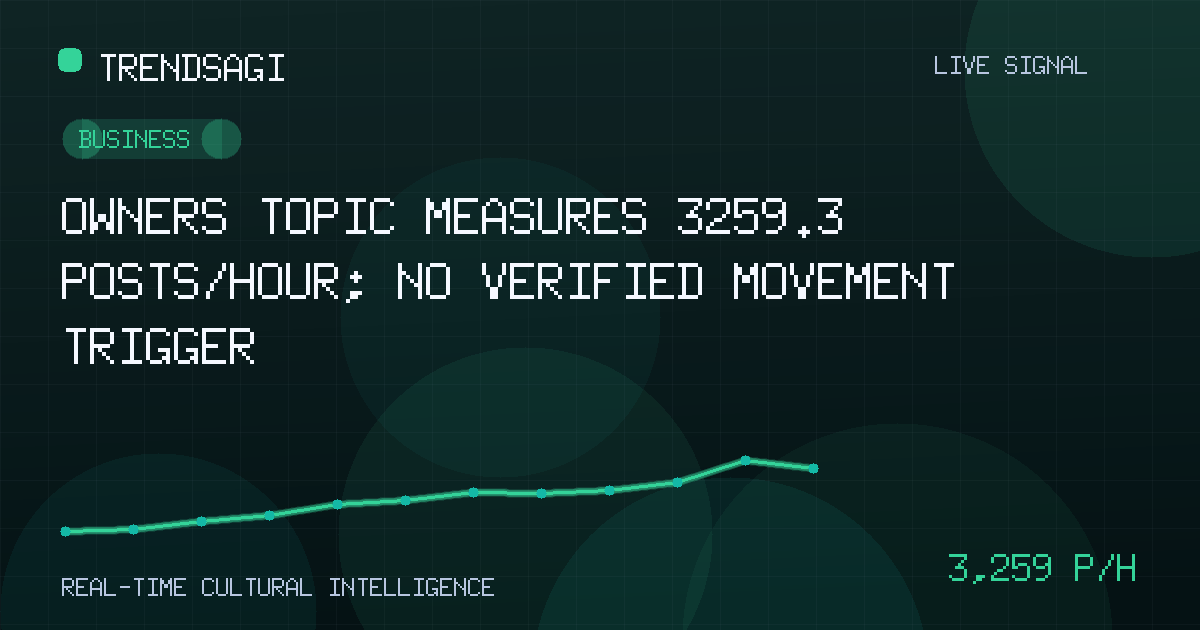
The Owners signal measures 3259.3 posts/hour and records 2571 posts in its snapshot; this briefing separates measured activity from its unverified cause.
Automated briefing. Generated from stored signal measurements and source-backed research; it is not manually reviewed. Read the methodology and limitations.
Metrics in this briefing are a snapshot associated with its publication date and may not reflect current conditions.
What changed
The latest stored snapshot for “Owners” contains 2571 posts, while the accompanying measured snapshot rate is 3259.3 posts/hour. The available record does not verify a public event or other trigger behind the movement, so the defensible answer is that posting activity is being monitored but its cause remains unclear.
This is a measured snapshot rate, not a live/current rate, forecast, reach figure, engagement measure, or unique-person count. It was measured over an exact 900-second window using 3 stored observations. Because the record supplies no prior comparable rate, it cannot establish that Owners is accelerating, decelerating, or sustaining a longer-term pattern. The 2571 snapshot volume is a separate count and should not be substituted for the rate.
| Measure | Stored value |
|---|---|
| Observation time | 2026-09-29T18:36:50Z |
| Measured snapshot rate | 3259.3 posts/hour |
| Latest snapshot volume | 2571 posts |
Why this topic may be moving
The label is too broad to diagnose by itself. Within the Business category, “Owners” could refer to business owners, ownership discussions, people describing themselves as owners, owner-related entities, or a wider set of posts selected by the monitoring taxonomy. No descriptive context accompanies the label, so its matching logic is unavailable.
Several explanations are plausible but unverified: a real-world business event, a seasonal discussion cycle, reaction to a policy, platform, or market development, a company or public figure connected to ownership language, or a change in the monitoring query itself. None should be presented as the cause until a representative post sample and verified public context support it.
The first verification task is classification. Determine what made a post qualify, whether one subtheme dominates, and whether the label is applied consistently. If the sample centers on one event, an event-driven interpretation may be warranted. If it spans unrelated subjects, the result is better treated as a broad-term cluster rather than a single trend.
What the signal can—and cannot—establish
The signal supports a narrow operational conclusion:
- At the stored observation time, the latest Owners snapshot contained 2571 posts.
- Across the supplied 900-second window, the measured rate was 3259.3 posts/hour, based on 3 stored observations.
- The records were assigned to the Business category.
It does not support the following conclusions:
- No prior equal-window result establishes a baseline or a direction of movement.
- No sample-level text establishes which entities, events, or issues dominate.
- No account-level data establishes unique authors, audience size, geography, or language.
- No sentiment or engagement fields establish what posters think or how widely the discussion reached.
- No later observation establishes persistence, reversal, or a forecast.
A measured posting rate identifies intensity in the observed record, not the identity, intent, reach, or consequence of the people posting.
Why it matters
For editors and communications teams, the signal is a prompt to verify, not a ready-made story. A concentrated event could merit reporting or a rapid response; a diffuse keyword cluster may not. The distinction affects whether teams publish an explanation, adjust messaging, or simply keep monitoring.
Businesses and customer-support teams should care only after the audience and subject are clearer. If qualifying posts repeatedly describe an operational, regulatory, or market problem, there may be a service or communication issue to investigate. The stored record does not currently establish any such problem.
Analysts and platform teams also have a measurement task: confirm that the category, query, and deduplication rules did not change. A taxonomy shift can create apparent momentum without a comparable change in underlying conversation.
What to watch next
- Recheck the definition. Retrieve the matching rule and review a representative set of qualifying posts. Record which uses of “Owners” actually appear and whether one meaning dominates.
- Build a real comparison. Compare earlier and later rates calculated with the same 900-second window and handling, then compare snapshot volumes separately. This is the minimum needed to distinguish persistence from a short burst.
- Look for concentration. Check whether posts cluster around one entity, event, complaint, announcement, or phrase. Concentration strengthens relevance; diffuse matches weaken any single causal story.
- Audit duplication and sourcing. Separate repeated content from distinct contributions and note whether activity comes from a small set of accounts. Raw volume can overstate independent participation.
- Add context cuts. Break the sample by source, geography, language, and time where the underlying data permits. These cuts can reveal whether Owners is one national conversation or several unrelated ones.
- Seek public corroboration. Look for a dated report, announcement, platform change, market event, or other external development that aligns with the matching posts. If none aligns, retain the cause as unknown rather than filling the gap with speculation.
- Track concrete transitions. Watch for repeated near-level rates, a material decline, a shift in dominant subtheme, or new entities entering the sample. Each would change how confidently the signal can be interpreted.
Methodology and limitations
The reported figures come directly from the stored signal: observation time 2026-09-29T18:36:50Z, measured snapshot rate 3259.3 posts/hour over the exact 900-second window using 3 stored observations, and latest snapshot volume of 2571 posts. The rate and volume are different measures and are not combined.
No raw posts, historical baseline, query logic, deduplication method, account data, engagement data, or verified public context accompanies the signal. The briefing therefore does not claim acceleration, relative abnormality, sentiment, causation, reach, or future persistence. Those questions require the checks above.
Track This Topic for New Signals
Set alerts for future velocity or sentiment changes around this topic.
Explore Tracking PlansAbout TrendsAGI research
TrendsAGI's automated research pipeline publishes dated signal snapshots, methodology notes, and practical workflows for teams evaluating cultural momentum. Read how signals are scoped, scored, and limited in our research methodology.


