842-second window · 3 observations · Measured Oct 9, 2026, 12:53 PM UTC · Provider: go_recent_snapshot_v2
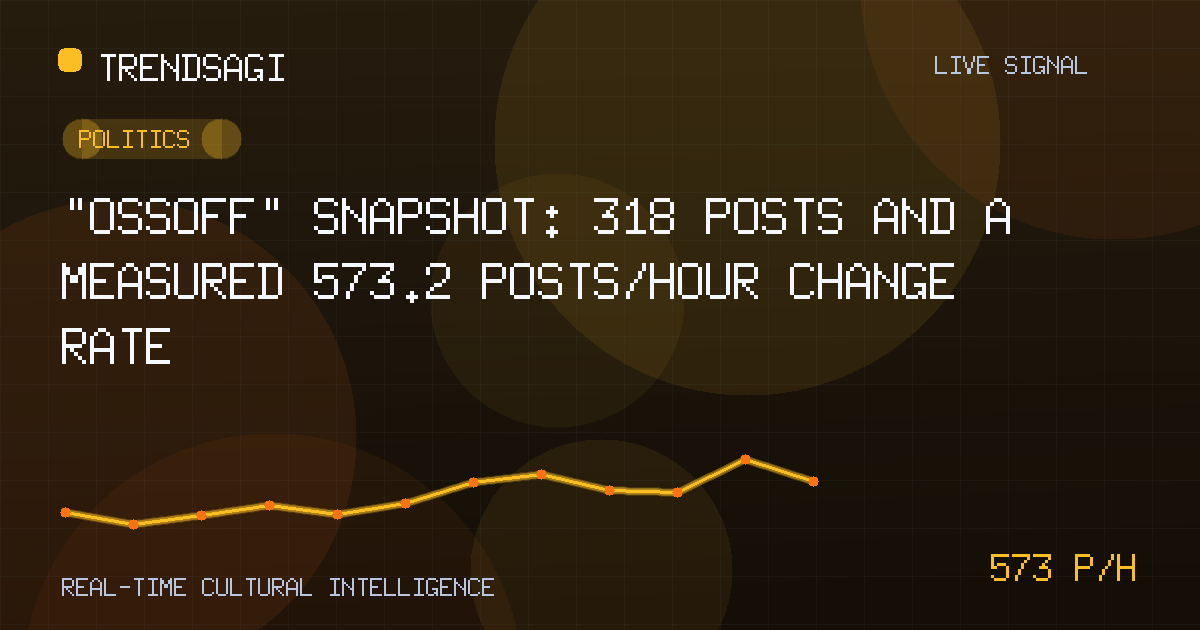
“Ossoff” snapshot: 318 posts and a measured 573.2 posts/hour change rate
At 2026-10-09T12:53:44Z, “Ossoff” had 318 posts and a measured 573.2 posts/hour change rate; the cause is unverified, so source checks follow.
Automated briefing. Generated from stored signal measurements and source-backed research; it is not manually reviewed. Read the methodology and limitations.
Metrics in this briefing are a snapshot associated with its publication date and may not reflect current conditions.
What changed
The available evidence shows a rapid short-window increase in captured posts associated with “Ossoff,” but it does not identify the event behind that increase. The latest snapshot, observed at 2026-10-09T12:53:44Z, contained 318 posts.
The measured change rate was 573.2 posts/hour over an exact 842-second window using 3 stored observations. That figure is a measured snapshot rate—not a live/current rate, forecast, reach figure, engagement count, or unique-person count. The defensible takeaway is rapid change in the captured topic during the measured interval; the cause is not established.
| Observation time | 2026-10-09T12:53:44Z |
|---|---|
| Measured posts/hour | 573.2 posts/hour, measured snapshot rate |
| Snapshot volume | 318 posts |
Why this topic may be moving
The topic is categorized as Politics, but neither the category nor the single-name label explains what happened. No publisher-attributed event explanation can be verified from the material available for this briefing. The record contains no post text, linked source, named event, or descriptive context. It would be speculative to attribute the movement to a campaign action, official statement, election result, controversy, or platform event. The cause remains unclear.
Several mechanisms could produce this pattern, but none is established by the current measurements:
- A newly published or resurfaced political item could prompt immediate reactions.
- A scheduled communication or event could produce a predictable burst.
- Prominent accounts could amplify older material, making recirculation look new.
- Reposts, duplicated text, or coordinated activity could reduce the share of original reporting.
- Query scope, labeling, or collection changes could raise the count without a comparable rise in underlying discussion.
These are hypotheses, not findings. The label also needs semantic validation: a search match may not concern the same person, office, campaign, place, or issue throughout the window. Until sampled posts resolve that ambiguity, assigning a political narrative would be premature.
Velocity is a reason to look faster, not a reason to declare a political event. A causal briefing should wait until the label resolves to a documented trigger and the relevant posts show what happened.
Why it matters
This signal matters as an investigation lead, not as a conclusion. It is relevant to campaign and communications teams, reporters, editors, election researchers, pollsters, fact-checkers, and platform-integrity specialists. If the label refers to an active political actor, a sudden increase may mark a messaging moment or public reaction. If it does not, the movement may instead reflect ambiguity, recirculation, or measurement noise. That distinction determines whether the signal merits response, reporting, or further monitoring.
- Campaign and communications teams can use the alert to check whether the activity aligns with scheduled messaging, but volume should not be treated as support, opposition, or influence.
- Reporters and editors need to identify the triggering document or statement before publishing a causal explanation. A fast post count is not, by itself, news of a consequential event.
- Researchers and pollsters should test whether the burst persists, where it is concentrated, and whether it is driven by original posts or repeated content. Those checks are necessary before using it as a political indicator.
- Fact-checkers and platform-integrity teams should look for a verifiable claim, correction, denial, or coordinated amplification that could explain the change in volume.
What to watch next
The next useful update should answer four linked questions: what the label denotes, what triggered the activity, whether the pattern persisted, and how much of it is original.
- Resolve the referent. Review sampled post text around the observation time and determine whether the label refers to the same person, office, campaign, place, or unrelated usage. A matching name alone is not enough.
- Audit the source trail. Inspect the earliest available substantive posts, direct quotations, attachments, and linked context. Separate original posts from quote posts, reposts, and duplicates; the earliest retained item may not be the original source.
- Verify a trigger. Seek direct confirmation from the relevant official, campaign, newsroom, or other primary source, then check independent publisher coverage. Any external fact should be attributed to the publisher that reported it and checked against the event time.
- Test persistence. Compare later snapshots using the same collection rules. Repetition of the measured velocity would support a sustained burst, while a sharp drop would point to a short-lived event. Either interpretation remains provisional until the referent and trigger are known.
- Read the metrics together. Track snapshot volume and measured posts/hour separately. If both remain elevated, that supports broader continued activity; if they diverge, investigate collection effects, repeated content, or a change in posting behavior.
- Watch for concrete follow-through. Look for a timestamped statement, correction, denial, fact-check, or independent report that explicitly connects an event to the label. Also watch whether new substantive posts replace duplicates. Those are stronger confirmation signals than another count alone.
Methodology and limitations
The measurement is anchored to the snapshot observed at 2026-10-09T12:53:44Z. Its reported volume is 318 posts. Its measured change rate is 573.2 posts/hour, calculated across an exact 842-second window using 3 stored observations. These are distinct measures: the volume describes the snapshot, while the rate describes change during the measured interval. They should not be combined to estimate audience or converted into a current activity level.
The evidence is narrow. Only 3 stored observations underpin the rate; no earlier baseline, time series, post-level sample, account composition, geography, sentiment, or source list is supplied. The signal cannot establish why the topic moved, how long the movement lasted, whether the posts were authentic or organic, how many people were involved, or what political effect they had. A surname label can also miss relevant posts or combine different referents. No verified public explanation was available for this briefing, so no specific event is asserted. A later update should retain the same metric definitions and add source-level verification before offering a cause.
Track This Topic for New Signals
Set alerts for future velocity or sentiment changes around this topic.
Explore Tracking PlansAbout TrendsAGI research
TrendsAGI's automated research pipeline publishes dated signal snapshots, methodology notes, and practical workflows for teams evaluating cultural momentum. Read how signals are scoped, scored, and limited in our research methodology.