901-second window · 3 observations · Measured Sep 27, 2026, 11:54 AM UTC · Provider: go_recent_snapshot_v2
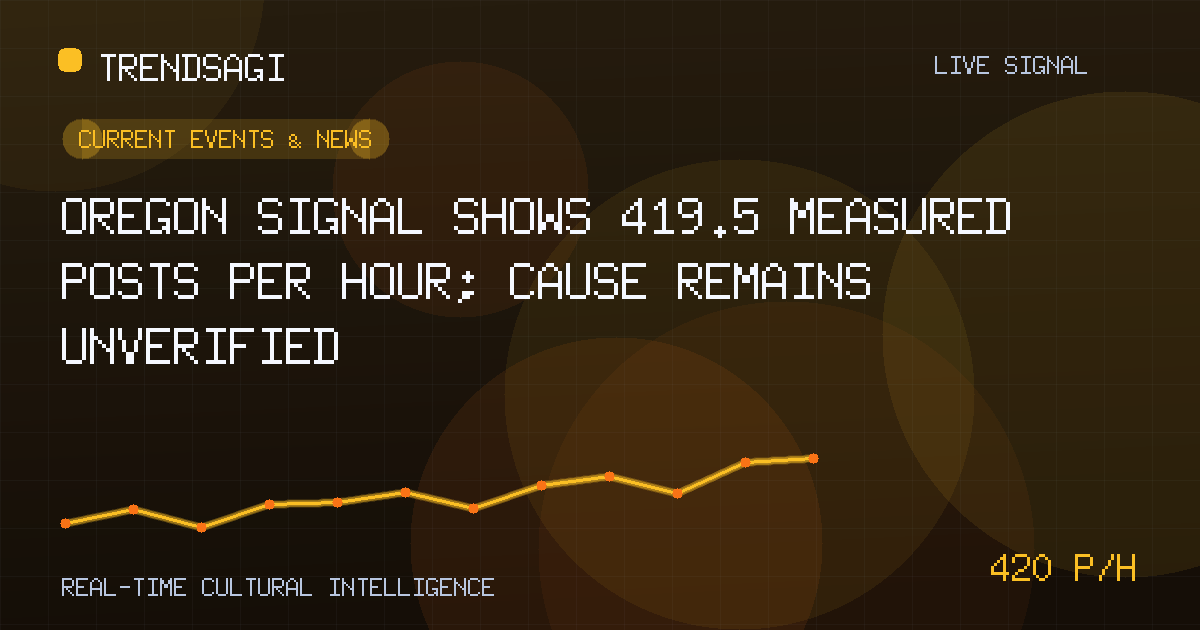
Oregon signal shows 419.5 measured posts per hour; cause remains unverified
Oregon-labeled activity measured 419.5 posts per hour; this briefing explains the known change, unresolved cause, limitations, and next checks.
Automated briefing. Generated from stored signal measurements and source-backed research; it is not manually reviewed. Read the methodology and limitations.
Metrics in this briefing are a snapshot associated with its publication date and may not reflect current conditions.
What changed
The latest Oregon-labeled signal shows a measured snapshot rate of 419.5 posts per hour, with 297 posts in the snapshot observed at 2026-09-27T11:54:37Z. The short-window movement is measurable, but the available record does not establish why the topic is moving.
The rate comes from 3 stored observations across an exact 901-second window. It is a measured snapshot rate, not a live or current rate, forecast, reach estimate, engagement count, or unique-person count. No specific triggering event has been independently verified, so the responsible description is an unexplained rise in Oregon-labeled posting activity—not a confirmed breaking-news trend.
| Metric | Stored value |
|---|---|
| Observation time | 2026-09-27T11:54:37Z |
| Measured snapshot rate | 419.5 posts/hour |
| Measurement basis | Exact 901-second window; 3 stored observations |
| Latest snapshot volume | 297 posts |
Why this topic may be moving
The stored record does not identify a trigger. Oregon is a broad label that can refer to a place, an event, a person, a team, or a wider state-related discussion; without post-level examples, the record cannot show which meaning is dominant. The category label Current Events & News is a classification, not evidence that any particular event caused the movement.
Possible explanations include a breaking development, scheduled activity, a policy debate, a weather or safety incident, a sports result, or widely reposted content. These are hypotheses, not verified facts about this signal. Without event-level public context, choosing among them would turn an unexplained measurement into a speculative headline.
The measured rate establishes a change in posting activity, not the identity of the event, the people behind the posts, or the veracity of their claims.
What the signal can establish
The signal directly supports a narrow operational conclusion: captured posting activity changed at the stated rate during the defined window, and the latest snapshot contained the stated volume. That is enough to justify rapid checking, not enough to characterize the subject matter.
It does not show:
- which event, decision, or incident produced the posts;
- whether authors are in Oregon or merely posting about the label;
- how many distinct people or organizations participated;
- reach, engagement, sentiment, agreement, or factual accuracy;
- whether material is original, reposted, duplicated, or automated;
- whether the movement persists beyond the short observation window.
Why it matters
The audience for this briefing is not only trend watchers. It matters to people deciding whether the topic requires immediate verification or sustained monitoring.
- News editors and reporters need to know that volume alone cannot support a headline, sourcing, or story framing until the trigger is verified.
- Civic, public-service, and community teams can use the alert to check for emerging information needs, safety claims, or service disruption, while avoiding unsupported public claims.
- Researchers and communications teams need to separate intensity from representativeness: many posts do not establish broad public opinion, and a short increase is not necessarily a durable trend.
What to watch next
The next useful step is a structured verification pass, followed by comparable monitoring.
- Inspect the underlying records. Review the actual post text, timestamps, source types, and topic labels. Look for repeated names, phrases, locations, or claims that reveal a common event; preserve the distinction between original posts and duplicates.
- Verify the trigger. Check whether an official statement, established local report, or another attributable public source corresponds to the same time and subject. If none does, retain the cause-unknown label.
- Test persistence. Compare subsequent 901-second windows using the same collection and classification method. A return to normal would indicate a burst; continued elevation would support a more sustained pattern, though still not a forecast.
- Measure concentration. Ask whether activity comes from many distinct sources or a small set repeatedly posting the same material. Concentration and duplication can inflate apparent momentum without adding independent information.
- Check relevance. Confirm that posts concern Oregon in the intended sense and are not dominated by incidental uses of the word. Geographic and semantic checks are essential before drawing a local conclusion.
Concrete watch signals are repeated event-specific terms, a diverse source mix, persistence in later comparable windows, and a verified public development that matches the captured posts. A rapid fade, heavy duplication, or failure to find a matching event would instead favor treating this as a short-lived or misclassified burst.
Methodology and limitations
The measurement is precise within its stated design: 419.5 posts per hour from 3 stored observations over 901 seconds, with the latest snapshot recorded at 2026-09-27T11:54:37Z. Precision describes the calculation; it does not remove collection bias, missing context, or uncertainty about cause.
The latest snapshot volume of 297 posts is a point-in-time count, not a rate. The available record does not provide a longer baseline, raw post text, source identities, engagement, geographic verification, collection coverage, or the topic-classification method. Those omissions prevent conclusions about uniqueness, influence, sentiment, or public consensus.
Accordingly, the defensible finding is a short-window rise in Oregon-labeled posting activity with no verified explanation yet. The right next move is not to amplify the label, but to identify the underlying records, verify the event, and test whether the movement persists.
Track This Topic for New Signals
Set alerts for future velocity or sentiment changes around this topic.
Explore Tracking PlansAbout TrendsAGI research
TrendsAGI's automated research pipeline publishes dated signal snapshots, methodology notes, and practical workflows for teams evaluating cultural momentum. Read how signals are scoped, scored, and limited in our research methodology.