1005-second window · 2 observations · Measured Oct 8, 2026, 8:56 PM UTC · Provider: go_recent_snapshot_v2
OpenAI snapshot: 1411 posts and a measured 2187.9 posts/hour rate
OpenAI's latest snapshot had 1411 posts and a measured 2187.9 posts/hour rate; here is what is known, unclear, and worth checking next.
Automated briefing. Generated from stored signal measurements and source-backed research; it is not manually reviewed. Read the methodology and limitations.
Metrics in this briefing are a snapshot associated with its publication date and may not reflect current conditions.
What changed
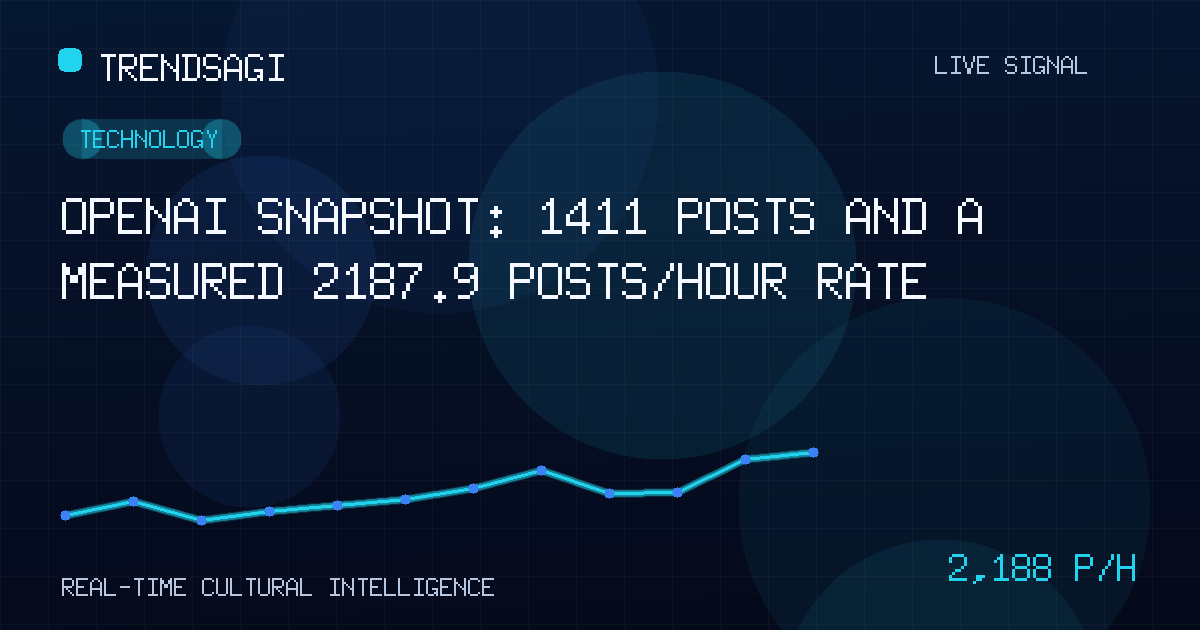
OpenAI-related posting activity registered a measured rise, with 1411 posts in the latest snapshot at 2026-10-08T20:56:23Z. The measured snapshot rate was 2187.9 posts/hour over an exact 1005-second window using 2 stored observations. Together, these figures establish a concentrated burst of discussion at that observation, but they do not identify the event behind it.
The direct takeaway is that OpenAI became a high-velocity monitoring topic at that moment. No specific public catalyst has been verified for this increase, so the reason it was moving remains unclear. The 2187.9 posts/hour figure describes the measured snapshot, not a live or current rate, and it should not be read as a forecast, reach, or audience size.
| Metric | Stored observation |
|---|---|
| Observation time | 2026-10-08T20:56:23Z |
| Measured snapshot rate | 2187.9 posts/hour |
| Latest snapshot volume | 1411 posts |
Why this topic may be moving
A topic label captures conversation, not its cause. Without post text, linked pages, account types, geography, or a time series longer than the stated window, several explanations remain possible rather than established:
- A dated announcement or publication connected to OpenAI may have started or amplified discussion.
- A news report, criticism, legal or policy development, or response by another organization may have widened the audience.
- A widely shared statement, debate, or criticism may have prompted reaction from accounts that were not examining the underlying issue in depth.
- Repeated copying, automated activity, or a change in collection coverage may have raised the post count without equivalent growth in distinct authors.
- The burst may be part of a recurring discussion cycle rather than a new event.
None of these possibilities is verified by the stored figures alone. Assigning the increase to a specific announcement, controversy, or wider trend without matching timestamps and source evidence would be speculation.
Why it matters
The practical significance is triage: a fast-moving topic can require rapid verification before teams respond, even when the cause is unknown. Researchers and editors should resist converting volume into importance, while communications teams should avoid treating every post as independent confirmation.
A high posting rate shows how quickly conversation appeared, not why it appeared, who participated, or whether it represented meaningful new interest.
What the signal establishes
- The latest stored snapshot contained 1411 posts.
- The measured change rate was 2187.9 posts/hour for the stated window.
- OpenAI warranted closer monitoring at the observation time.
It cannot establish who posted, whether participants agreed, whether the content was true, or whether the burst produced any real-world outcome. It also cannot show how the event compares with OpenAI’s normal baseline because no baseline is supplied. The topic label alone does not reveal whether posts concerned company news, a specific product, or an unrelated use of the name.
Who should care
The people most likely to need this briefing are teams with direct exposure to the conversation:
- News editors and fact-checkers need the increase separated from an unverified story.
- OpenAI communications, product, and policy teams need the initiating source and audience reaction identified.
- Researchers and analysts need deduplicated, source-diverse data before drawing conclusions about attention.
- Technology leaders and investors should treat the burst as a monitoring input, not evidence of business or market impact.
For all of these readers, the immediate action is validation rather than explanation. A plausible narrative is less valuable than a timestamped fact that can be checked.
What to watch next
The next useful checks should distinguish persistence, origin, breadth, and confirmation.
- Repeat the measurement. Compare another exact 1005-second window with the 2187.9 posts/hour benchmark. Another elevated result would strengthen the case for sustained attention; a sharp drop would make the initial burst appear more event-specific.
- Find the earliest substantive posts. Work backward from the observation time to identify what appeared first, then separate original contributions from reposts and near-duplicate wording.
- Cluster the content. Group posts by the issue being discussed and by linked source. One dominant story suggests a shared catalyst; unrelated clusters suggest broader attention or noisy measurement.
- Verify the apparent trigger. Use dated public search results to confirm any claimed announcement or event. Look for direct confirmation and independent reporting with matching timestamps; do not rely on an unexplained increase in posts.
- Check audience composition. Determine whether activity came from distinct accounts, a small set of highly active accounts, or automated patterns. This changes what the volume means.
- Watch for confirmation or fade. Track whether official OpenAI material, credible publishers, or other relevant organizations add dated context. Also compare later snapshot volume with 1411 rather than assuming the latest count will persist.
A strong follow-up signal would be repeated elevated activity combined with multiple independent content clusters and verified public context. A weak follow-up would be high volume that collapses quickly, traces mainly to one repeated source, or lacks confirmation.
Methodology and limitations
This briefing uses the stored Technology-category observation for OpenAI at 2026-10-08T20:56:23Z. The reported 2187.9 posts/hour is a measured snapshot rate based on 2 stored observations over an exact 1005-second window. The latest snapshot volume is 1411 posts. Volume and rate are separate: the post count is not a rate, and the rate is not a count of people.
The record does not provide the earlier raw observation, collection settings, post-level samples, sentiment, geography, or source distribution. Those gaps prevent independent reproduction and block conclusions about cause, reach, or significance. No external event is presented as fact because no specific catalyst could be verified. Readers should use the figures as a historical alert and remeasure before acting.
Track This Topic for New Signals
Set alerts for future velocity or sentiment changes around this topic.
Explore Tracking PlansAbout TrendsAGI research
TrendsAGI's automated research pipeline publishes dated signal snapshots, methodology notes, and practical workflows for teams evaluating cultural momentum. Read how signals are scoped, scored, and limited in our research methodology.