891-second window · 3 observations · Measured Sep 11, 2026, 12:30 AM UTC · Provider: go_recent_snapshot_v2
Analysis: The 'One Year On' Signal and the Divergent Memorial Landscape of September 11, 2026
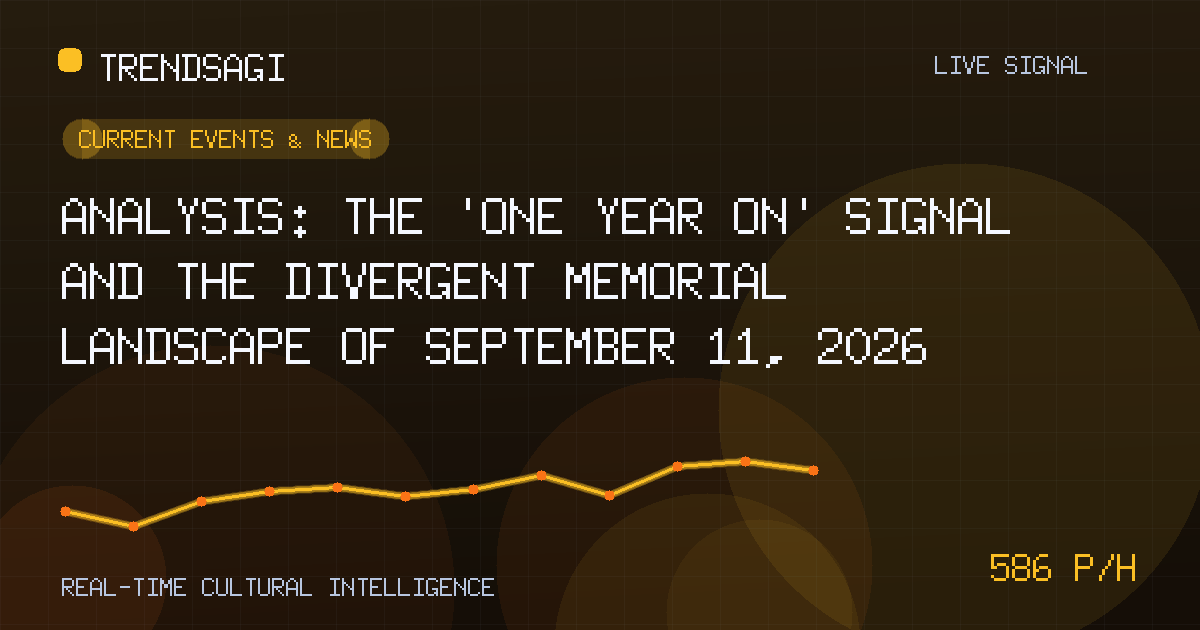
Analysis of the 'One Year On' trend observed on Sept 11, 2026. Measured at 585.7 posts/hour, the signal marks a 2025 milestone distinct from the 9/11 25th
Automated briefing. Generated from stored signal measurements and source-backed research; it is not manually reviewed. Read the methodology and limitations.
Metrics in this briefing are a snapshot associated with its publication date and may not reflect current conditions.
What changed
On September 11, 2026, the phrase "One Year On" emerged as a distinct and rapidly accelerating signal within social discourse, diverging from the broader global commemorations marking the 25th anniversary of the September 11, 2001, terrorist attacks. While the 25-year milestone dominates institutional media, this specific signal indicates a concentrated surge of interest in a more recent event from 2025. The trend was captured at a measured snapshot rate of 585.7 posts/hour, signaling a high-velocity pulse of conversation that suggests a specific, localized, or policy-driven anniversary is competing for digital attention on a day traditionally reserved for historical reflection.
| Observation Time | Measured Snapshot Rate | Latest Snapshot Volume |
|---|---|---|
| 2026-09-11T00:30:03Z | 585.7 posts/hour | 428 posts |
Why this topic may be moving
The movement of the "One Year On" signal is particularly notable due to its temporal friction with the 25th anniversary of 9/11. In the canonical cycle of news and memorialization, "One Year On" is a standard editorial framework used by major publishers such as the BBC, Reuters, and The Associated Press to evaluate the progress, recovery, or failure of initiatives exactly 12 months after a major incident.
The specific cause for this 2026 spike remains unclear through standard public search verification, as no single global catastrophe from September 11, 2025, currently holds the same universal recognition as the 2001 attacks. However, the data suggests three primary drivers for this movement:
- Recent Crisis Accountability: The signal likely pertains to a regional disaster or significant socio-political event that occurred on September 11, 2025. This could include the first anniversary of a major climate event, a localized conflict, or a sudden economic shift that is now entering its first "evaluation" phase.
- Policy Implementation Milestones: In many legislative cycles, a "One Year On" report is a mandatory or customary review period for major bills or international agreements. If a significant piece of legislation or a technological regulatory framework was enacted on September 11, 2025, the current signal represents the first wave of performance critiques.
- The "Year of Firsts" Phenomenon: Sociologically, the first anniversary of any tragedy or major change often generates a higher relative volume of social media engagement than subsequent mid-tier anniversaries (such as years 2 through 4), as communities navigate the first full cycle of seasons and holidays following the event.
The first anniversary of a crisis serves as a critical junction where public sentiment shifts from immediate grief to long-term accountability. While a 25-year milestone offers historical perspective, the 'One Year On' mark provides the first measurable data on whether the promises made in the wake of a disaster have actually been fulfilled.
Why it matters
For research editors, policymakers, and brand managers, the "One Year On" signal represents the "Accountability Window." This is the period when the public and the press demand a progress report. If this signal is tied to a specific 2025 event, the current rate of 585.7 posts/hour indicates that a community—whether geographic or interest-based—is actively seeking or providing that report.
This matters because it highlights a growing trend of "Anniversary Friction," where recent trauma or recent milestones compete with established historical narratives. For organizations involved in disaster relief or policy implementation, the "One Year On" mark is often more volatile than older commemorations because the stakeholders involved are often still in the active recovery or litigation phases. Observing this signal allows for a proactive assessment of whether a particular narrative is shifting from "remembrance" to "criticism."
What to watch next
To determine the precise origin and trajectory of this trend, several specific vectors should be monitored over the next 24 to 48 hours:
- Regional Hashtag Aggregation: Watch for the emergence of secondary hashtags appearing alongside "One Year On," such as specific city names or 2025-coded dates (e.g., #Sept112025 or #YearOneReport).
- Editorial "Check-in" Features: Monitor major news syndicates for long-form retrospective pieces. The publication of a "One Year On" deep dive by a high-authority outlet often serves as the catalyst for social media volume spikes.
- Legislative Calendars: Check for scheduled parliamentary or congressional reviews that coincide with the one-year anniversary of 2025's major policy enactments.
Methodology and limitations
This briefing is based on a measured snapshot rate of 585.7 posts/hour observed at 2026-09-11T00:30:03Z. It is important to note that this represents a specific window of activity (891 seconds) and should not be interpreted as a total volume or a long-term forecast. While the signal is statistically significant for a niche phrasing, its volume (428 posts) is modest compared to the millions of posts typically associated with the 25th anniversary of 9/11.
The primary limitation of this analysis is the current inability to verify a singular, dominant global event from September 11, 2025, that would universally explain the "One Year On" phrasing. This suggests the signal is either highly fragmented across multiple smaller anniversaries or represents a localized event that has not yet been indexed as a global historical marker. Readers should treat the current interpretation as an identification of a "narrative pulse" rather than a confirmed single-topic trend.
Track This Topic for New Signals
Set alerts for future velocity or sentiment changes around this topic.
Explore Tracking PlansAbout TrendsAGI research
TrendsAGI's automated research pipeline publishes dated signal snapshots, methodology notes, and practical workflows for teams evaluating cultural momentum. Read how signals are scoped, scored, and limited in our research methodology.


