916-second window · 3 observations · Measured Oct 3, 2026, 12:57 PM UTC · Provider: go_recent_snapshot_v2
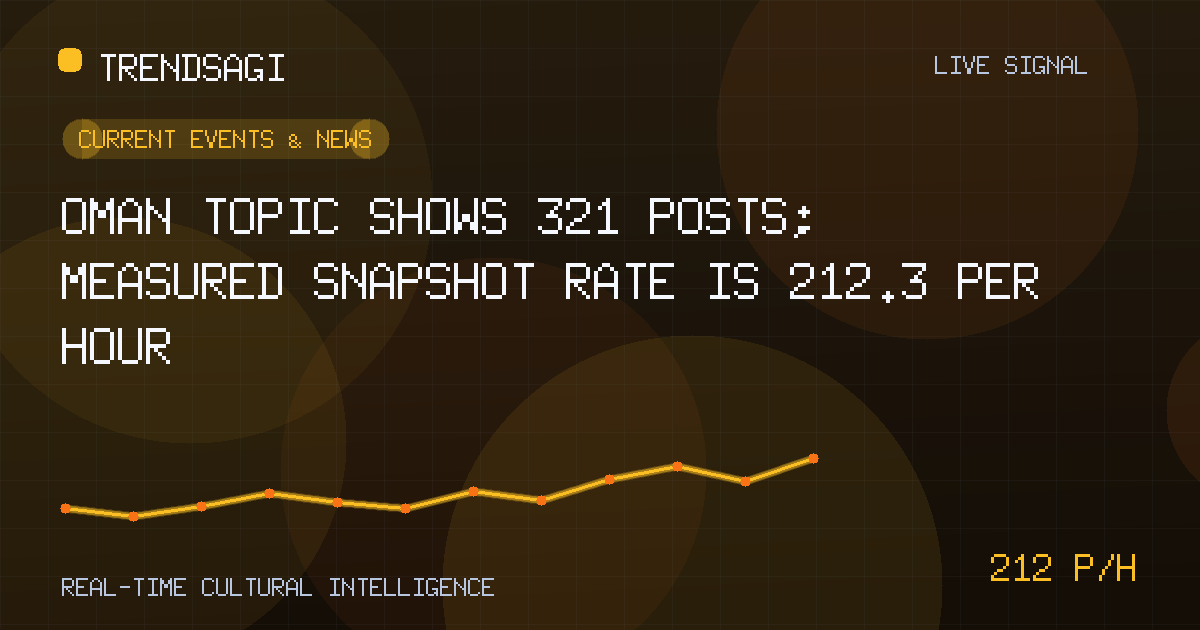
Oman topic shows 321 posts; measured snapshot rate is 212.3 per hour
Oman’s latest signal contains 321 posts and a measured snapshot rate of 212.3 posts per hour; here is what is known, unknown, and worth checking next.
Automated briefing. Generated from stored signal measurements and source-backed research; it is not manually reviewed. Read the methodology and limitations.
Metrics in this briefing are a snapshot associated with its publication date and may not reflect current conditions.
What changed
The latest stored snapshot for “Oman” shows 321 posts, while the measured snapshot rate is 212.3 posts/hour. The direct conclusion is deliberately narrow: within the monitored sample, posts were arriving at that pace during the defined measurement window. The available evidence does not establish which event, claim, or type of content drove the activity.
The rate was measured at 2026-10-03T12:57:04Z across an exact 916-second window using three stored observations. It is not a live rate, forecast, reach estimate, engagement measure, or count of unique people. Without a previous comparable snapshot or baseline, the figures also cannot show whether the pace is unusual for Oman-related conversation.
| Signal measure | Observed value |
|---|---|
| Observation time | 2026-10-03T12:57:04Z |
| Latest snapshot volume | 321 posts |
| Measured snapshot rate | 212.3 posts/hour |
| Measurement basis | Exact 916-second window; 3 stored observations |
Why this topic may be moving
The strongest defensible answer is that the cause remains unverified. No named event, official statement, or other public development is identified in the available context. It would therefore be speculative to attribute the activity to a particular political, economic, sporting, or social story.
A short-window rate such as this can have several explanations, all of which require testing:
- A new or scheduled Oman-related event may be generating timely reactions.
- An older story may have resurfaced after being recirculated.
- Several independent conversations may be converging on the same subject.
- Repeated posts, reposts, or closely copied wording may inflate apparent activity.
- A change in collection coverage, topic classification, or query behavior may affect the sample.
- Unrelated uses of the word “Oman” may be grouped under one broad label.
Until the underlying posts are reviewed and the timing is matched to verified public reporting, these remain hypotheses rather than findings.
Within this monitored sample, 212.3 posts/hour measures the pace of observed posts—not the importance, accuracy, reach, or sentiment of the conversation.
Why it matters
A short-window country signal is most useful as a prompt for rapid verification. The volume tells editors and communicators where to look, but it does not tell them what happened. A label can combine breaking news, practical information, cultural discussion, criticism, travel questions, or unrelated mentions of the country’s name. Those situations require very different responses.
Newsrooms should inspect the source posts before turning the signal into a story premise. Editors, public-sector communications teams, and organizations monitoring Oman-related operations or reputation can use it to prioritize a verification pass. Researchers need the underlying sample before drawing conclusions about participation or sentiment. Community leaders and customer-support teams may also need to determine whether a specific question or claim is being repeated.
Volume alone should not be treated as evidence of public anger, consensus, or crisis. Even a large number of posts can come from a narrow set of accounts, repeated material, or a single subtopic. The useful question is not merely whether many posts exist, but whether they are independent, relevant, and connected to a verifiable development.
What the signal can—and cannot—establish
It can establish a timestamped snapshot count, a measured short-window posting pace, and a reference point for later comparison. Subject to consistent collection methods, subsequent snapshots could show whether activity persists, changes, or dissipates.
It cannot establish:
- the event or information that triggered the activity;
- whether the rate is above or below a normal baseline;
- the number of distinct authors or people exposed;
- whether a post is original, copied, reposted, or automated;
- the sentiment, factual accuracy, or importance of the claims;
- where a post was produced or whether its author is physically in Oman; or
- whether the topic label reflects a specific event rather than broad country-related mentions.
What to watch next
- Inspect the source sample. Review the earliest available posts, their timestamps, linked media, named places, recurring wording, and the claims receiving the most repetition. This is the fastest way to distinguish a coherent event from unrelated uses of the label.
- Verify a named trigger. Check whether credible reporting or an official statement identifies a specific development at the same time. A match in subject and timing would support an explanation; topical similarity alone would not.
- Separate breadth from repetition. Look for independently authored material and identify duplicated text, reposts, quote-posts, and repeated media. A large post count with little original discussion should be interpreted differently from broad activity across distinct sources.
- Compare comparable snapshots. Preserve the same topic definition and check whether later measured snapshot rates remain near 212.3 posts/hour, rise, or fall. Compare rate and snapshot volume together rather than treating either number as a complete trend.
- Watch for convergence. Concrete confirmation signals would include independent credible reports identifying the same event, an official response using the same description, and later snapshots containing varied original posts on that subject.
- Watch for weakening explanations. A changing query, heavy duplication, concentration in one account, or later snapshots dominated by unrelated meanings of “Oman” would weaken the case for a unified trend.
Also monitor corrections, changes in language or geographic focus, and shifts from general mentions to a specific claim. These qualitative developments can explain the activity more effectively than volume by themselves.
Methodology and limitations
The briefing uses the stored observation at 2026-10-03T12:57:04Z. The reported measured snapshot rate of 212.3 posts/hour comes from three stored observations over an exact 916-second window. The separate snapshot volume is 321 posts; it is a count at the observation time, not a rate.
Because the window is short and the observation count is limited, a brief burst could strongly affect the result. No platform coverage, collection method, query definition, language mix, account-level data, engagement data, geographic metadata, prior baseline, or verified triggering context is available. The rate therefore should not be extrapolated beyond its measurement window or interpreted as a measure of public reach. A later assessment should retain the timestamp, window, observation count, snapshot volume, and topic definition so that change is measured on a comparable basis.
Track This Topic for New Signals
Set alerts for future velocity or sentiment changes around this topic.
Explore Tracking PlansAbout TrendsAGI research
TrendsAGI's automated research pipeline publishes dated signal snapshots, methodology notes, and practical workflows for teams evaluating cultural momentum. Read how signals are scoped, scored, and limited in our research methodology.


