1026-second window · 3 observations · Measured Sep 30, 2026, 7:56 AM UTC · Provider: go_recent_snapshot_v2
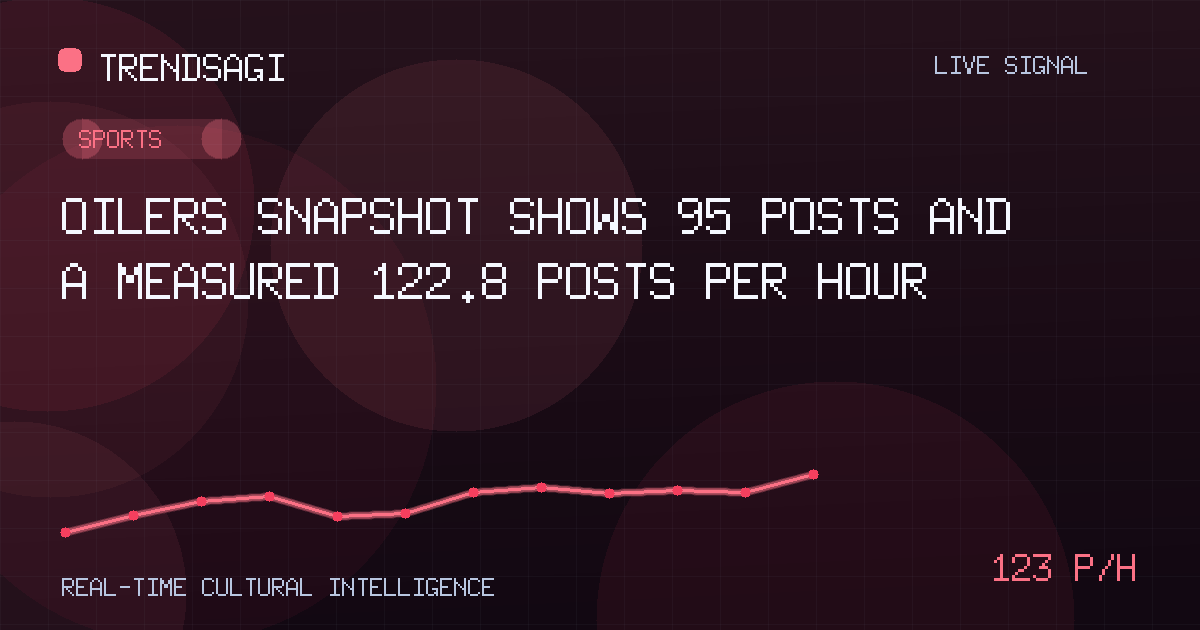
Oilers snapshot shows 95 posts and a measured 122.8 posts per hour
The latest Oilers snapshot has 95 posts and a measured 122.8 posts/hour; the pace is clear, its trigger is unverified, and these checks help.
Automated briefing. Generated from stored signal measurements and source-backed research; it is not manually reviewed. Read the methodology and limitations.
Metrics in this briefing are a snapshot associated with its publication date and may not reflect current conditions.
What changed
The latest Oilers snapshot records an active cluster of discussion, but not a verified explanation for it. At 2026-09-30T07:56:14Z, the snapshot contained 95 posts. That warrants a rapid editorial check, yet no verified public context establishes that a game result, roster move, injury, controversy, or other specific event triggered the cluster. The cause remains unclear and should be treated as unconfirmed.
The measured snapshot rate is 122.8 posts/hour over an exact 1026-second window based on 3 stored observations. It describes posting pace only within that measured slice. It is not a live or current rate, a forecast, reach, engagement, or a unique-person count. The 95 posts are the separate snapshot volume, not another rate. Together, the figures establish a concentrated period of activity; without an earlier comparable baseline, they do not show how unusual that pace is or whether attention is still rising.
| Observation time | Measured snapshot rate | Snapshot volume |
|---|---|---|
| 2026-09-30T07:56:14Z | 122.8 posts/hour | 95 posts |
Why this topic may be moving
No verified public report or first-party announcement accompanying the signal aligns with the timestamp. The Oilers label and Sports category make an Edmonton Oilers interpretation plausible, but they do not prove which entity or narrative is driving the posts. A cause should be assigned only when a dated development can be matched to the observation window.
Several explanations remain hypotheses:
- Game or schedule reaction: Check official match reports, schedule updates, or postgame commentary published before and during the window. A game-related response is plausible, not established.
- Roster or injury news: Look for timestamped team, league, or player announcements and corroborating reporting. Similar language alone is not confirmation.
- Controversy or viral media: Determine whether a repeated quote, image, or clip connects the posts, then trace it to a primary statement or reported fact rather than assume backlash.
- Broader seasonal attention: If no single event aligns, check whether conversation is distributed across routine hockey coverage rather than concentrated on one issue.
If none of those checks produces a time-matched source, the defensible explanation is simply that the reason remains unresolved. Repetition by itself does not reveal whether fans are reacting to news, debating an older issue, or amplifying the same post.
A concentrated short-window posting rate is a reason to investigate, not proof of the event that caused it. The number identifies where to look; verified, time-matched reporting must establish why.
Why it matters
Editors and newsrooms should care because a concentrated social signal can speed verification, but it should determine where to look, not what happened. Publishing an unverified cause would turn a measurable activity pattern into an unsupported story claim. The immediate conclusion is limited to active Oilers posting during the measured window.
Audience, community, and reputation teams should care because apparent momentum can be misleading if it comes from repeated posts, a narrow set of accounts, or one platform. The available figures do not reveal that distribution, so they cannot establish broad consensus, public sentiment, or reputational impact.
Researchers and analysts should care because 3 observations across one narrow window are a monitoring signal, not a stable estimate of normal behavior. Repeated comparable windows and entity-level coding are needed before describing the activity as a sustained trend, an acceleration, or a broad audience shift.
What to watch next
- Persistence: Compare the next like-for-like window with 122.8 posts/hour, and compare its snapshot volume with 95 posts separately. Repeated readings are needed before calling the burst sustained; one window can be transient.
- Timing: Check whether an official update, game report, interview, or reported article appeared before or during the exact 1026-second window. Record the publisher and publication time. Material published afterward may describe the reaction rather than cause it.
- Entity resolution: Review the posts and hashtags for location, team, player, and topic cues. Confirm that the cluster concerns the intended Oilers entity before applying hockey context.
- Concentration: Examine repost frequency, repeated wording, linked media, and account overlap. This helps distinguish broad discussion from a narrow amplification pattern, but cannot by itself label activity artificial.
- Narrative: Code the principal claims, then look for a primary statement and independent reporting that support them. Do not infer an injury, controversy, result, or sentiment from keywords alone.
- Context: Compare earlier and following windows and check whether activity spans platforms, languages, or regions. That will show whether the movement is locally contained, cross-platform, or associated with one audience.
Methodology and limitations
The measured snapshot rate of 122.8 posts/hour comes from 3 stored observations over the exact 1026-second window measured at 2026-09-30T07:56:14Z. The latest snapshot contains 95 posts. The rate is historical to that observation, not live after it, and it does not measure unique participants, engagement quality, sentiment, geography, or platform coverage. Snapshot volume and posting rate answer different questions and should remain separate.
The record does not provide an earlier baseline, collection coverage, deduplication method, language mix, geographic mix, or verified causal context. As a result, this briefing cannot say whether the pace is exceptional, whether activity is accelerating, who dominates the conversation, or why it occurred. The most reliable conclusion is narrow: the measured window was active, while the trigger remains unverified.
Track This Topic for New Signals
Set alerts for future velocity or sentiment changes around this topic.
Explore Tracking PlansAbout TrendsAGI research
TrendsAGI's automated research pipeline publishes dated signal snapshots, methodology notes, and practical workflows for teams evaluating cultural momentum. Read how signals are scoped, scored, and limited in our research methodology.