885-second window · 3 observations · Measured Oct 4, 2026, 1:26 AM UTC · Provider: go_recent_snapshot_v2
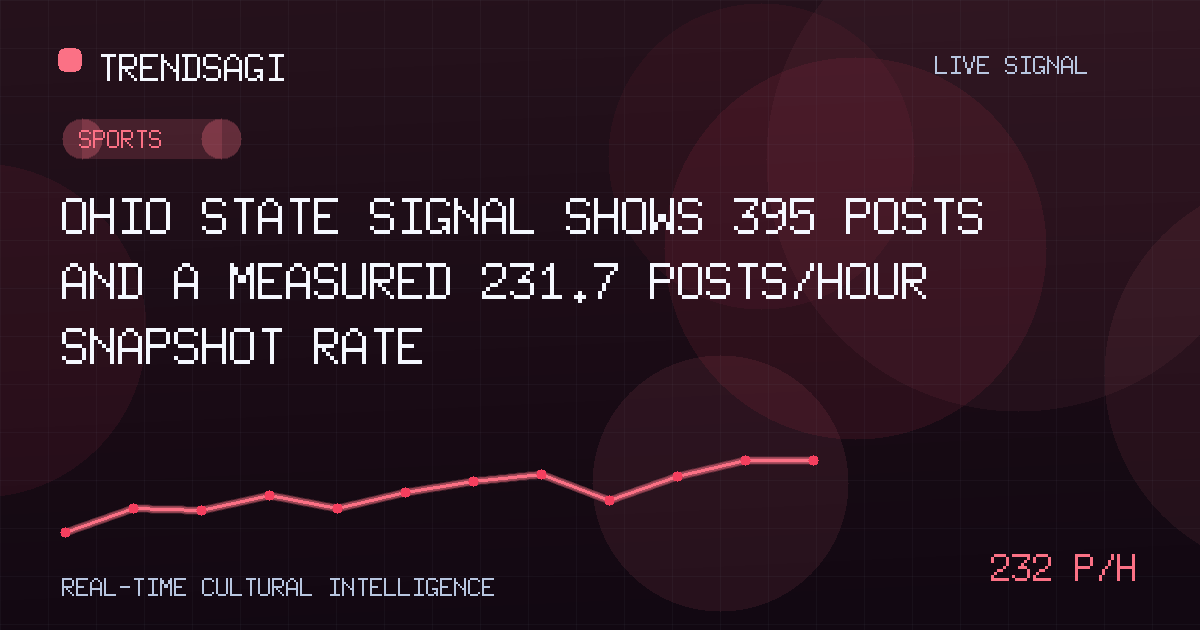
Ohio State signal shows 395 posts and a measured 231.7 posts/hour snapshot rate
Ohio State shows 395 posts and a measured 231.7 posts/hour snapshot rate; the verified reason for movement remains unclear.
Automated briefing. Generated from stored signal measurements and source-backed research; it is not manually reviewed. Read the methodology and limitations.
Metrics in this briefing are a snapshot associated with its publication date and may not reflect current conditions.
What changed
Direct answer: The stored “Ohio State” signal shows positive movement in captured conversation. At 2026-10-04T01:26:09Z, the latest snapshot contained 395 posts, and the supplied series records a measured snapshot rate of 231.7 posts/hour over an exact 885-second window using 3 stored observations. No verified public context links that movement to a specific sports event, announcement, or controversy.
The two figures answer different questions. Snapshot volume reports how many posts were present in the latest capture; the measured posts/hour figure reports the rate calculated across the stated observation window. It is not a live or current rate, a forecast, reach, engagement, or a count of unique people. The stored record also supplies no historical baseline against which to judge whether this is unusual for the label.
| Observation time | 2026-10-04T01:26:09Z |
|---|---|
| Measured posts/hour | 231.7 posts/hour |
| Snapshot volume | 395 posts |
| Measurement basis | Exact 885-second window; 3 stored observations |
The rate should not be added to or blended with the 395-post volume. One is a measured change rate; the other is a captured count, and combining them would create a misleading total. The defensible conclusion is that the series moved during the measured window, while the reason for that movement remains unconfirmed.
Why this topic may be moving
There is no defensible event attribution yet. The label is broad, the stored category is Sports, and the supplied description contains no finer detail. The following are mechanisms to test, not findings:
- Event-driven attention. If the label refers to Ohio State University athletics, a game result, schedule update, roster matter, or controversy could prompt concentrated discussion. The record identifies none of those occurrences.
- News-cycle pickup. Reporting or social posts from a small set of accounts could recirculate one development and raise the number of captured posts. No source concentration is supplied.
- Audience participation. Reactions from students, alumni, supporters, or casual observers could differ in tone while sharing the same label. That possibility cannot establish sentiment or intent.
- Classification or collection effects. A broad entity label, repeated content, or the timing of the capture could affect volume without representing 395 distinct real-world reactions.
A causal explanation should require both a verified public development and evidence that contemporaneous posts explicitly referred to it. Neither condition is established here, so it would be premature to name a game, announcement, or incident as the trigger.
The strongest defensible conclusion is movement in the number of captured posts, not a verified explanation for why “Ohio State” is being discussed.
Why it matters
For media and communications teams, the signal is an early prompt to inspect the conversation, not proof that a major event occurred. A rapid operational response should wait until the catalyst, source mix, and audience geography are known. Replying to the wrong entity or assuming a crisis could amplify confusion.
For sports editors and analysts, the distinction between volume and rate prevents bad comparisons. The 395-post snapshot may be useful for sizing the latest capture, while 231.7 posts/hour is useful only for describing the supplied change measurement. Neither establishes how many people saw the posts, how many expressed support or criticism, or whether the pattern will continue.
For readers, the most important unanswered question is simple: what concrete development connects these posts to the label? Until that is verified, the signal indicates attention worth checking but does not justify claims about a result, controversy, or institutional crisis.
What to watch next
The next checks should separate a real news catalyst from a broad or duplicated conversation:
- Persistence. Compare the next stored snapshots using the same label definition, capture method, and exact 885-second measurement window. Movement in one window may reflect a transient burst; repeated positive movement under the same method would provide stronger evidence of a sustained topic.
- Earliest substantive posts. Inspect the earliest posts near the measured window to identify what they explicitly discuss. Their claims and links—not the aggregate label alone—should guide verification.
- A verifiable catalyst. Look for a contemporaneous public report or first-party announcement with a timestamp that matches the sequence of posts. Do not assign causality merely because a news item appeared nearby.
- Source concentration. Determine whether volume is distributed across distinct accounts or dominated by a publisher, team, fan account, or automated repost pattern. Concentration changes the interpretation of apparent public attention.
- Content mix. Separate original reactions from copied headlines, highlights, questions, promotional material, and unrelated uses of “Ohio State.” This will show whether the conversation is genuinely varied or one story repeated.
- Label precision. Confirm whether the posts concern the university, its athletics program, a location, an organization, or another entity sharing the name. The Sports category provides context but does not resolve every ambiguity.
A practical decision rule is straightforward: call the movement event-driven only when a public catalyst is verified and the posts explicitly connect to it; call it sustained only when comparable observations persist; and flag possible amplification when concentration or duplication is visible. Those checks add explanation without overstating what the current count can prove.
Methodology and limitations
This briefing uses the supplied observation at 2026-10-04T01:26:09Z: 395 posts as the latest snapshot volume and 231.7 posts/hour as the measured snapshot rate over the exact 885-second window using 3 stored observations. The rate is reported exactly as supplied. It is not a live or current rate, and it does not describe forecast conditions. The snapshot count and measured rate should not be reconciled arithmetically.
Only 3 stored observations over the exact window support the reported movement but cannot establish duration, seasonality, or persistence. The record does not provide a prior baseline, sentiment, geography, platform split, post originality, author uniqueness, engagement, or reach. It also does not establish whether all posts were organic.
No supporting description identifies an event, and no contemporaneous public report or first-party announcement was verified for this briefing. Accordingly, the cause remains unclear. The appropriate next step is not a stronger narrative but better matching of the next snapshot to primary posts and verified public context.
Track This Topic for New Signals
Set alerts for future velocity or sentiment changes around this topic.
Explore Tracking PlansAbout TrendsAGI research
TrendsAGI's automated research pipeline publishes dated signal snapshots, methodology notes, and practical workflows for teams evaluating cultural momentum. Read how signals are scoped, scored, and limited in our research methodology.