938-second window · 3 observations · Measured Sep 24, 2026, 4:22 PM UTC · Provider: go_recent_snapshot_v2
Oasis: 857-post snapshot and a measured change rate of 583.3 posts/hour
An 857-post Oasis snapshot records a measured 583.3 posts/hour change. Review the cause, scope, and persistence checks before drawing conclusions.
Automated briefing. Generated from stored signal measurements and source-backed research; it is not manually reviewed. Read the methodology and limitations.
Metrics in this briefing are a snapshot associated with its publication date and may not reflect current conditions.
What changed
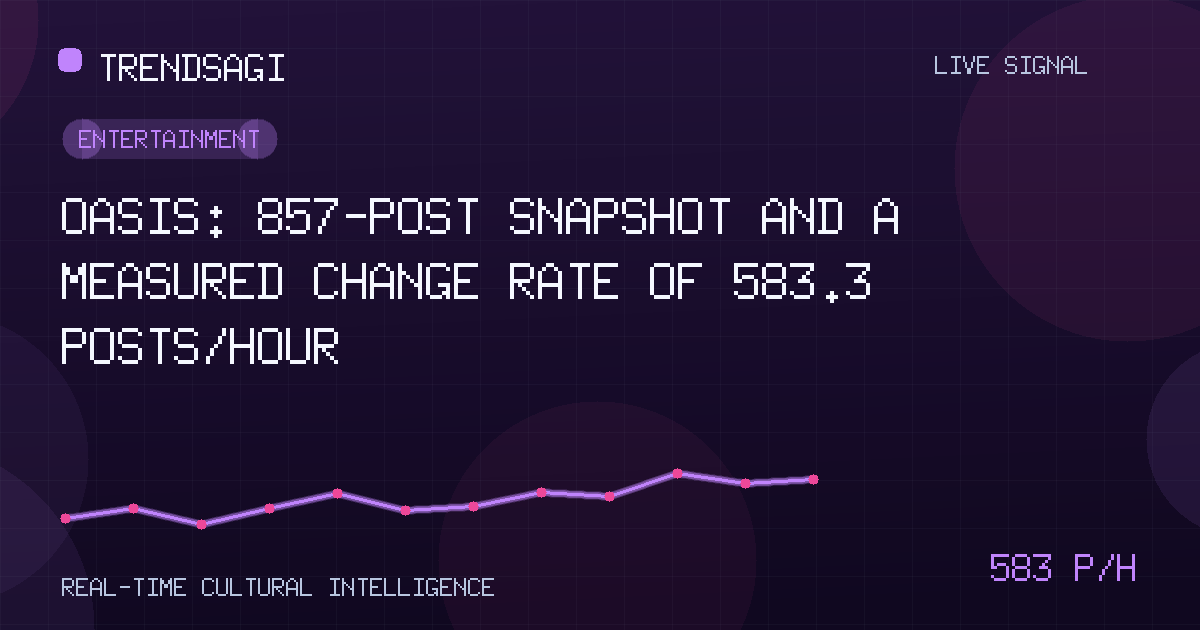
The latest stored snapshot for “Oasis” contains 857 posts. Its measured snapshot change rate is 583.3 posts/hour. The available evidence does not establish what caused the movement, so this is a monitoring lead—not a verified event recap or proof of sustained public interest.
That rate was measured at 2026-09-24T16:22:03Z over an exact 938-second window using three stored observations. It is a measured snapshot rate—not a live/current rate, forecast, reach, engagement figure, or unique-person count. The 857-post figure is snapshot volume, while 583.3 posts/hour summarizes change within the supplied window. They are not interchangeable.
| Observation time | Measured snapshot rate | Snapshot volume |
|---|---|---|
| 2026-09-24T16:22:03Z | 583.3 posts/hour | 857 posts |
Why this topic may be moving
The available record includes no verified public catalyst, so the reason for the movement is unconfirmed. The stored category is Entertainment, but that classification does not identify the people, work, or event behind the posts. “Oasis” remains a working topic label, not a verified identification of the subject.
The rate alone cannot distinguish a reaction to a specific development from repeated or duplicated posts, ambiguous keyword matching, or separate conversations sharing the same label. A plausible story is not enough. If the proposed explanation is a public event, it needs a documented connection to the same subject and to the timing of the activity. Until that connection is established, the responsible conclusion is that the tracked count changed within the measured window and its cause is unknown.
Why it matters
For editors and audience researchers, the immediate value is triage, not a verdict. The measurement identifies a short observation window worth inspecting, but it does not establish persistence or show how this topic compares with an ordinary period. A later, comparably collected snapshot would make that judgment more defensible.
For media, community, and marketing teams, the signal is a reason to check the underlying posts and public context—not evidence of sales impact, cultural reach, or audience loyalty. Those questions require different evidence, including what was posted, by whom, and whether the discussion is independent.
For readers, the key distinction is between many posts and many people. A concentrated cluster can lift a short-window change rate without demonstrating broad adoption. The supplied record does not support claims about unique users, engagement, sentiment, or geography.
Keep the interpretation proportionate: this snapshot warrants a closer look, not a definitive claim that an event is driving mass attention.
A measured change rate can prioritize investigation; it cannot, by itself, establish persistence, breadth, originality, or causation. The posts/hour figure describes movement in a tracked count—not the size or importance of the audience behind it.
What to watch next
- Collect a comparable follow-up. Use the same 938-second window, retain the observation timestamps, and record whether the count continues changing at the same measured snapshot rate. A later observation would test persistence without treating this short window as a forecast.
- Inspect raw posts across the window. Sample the beginning, middle, and end; confirm that “Oasis” is the actual subject; and separate original posts, replies, and duplicates. Preserve the matching rules so that a broader label does not silently expand the count.
- Establish the referent. Determine whether the posts concern the same person, group, work, or other entity. Do not attach a biography, nationality, catalog, or event history until the underlying posts support that identification.
- Look for a time-aligned catalyst. A verified public source would need to connect the same subject to a development during or immediately before the measured window. Attribute the publisher’s account in prose only if that connection is established; otherwise retain an explicit cause-unknown assessment.
- Check whether activity is independent. Look for multiple distinct accounts discussing the same verifiable subject, rather than a single item repeatedly appearing in the collection. This helps distinguish broader discussion from repetition without equating post totals with audience size.
- Watch concrete continuation signals. Comparable post counts in a later window, repeated references to the same subject, and multiple independently posted explanations would strengthen the monitoring case. A change in matching rules or collection coverage should be recorded as a possible break in comparability.
Methodology and limitations
Three stored observations support the reported 583.3 posts/hour measured change rate over the exact 938-second window. The 857-post value is the latest snapshot volume, not an all-time total or another rate. The measurement was recorded at 2026-09-24T16:22:03Z and should be read as a snapshot measurement, not a live/current value or projection.
Three observations are insufficient to characterize normal behavior, seasonal demand, or long-term persistence. No baseline, platform mix, geography, account deduplication, audience count, or engagement measure is supplied. The measured rate also does not indicate whether the underlying conversation is positive, negative, or neutral.
The record contains no stored description or verified public explanation for the movement. That absence limits causal reporting: the signal can direct attention, but it cannot identify the catalyst, confirm the topic’s referent, or establish cultural significance. Verification should precede any claim that “Oasis” is reacting to a particular event.
Track This Topic for New Signals
Set alerts for future velocity or sentiment changes around this topic.
Explore Tracking PlansAbout TrendsAGI research
TrendsAGI's automated research pipeline publishes dated signal snapshots, methodology notes, and practical workflows for teams evaluating cultural momentum. Read how signals are scoped, scored, and limited in our research methodology.


