3621-second window · 3 observations · Measured Oct 9, 2026, 1:54 PM UTC · Provider: go_recent_snapshot_v2
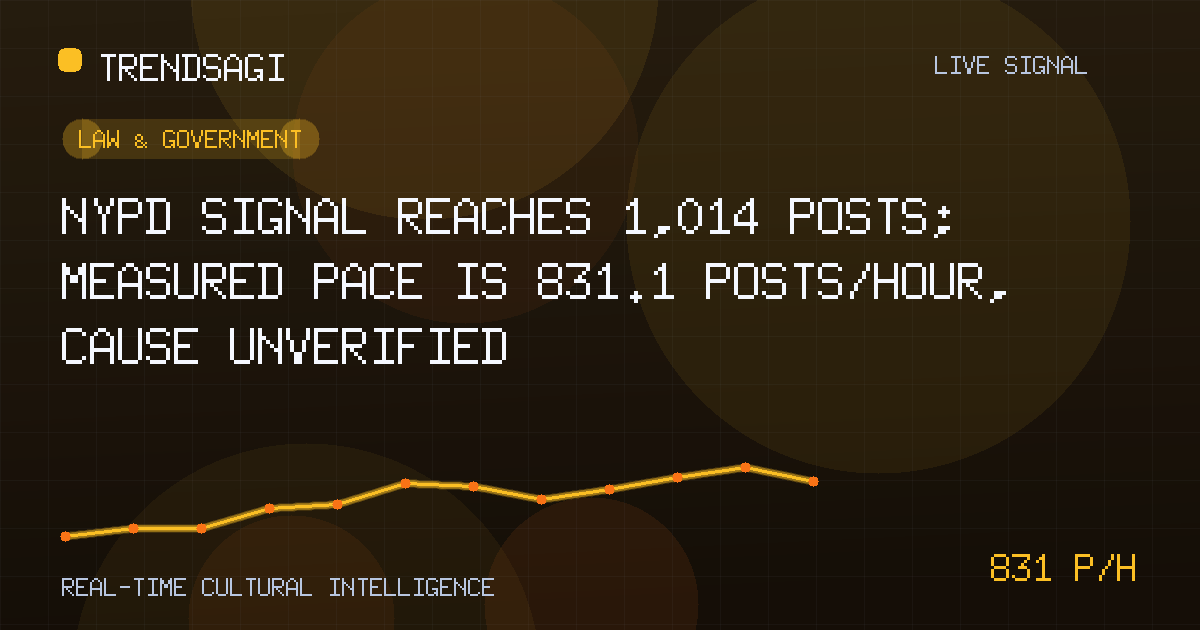
NYPD signal reaches 1,014 posts; measured pace is 831.1 posts/hour, cause unverified
The NYPD signal reached 1,014 posts, with a measured snapshot rate of 831.1 posts/hour; the catalyst is unverified and the next checks are explained.
Automated briefing. Generated from stored signal measurements and source-backed research; it is not manually reviewed. Read the methodology and limitations.
Metrics in this briefing are a snapshot associated with its publication date and may not reflect current conditions.
What changed
The NYPD label had 1,014 posts in the latest stored snapshot at 2026-10-09T13:54:03Z. The same signal records a measured snapshot rate of 831.1 posts/hour. This is a substantial short-window burst of attention, but no specific public catalyst has been verified, so it should not yet be attributed to a particular event.
The rate was measured over an exact 3,621-second window using three stored observations. It describes the observed pace within that historical window—not a live or current rate, forecast, reach, engagement level, or unique-person count. The 1,014 figure is the latest snapshot volume, not a rate.
| Observation time | 2026-10-09T13:54:03Z |
|---|---|
| Measured snapshot rate | 831.1 posts/hour |
| Latest snapshot volume | 1,014 posts |
Why this topic may be moving
The stored record establishes an increase in measured activity, but it does not establish a cause. Its Law & Government classification provides category context without identifying what the posts were discussing. There is no verified external event in the available record that can confidently explain the burst.
Several mechanisms should therefore be investigated as hypotheses rather than reported as findings:
- A time-specific development: Determine whether an announcement, incident, legal development, policy debate, protest, or other public event preceded the acceleration and specifically referenced the NYPD.
- Media amplification: Check whether one report, video, clip, or claim was repeatedly distributed and drove most of the measured posts.
- A broader issue cycle: The activity might be part of an ongoing conversation about policing or public affairs rather than a response to a fresh announcement.
- A collection or labeling effect: Repeated content, coordinated posting, or a change in how posts were classified could contribute to the volume without representing an equivalent increase in distinct participants.
The most useful causal test is chronological. A verified catalyst should appear before the acceleration, align closely with the observed timestamps, and account for a meaningful share of the posts. A later article explaining an earlier spike may add context, but it does not by itself demonstrate what triggered the activity.
Why it matters
A high-volume NYPD conversation can affect what journalists, officials, researchers, and community organizations pay attention to next. It may also indicate that a claim, image, or video is spreading quickly. However, message volume is not evidence that crime has changed, that official policy has changed, or that public opinion has shifted in a particular direction.
A large NYPD conversation is a signal to investigate, not evidence of a new NYPD event, a change in crime, or a movement in public opinion.
The distinction matters because the available figures do not reveal who posted, whether the accounts are distinct, how often content was duplicated, what claims were being made, or how positive or negative the conversation was. The same 1,014-post volume could reflect broad public attention, a highly concentrated repost cycle, or automated repetition. Without those checks, it cannot serve as a representative public-opinion measure.
Newsrooms should verify the first reports and avoid treating the topic label as confirmation of their claims. NYPD-related communications teams should determine whether the spike reflects an incident requiring accurate public information or simply an already-circulating discussion. Researchers and civic organizations should inspect source diversity, original material, and repeated text before drawing conclusions. Readers should apply the same standard to viral posts: identify the original source, establish when it appeared, and separate verified information from allegations or commentary.
What to watch next
The next phase should prioritize signals that can confirm, narrow, or weaken the unexplained movement:
- Persistence or decay: Compare subsequent observations over comparable windows. A continuing high pace would suggest sustained attention; a sharp decline would be more consistent with a short-lived burst.
- Concentration: Examine whether a small set of accounts, identical passages, or repeated media objects accounts for much of the activity. Broad distribution and a tightly synchronized repost chain have different implications.
- Content composition: Separate official information, news reporting, first-person accounts, allegations, political commentary, and criticism. This will show whether the label reflects one issue or several unrelated conversations.
- External-event alignment: Look for a public source timestamped before the acceleration that can be connected to the dominant posts. The causal claim should remain unconfirmed until that timing and content relationship are clear.
- Geographic and linguistic patterns: Determine whether the discussion is centered on New York City, concerns a specific neighborhood or incident, or is driven by users outside the region. A localized burst and a broad national conversation should not be interpreted alike.
- Baseline comparison: Compare the measured window with earlier periods of the same length and under the same collection method. Without that benchmark, the signal cannot support claims such as an all-time high, unusual acceleration, or lasting trend.
A stronger explanation would require at least a verified public source, clear timing alignment, and evidence that the source is represented in the post cluster. Until those conditions are met, the defensible conclusion is that attention rose and its cause remains unclear.
Methodology and limitations
The measured rate of 831.1 posts/hour comes from the supplied change calculation for an exact 3,621-second window based on three stored observations. It is intentionally described as a measured snapshot rate because it applies only to that recorded interval. It should not be extrapolated as a forecast or presented as the rate after the observation time.
The latest snapshot contains 1,014 posts, but the available briefing does not expose the individual observations, post text, account characteristics, engagement, sentiment, locations, or source links. It also provides no earlier baseline of equal length. Consequently, the signal can establish the reported pace and latest volume, but it cannot establish prevalence, authenticity, causation, or public sentiment.
No external event is described as fact because no current catalyst could be verified from the available context. The responsible editorial conclusion is therefore narrow: the stored NYPD signal was moving rapidly at the stated observation time, while the reason and broader significance remain unresolved.
Track This Topic for New Signals
Set alerts for future velocity or sentiment changes around this topic.
Explore Tracking PlansAbout TrendsAGI research
TrendsAGI's automated research pipeline publishes dated signal snapshots, methodology notes, and practical workflows for teams evaluating cultural momentum. Read how signals are scoped, scored, and limited in our research methodology.