1822-second window · 3 observations · Measured Sep 4, 2026, 7:40 PM UTC · Provider: go_recent_snapshot_v2
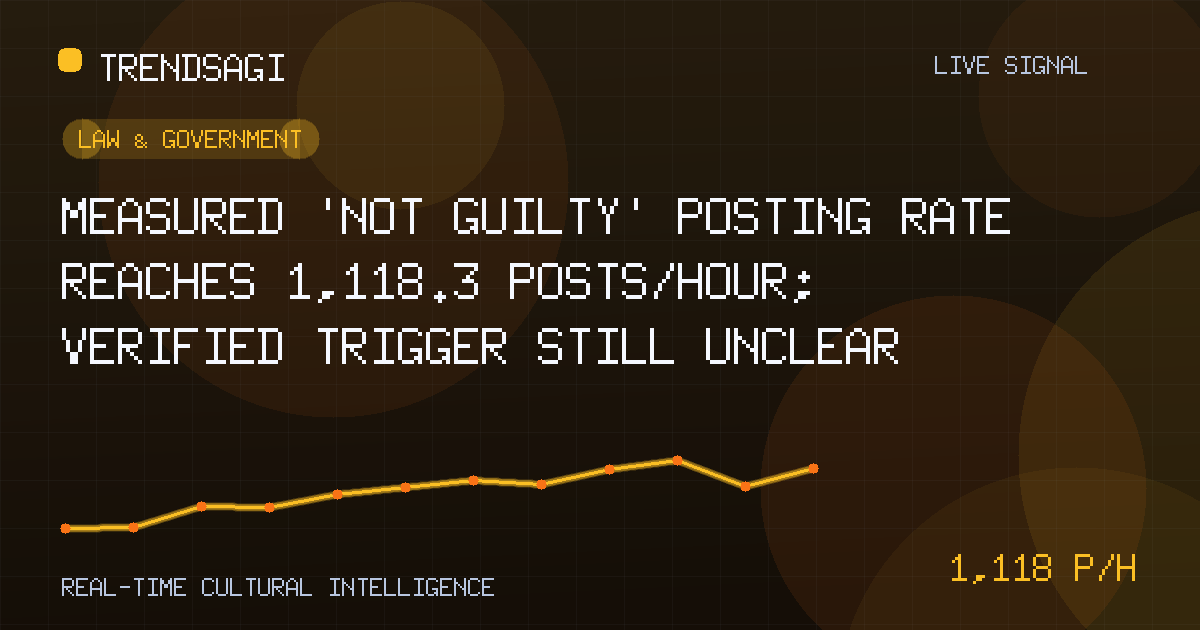
Measured 'Not Guilty' Posting Rate Reaches 1,118.3 Posts/Hour; Verified Trigger Still Unclear
On 2026-09-04, a monitored snapshot recorded 2,322 'Not Guilty' posts at 1,118.3 posts/hour. The trigger is not yet verified.
Automated briefing. Generated from stored signal measurements and source-backed research; it is not manually reviewed. Read the methodology and limitations.
Metrics in this briefing are a snapshot associated with its publication date and may not reflect current conditions.
What changed
A stored monitoring snapshot for the topic label “Not Guilty” recorded 2,322 posts at 2026-09-04T19:40:16Z. The measured snapshot rate was 1,118.3 posts/hour over an exact 1,822-second window, based on three stored observations. That is a measurement of observed posting velocity during that window, not a live/current rate, forecast, reach, engagement, or unique-person count. As of this briefing, no verified public explanation for the increase was available in the sources consulted, so the specific trigger remains unclear.
The label belongs to the Law & Government category, but the phrase “Not Guilty” is broad enough to cover verdicts, pleas, commentary on criminal justice, and non-legal uses. Without a confirmed news event, the snapshot alone cannot identify a defendant, jurisdiction, or proceeding.
Why this topic may be moving
Because the stored label is generic, several kinds of events could produce a “Not Guilty” posting cluster. Candidate explanations include:
- A not-guilty verdict in a criminal trial, announced close to the observation window.
- A high-profile defendant entering a not-guilty plea.
- Legal commentary about jury instructions, reasonable doubt, or acquittal rates.
- Political or cultural conversation that uses “not guilty” metaphorically.
None of these explanations can be confirmed from the stored signal. The measured rate tells us that posts containing or labeled as “Not Guilty” were being observed at a substantial clip around the snapshot time; it does not tell us which post content drove the cluster or whether it was connected to a real-world court event. In the absence of an independently verified source, the prudent position is to treat the cause as unconfirmed.
Why it matters
For legal journalists, court reporters, and public affairs analysts, a fast-moving “Not Guilty” cluster can serve as a useful tripwire. It may signal breaking developments in a case audiences are watching, or a wave of opinion around a verdict. The category placement in Law & Government makes legal teams and policy monitors the most relevant readers.
Before treating any fast-moving legal topic as a story, confirm that the underlying case exists, the verdict or plea is real, and the language in posts matches the court’s official record. Conversation velocity alone cannot tell us who is being discussed or why.
The signal can establish that attention was concentrated on this phrase at a specific time. It cannot establish sentiment, truthfulness, geographic distribution, author identity, or whether the conversation was organic. It also cannot be used as a measure of reach or unique-person exposure, because snapshot volume is a count of observed posts, not people.
What to watch next
For readers deciding whether this becomes actionable, the next practical checks are:
- Search reputable court and legal-news sources for verdicts or pleas reported in the four to six hours before 2026-09-04T19:40:16Z.
- Look for named defendants, docket numbers, court names, or attorney statements inside the posts themselves.
- Compare subsequent snapshot volumes to see whether the rate continues, decays, or spikes again.
- Separate “not guilty” verdicts from “not guilty” pleas; the legal stakes and follow-up coverage are very different.
- Check whether the conversation is driven by news accounts or by opinion and meme formats before assigning editorial weight.
Concrete watch signals include a second observed snapshot above 1,000 posts/hour, increased use of case-specific terms such as “acquitted” or “jury,” and the appearance of official court records in the feed. If none of those appear, the cluster may be rhetorical or topic-tag drift rather than a legal development.
Methodology and limitations
| Metric | Value |
|---|---|
| Observation time | 2026-09-04T19:40:16Z |
| Measured snapshot rate | 1,118.3 posts/hour |
| Snapshot volume | 2,322 posts |
The measured snapshot rate is derived from three stored observations spanning an exact 1,822-second window. It is not a live/current rate, forecast, reach, engagement, or unique-person count. The snapshot volume of 2,322 posts is the total number of posts observed in the stored label at the observation time; it does not decompose into unique authors, geographic regions, or verified accounts.
The main limitation is the ambiguity of the label. “Not Guilty” can refer to a verdict, a plea, a legal standard, or a phrase in unrelated commentary. This briefing therefore limits its claims to what the stored measurement directly supports and flags the cause as unverified.
Track This Topic for New Signals
Set alerts for future velocity or sentiment changes around this topic.
Explore Tracking PlansAbout TrendsAGI research
TrendsAGI's automated research pipeline publishes dated signal snapshots, methodology notes, and practical workflows for teams evaluating cultural momentum. Read how signals are scoped, scored, and limited in our research methodology.