899-second window · 3 observations · Measured Oct 1, 2026, 4:56 PM UTC · Provider: go_recent_snapshot_v2
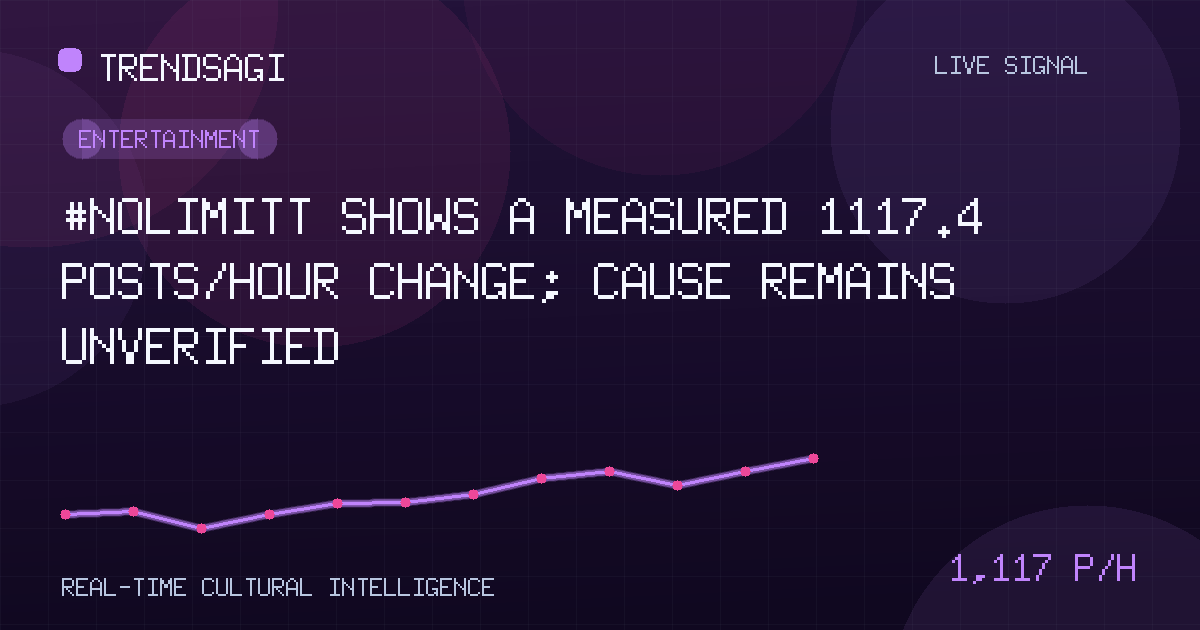
#nolimitt shows a measured 1117.4 posts/hour change; cause remains unverified
#nolimitt's snapshot had 385 posts and a measured 1117.4 posts/hour change; the cause is unverified, with practical verification steps for editors.
Automated briefing. Generated from stored signal measurements and source-backed research; it is not manually reviewed. Read the methodology and limitations.
Metrics in this briefing are a snapshot associated with its publication date and may not reflect current conditions.
What changed
The latest snapshot for #nolimitt shows a sharp burst of posting activity, but it does not identify a verified news event, campaign, release, or reaction behind it. The defensible conclusion is narrow: the monitored signal changed materially and merits verification, while its cause remains unclear.
At the observation time of 2026-10-01T16:56:32Z, the latest snapshot contained 385 posts. Across an exact window of 899 seconds using 3 stored observations, the measured snapshot rate was 1117.4 posts/hour. This is a measured snapshot rate, not a live or current rate, forecast, reach, engagement result, or unique-person count.
| Measure | Stored value |
|---|---|
| Observation time | 2026-10-01T16:56:32Z |
| Measured snapshot rate | 1117.4 posts/hour |
| Exact measurement window | 899 seconds |
| Stored observations | 3 |
| Latest snapshot volume | 385 posts |
The rate and volume answer different questions. The 385 posts describe the latest snapshot; 1117.4 posts/hour describes change measured within the specified stored window. Their co-occurrence makes the burst notable, but neither figure says how many people saw the posts, how many participated, or whether activity continued after the snapshot.
Why this topic may be moving
No verified public context accompanies this signal, so no publisher-backed catalyst can be named. The available classification is entertainment, but that category is not evidence of a particular release, incident, or conversation. It would be unsupported to infer that a show, celebrity post, promotion, controversy, or platform event caused the increase.
Possible explanations remain hypotheses. A useful verification pass would use Google Search for contemporaneous context, then check official accounts, publisher reports, and early high-volume posts. Ask whether posts repeat one item, a few accounts dominate, or the hashtag has a stable meaning. These checks can distinguish possible amplification from original discussion; they do not prove organic activity.
A measured posting spike is a prompt to investigate, not proof that a particular event caused it.
Without corroboration, an unexplained entertainment-related posting spike is more precise than fan reaction, viral moment, or a claim about a specific program.
Why it matters
The signal is most useful as a verification trigger for people who must make quick decisions under uncertainty.
- Media and social editors: Treat the burst as a lead, not an angle, until a credible catalyst and timing can be documented.
- Brand-safety teams: Review surrounding content before assuming that #nolimitt carries a positive, neutral, or even consistent meaning.
- Creators and community managers: Decide whether joining the conversation serves the audience only after determining what is driving it.
- Researchers and analysts: Preserve the distinction between a measured anomaly, a sustained trend, and an explanation for the anomaly.
What the signal can—and cannot—establish
It can establish that posts carrying the observed label were present in the monitored snapshot and that the supplied calculation recorded 1117.4 posts/hour over its defined window. It can also establish a clear moment for checking whether public reporting or an official announcement aligns with the activity.
- It cannot establish causation. There is no verified catalyst in the available record, so assigning the spike to a release, controversy, or celebrity would be speculation.
- It cannot establish who participated. Posts are not people; repeated, copied, automated, or coordinated content may affect volume, and no account-quality evidence is provided.
- It cannot establish sentiment or meaning. A hashtag may be used approvingly, critically, humorously, or for unrelated reasons.
- It cannot establish persistence. A measured window ending at the snapshot cannot show whether activity continued, returned to normal, or peaked earlier.
What to watch next
The next checks should move from plausible stories to observable evidence.
- Identity: Search the exact hashtag plus case and punctuation variants. Check whether one meaning accounts for most results or whether several unrelated uses are colliding.
- Catalyst: Look for a timestamped official announcement or credible publisher report close to the observation. Require the source to explain the connection rather than merely mention the label.
- Concentration: Review leading posts and account contribution. Repeated wording, media, or destinations can indicate a common source; broad participation across independent accounts supports a different reading.
- Breadth: Compare languages, locations, content types, and subtopics. A shift across distinct communities is different from one community repeating itself.
- Persistence: Use successive observations with the same collection method. A sustained elevated rate, a second burst, or a quick return toward the prior pattern would tell analysts different things.
Concrete escalation signals are verified catalyst confirmation, diverse independent participation, and continued elevated measurement. Concrete caution signals are heavy account concentration, duplicated material, inconsistent hashtag meaning, and failure to reproduce outside the measured window.
Methodology and limitations
The 1117.4 posts/hour figure comes from 3 stored observations across exactly 899 seconds ending at 2026-10-01T16:56:32Z. It is reported as a measured snapshot rate without extrapolation. The separate figure of 385 posts is the latest snapshot volume; it is not treated as a rate, reach estimate, or audience count.
Collection scope, deduplication, geography, language, account authenticity, and historical baseline are not supplied. Those omissions limit comparisons and leave possible measurement effects unresolved. The signal supports timely investigation, but without verified public context it does not support a named cause or a claim that the burst continued beyond the observation.
Track This Topic for New Signals
Set alerts for future velocity or sentiment changes around this topic.
Explore Tracking PlansAbout TrendsAGI research
TrendsAGI's automated research pipeline publishes dated signal snapshots, methodology notes, and practical workflows for teams evaluating cultural momentum. Read how signals are scoped, scored, and limited in our research methodology.