15-minute window · 3 observations · Measured Sep 27, 2026, 1:36 PM UTC · Provider: go_recent_snapshot_v2
Noel entertainment signal measures 992.3 posts/hour; cause remains unverified
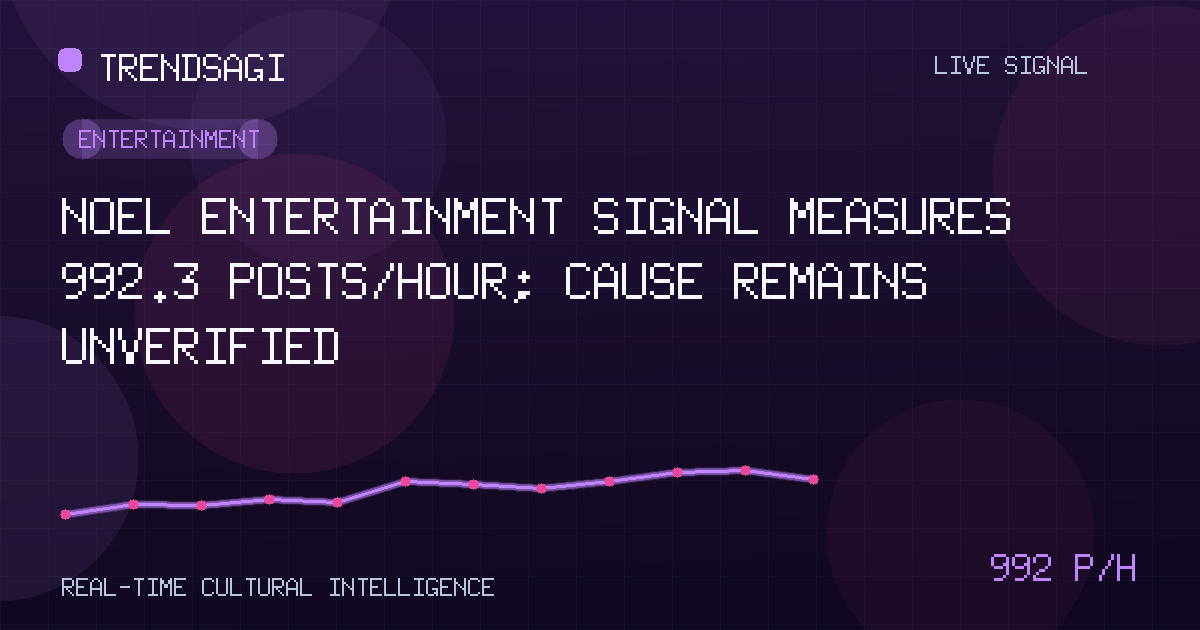
The stored Noel signal shows 525 posts and a measured 992.3 posts/hour snapshot rate; the event driving the activity remains unverified.
Automated briefing. Generated from stored signal measurements and source-backed research; it is not manually reviewed. Read the methodology and limitations.
Metrics in this briefing are a snapshot associated with its publication date and may not reflect current conditions.
What changed
The direct conclusion is narrow: the stored entertainment signal labeled Noel contains 525 posts in its latest snapshot, but it does not identify which person, work, character, or event those posts concern. No description or verified public trigger accompanies the signal, so this is a change alert, not a confident explanation of what happened.
Across an exact 900-second window built from 3 stored observations, the measured change was 992.3 posts/hour at 2026-09-27T13:36:39Z. This is a measured snapshot rate, not a live or current rate, forecast, reach, engagement count, or unique-person count.
| Observation time | Measured posts/hour | Snapshot volume |
|---|---|---|
| 2026-09-27T13:36:39Z | 992.3 posts/hour | 525 posts |
What the signal establishes
The strongest supported statement is that posts accumulated against a single monitored label during the measured interval. It gives editors a reason to inspect the sample promptly. It does not establish why the posts appeared, whether they discuss the same subject, whether people authored them independently, or what they think.
Without a prior benchmark, the record also cannot show whether 992.3 is unusual for this label. Without post-level data, it cannot show sentiment, geography, language, or the balance among original comments, reposts, and automated activity.
The rate is evidence of movement in the monitored sample, not evidence of its cause, meaning, or audience size.
Why this topic may be moving
A cause cannot be verified from the available record. There are no source posts, linked announcements, named entities, baseline, geography, or language breakdown to connect the timing to a public event. The stored Entertainment category describes where the label was filed; it is not evidence of the trigger.
Several explanations remain possible and should be treated as hypotheses, not facts:
- Entity ambiguity: A single-word label can pool unrelated people, works, or contexts until the post text and linked profiles are checked.
- Event-led attention: A timestamped announcement or other public development may be associated with the burst, but the record names and verifies none.
- Keyword collision: If collection is keyword-based, the label may combine distinct matches; post-level review is needed to separate them.
- Repetition: A small set of accounts or duplicated text could contribute heavily without representing broad participation.
Post text, timestamps, account identity, and a comparable earlier window are needed to distinguish these possibilities. Until then, the reason for the movement is plainly unclear.
Why it matters
For entertainment editors, the signal is a triage tool. It can identify a label that merits review before coverage decisions are made, but it should not determine the story angle. The main risk is false specificity: connecting a burst to the wrong Noel or presenting an unverified catalyst as fact.
For communications, talent, and platform teams, the same alert can prompt a quick check for an official announcement, a developing story, or repeated posting. A verified explanation should cite the relevant public publisher and distinguish an event from the subsequent reaction.
For analysts, the sample is a prompt to improve entity resolution and benchmarking. Persistence and participation beyond one account cluster would provide stronger evidence of a durable trend; a brief, concentrated cluster may have a different explanation.
What to watch next
Six checks would turn this snapshot into a more reliable trend assessment:
- Resolve the label. Review a time-ordered, representative sample of posts and account profiles. If the posts converge on one named subject, retain that specificity; if not, split the label into separate entities before analysis.
- Test for a catalyst. Look for a timestamped public development that precedes the acceleration. Verify any candidate with an official post or named publisher and, when possible, independent reporting before attributing the movement to it.
- Measure persistence. Collect the next 900-second window using the same query and method. Compare matched intervals to see whether the rate remains elevated, fades, or was a single burst.
- Check concentration. Count unique accounts, the share posting from the leading accounts, exact duplicate text, and obvious repost chains. These measures help separate broad discussion from repeated distribution.
- Map the context. Record language, geography, platform, and whether posts are questions, reactions, criticism, news, or incidental uses of the word. This can expose an entity mix hidden by the short label.
- Audit the claims. Separate verifiable statements from reactions and unsupported allegations. Do not infer sentiment or motive from volume alone.
Concrete watch signals are a consistently named referent, a verified event timestamp near the change, continued activity in the next matched window, and participation beyond one account cluster. If the label fragments across unrelated subjects or quickly subsides, the safer conclusion is a transient or ambiguous burst.
Methodology and limitations
The supplied rate was calculated over an exact 900-second window from 3 stored observations and recorded at 2026-09-27T13:36:39Z. It is a measured snapshot rate. The 525-post figure is snapshot volume, not a rate, and the available information does not provide enough window detail to reconcile the two measures.
Only 3 observations are available, so they do not reveal the full shape, peak, or duration of the activity. The signal also omits the collection query, earlier baseline, source-post text, account counts, sentiment, geography, and language. No external fact is attributed here because no public trigger could be verified from the available record.
The appropriate use is therefore to trigger verification, not to claim a cause. Entity identity, persistence, concentration, and corroborating public context should be resolved before the signal is described as a confirmed event-driven trend.
Track This Topic for New Signals
Set alerts for future velocity or sentiment changes around this topic.
Explore Tracking PlansAbout TrendsAGI research
TrendsAGI's automated research pipeline publishes dated signal snapshots, methodology notes, and practical workflows for teams evaluating cultural momentum. Read how signals are scoped, scored, and limited in our research methodology.


