2685-second window · 3 observations · Measured Oct 3, 2026, 6:26 AM UTC · Provider: go_recent_snapshot_v2
“NO GOOD” Entertainment signal measures 1963.9 posts/hour at a 2400-post snapshot
The “NO GOOD” Entertainment signal measured 1963.9 posts/hour; here is what changed, what remains unclear, and what to verify next.
Automated briefing. Generated from stored signal measurements and source-backed research; it is not manually reviewed. Read the methodology and limitations.
Metrics in this briefing are a snapshot associated with its publication date and may not reflect current conditions.
What changed
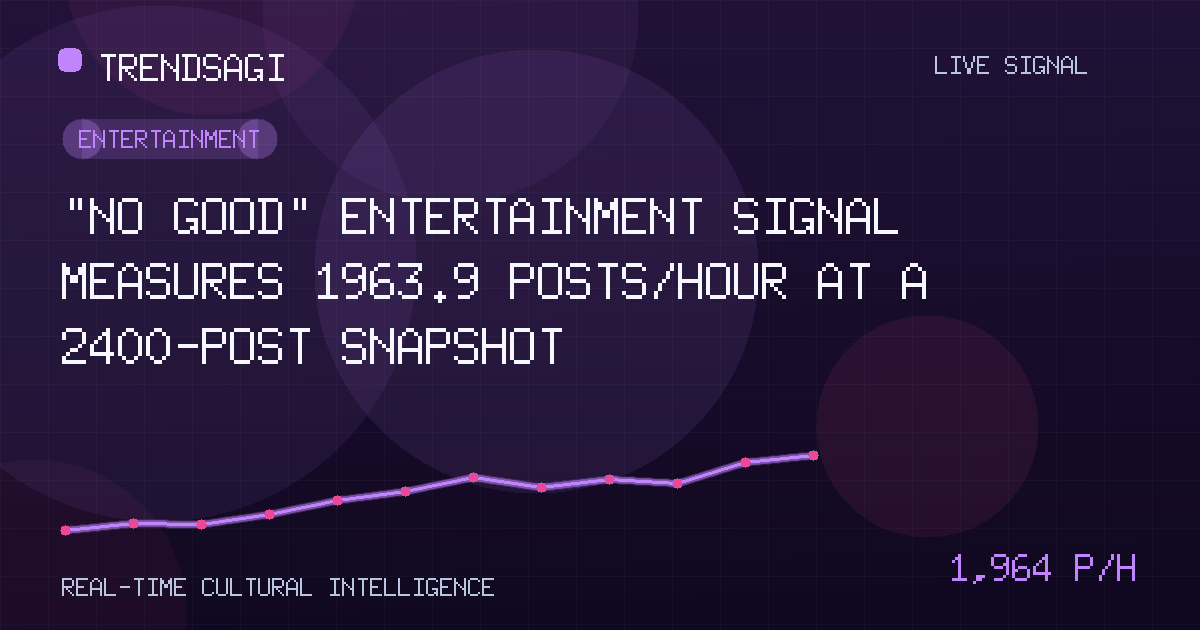
The Entertainment topic labeled “NO GOOD” registered a measured snapshot rate of 1963.9 posts/hour over an exact 2685-second window using 3 stored observations. The figure describes the measured change ending at 2026-10-03T06:26:39Z. It is not a live or current rate, forecast, reach figure, engagement total, or unique-person count. The defensible takeaway is a sharp concentration of posting activity around the label during the measured interval.
The latest snapshot at 2026-10-03T06:26:39Z contained 2400 posts. No verified public context establishes whether “NO GOOD” refers to a title, quotation, person, campaign, controversy, or ordinary language, and no verified reporting identifies a catalyst. The cause remains unclear. Treat the spike as a measured burst in the labeled conversation, not as proof of a specific event or public consensus.
| Observation time (UTC) | Measured snapshot rate | Snapshot volume |
|---|---|---|
| 2026-10-03T06:26:39Z | 1963.9 posts/hour | 2400 posts |
Why this topic may be moving
The series shows that posting activity changed; it does not identify the event behind that change. “NO GOOD” is a broad phrase, so the Entertainment label could describe a specific work, a quotation, or a loose keyword cluster. Any causal account must be tested against the posts themselves.
- Release-related attention: A song, film, episode, performance, or announcement could have supplied a shared label. No such release is verified here.
- Quotation or controversy: A reaction to words or an interpersonal dispute could be driving repeated use of the phrase. No verified account identifies either explanation.
- Repeatable content: A meme, clip, or catchphrase could encourage rapid copying. Similar text, recycled media, or synchronized timing would support that possibility.
- Cross-category news: A broader story could have spilled into Entertainment. The timing and substance of the posts would need to match a dated public event.
- Coordination or automation: Repetition from a narrow set of accounts or machine-like posting patterns could inflate a keyword cluster. Those are warning signs to investigate, not proof of manipulation.
These are hypotheses, not findings. Volume alone cannot distinguish a cultural event from repetition, a popular in-joke, or a noisy keyword match.
The strongest conclusion available is that the labeled Entertainment conversation intensified during the measured window; the record does not yet establish what “NO GOOD” refers to, who initiated it, or why it spread.
Why it matters
Editors and publishers. The immediate risk is misidentification. Publishing a causal story before checking the posts could attach a viral label to the wrong person, work, or issue. Hold the spike as a lead until the referent and catalyst are supported.
Analysts and communications teams. The signal is useful as an investigation prompt, not a finished trend story. It identifies where attention was concentrated at a recorded moment, but not distinct participants, sentiment, conversion, or persistence.
Brands, talent teams, and creators. Relevance depends on what the phrase means and whether posts are organic, duplicated, paid, or coordinated. A high-volume label without a stable subject can create monitoring noise even without a single triggering event.
General audiences. A volume spike is not evidence that everyone is reacting in the same way or that the signal has lasting cultural importance.
What the signal can—and cannot—establish
The measured series supports a narrow set of claims: the topic is classified as Entertainment; its latest supplied snapshot contained 2400 posts; and the measured snapshot rate for the stated 2685-second window was 1963.9 posts/hour. It also fixes the latest observation time at 2026-10-03T06:26:39Z.
- Subject: The posts may not all refer to the same thing.
- Participants: Post count is not a unique-person count.
- Authenticity: The series does not separate original, duplicated, paid, automated, or coordinated content.
- Audience response: Volume does not reveal sentiment, reach, engagement, or conversion.
- Duration: A completed measurement window cannot establish whether attention will persist.
These distinctions matter because a fast keyword burst can resemble a cultural event while still lacking a stable subject or verified origin.
What to watch next
The immediate priority is disambiguation, followed by persistence and provenance checks.
- Read a representative slice of posts. Record what “NO GOOD” describes and separate titles, quotations, reactions, and unrelated keyword uses.
- Inspect timing. Review the earliest substantive posts and distinguish original contributions from copies or reposts of earlier material.
- Check content and account patterns. Look for duplicate wording, recycled media, narrow repetition, and abrupt synchronized activity.
- Seek attributable confirmation. Check official accounts and reputable reporting for a dated catalyst; retain only facts that can be tied to a publisher.
- Extend the series. Compare later exact windows using the same collection and classification method, keeping the measured rate separate from snapshot volume.
Concrete watch signals are:
- Later windows retain a comparably elevated measured rate, with snapshot volume supported by new and varied posts.
- An official announcement or independent reporting identifies the referent and explains the timing.
- Conversation remains coherent as it appears in more than one category or platform.
- The rate decays quickly, the label fragments into unrelated uses, or duplication dominates the cluster.
Methodology and limitations
The reported 1963.9 posts/hour figure is a measured snapshot rate over an exact 2685-second window using 3 stored observations, not a live rate or a forecast. The 2400-post snapshot volume is a separate count taken at 2026-10-03T06:26:39Z. The topic label and category are stored classifications, while no collection method, account-level analysis, or verified public catalyst was supplied. No sentiment, geography, language, account-uniqueness, or engagement data is provided. With no verified catalyst, the cause remains unknown, and “NO GOOD” should remain a monitored signal rather than be presented as a confirmed event, release, or controversy.
Track This Topic for New Signals
Set alerts for future velocity or sentiment changes around this topic.
Explore Tracking PlansAbout TrendsAGI research
TrendsAGI's automated research pipeline publishes dated signal snapshots, methodology notes, and practical workflows for teams evaluating cultural momentum. Read how signals are scoped, scored, and limited in our research methodology.


