899-second window · 3 observations · Measured Oct 7, 2026, 5:22 PM UTC · Provider: go_recent_snapshot_v2
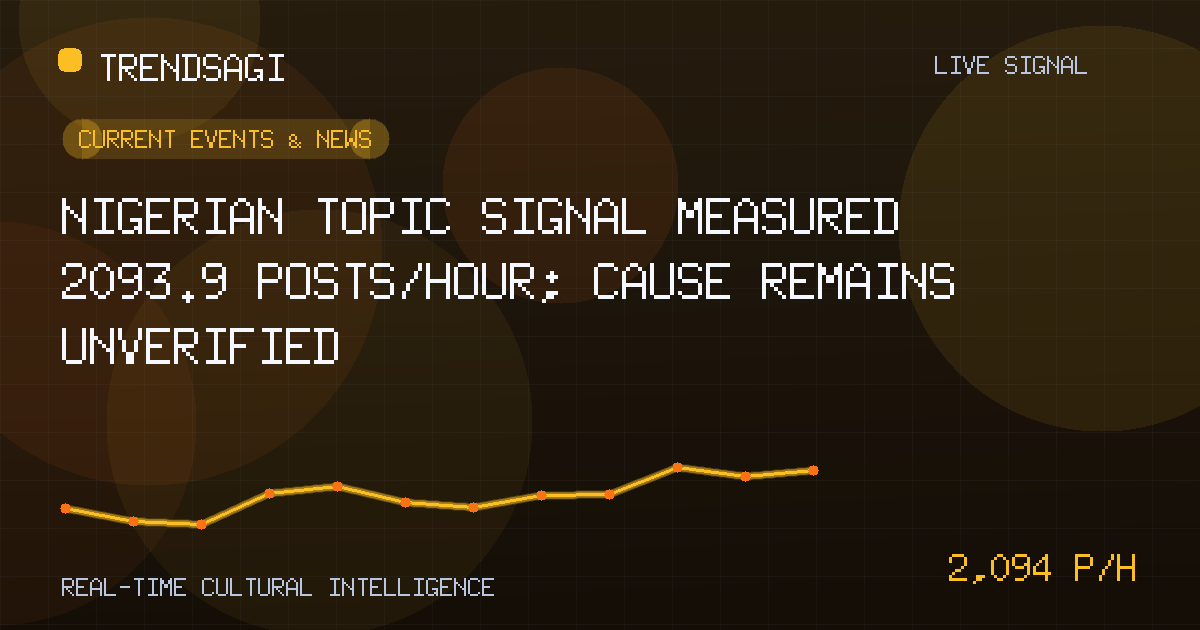
Nigerian topic signal measured 2093.9 posts/hour; cause remains unverified
Nigerian-labeled posts measured 2093.9 posts/hour over an exact 899-second window; the briefing separates the signal from an unverified cause.
Automated briefing. Generated from stored signal measurements and source-backed research; it is not manually reviewed. Read the methodology and limitations.
Metrics in this briefing are a snapshot associated with its publication date and may not reflect current conditions.
What changed
The stored signal shows a sharp increase in posts captured under the broad “Nigerian” label, but it does not identify a verified event or establish why activity changed. The defensible takeaway is narrow: monitoring detected faster posting growth around the observation time; the underlying story, geography, participants, and significance remain unresolved.
The measured snapshot rate was 2093.9 posts/hour over an exact 899-second window using 3 stored observations, with the latest observation at 2026-10-07T17:22:17Z. This is a measured historical snapshot rate, not a live or current rate, forecast, reach figure, engagement count, or unique-person count. The latest snapshot volume was 1411 posts.
| Observation time | Measured snapshot rate | Latest snapshot volume |
|---|---|---|
| 2026-10-07T17:22:17Z | 2093.9 posts/hour | 1411 posts |
What the signal can establish
The rate captures how quickly the number of collected posts changed across the stored observation sequence. It does not mean that 1411 posts represented the full conversation, and it cannot be read as the number of people involved. The measures answer different questions: snapshot volume is the size of the captured collection at one observation, while the measured snapshot rate describes change over the stated window. The rate therefore need not match a single snapshot count.
- Observed momentum: There was a positive, rapid change in captured posting volume during the measured window.
- Timing: The signal is anchored to the latest stored timestamp, not to the present.
- Scope: “Nigerian” is a broad label that may collect multiple meanings, locations, subjects, and conversations.
- Classification: “Current Events & News” is the stored category, but a category assignment is not evidence of a particular event.
The stored signal supports a claim about the pace of change in captured posts, not a claim about the nature, origin, audience, or importance of an event.
Why this topic may be moving
No verified publisher or primary source has been linked to this observation in the available context. That means the cause is unclear, not that no event occurred.
- A real-world event may have prompted rapid posting, but the stored record does not identify one.
- An official communication, sports result, cultural release, or public controversy could create a burst; none is confirmed here.
- A short-lived trend, coordinated repost campaign, or automated activity could also increase captured volume.
- Changes in collection, query matching, language handling, or duplicate removal could affect the measurement without representing a broader public shift.
These are verification hypotheses, not findings. A defensible explanation would need public evidence aligned with both the observation time and the posts actually captured.
Why it matters
For newsrooms and fact-checkers, the signal is a reason to investigate, not a sufficient basis for a breaking-news claim. A broad label can combine unrelated conversations and reward a precise headline too early.
For researchers and analysts, the short observation window and limited stored points make durability, geography, and representativeness uncertain. The result should not be generalized beyond this snapshot.
For public agencies, communicators, businesses, and communities tracking Nigeria-related discussion, acting on inferred sentiment or audience size could misdirect resources. The data do not establish who posted, where they were, how influential they were, or whether the activity was authentic.
What to watch next
- Independent confirmation: Look for several reputable publishers or primary sources naming the same event and aligning its timing with the observed burst.
- Primary evidence: Seek an attributable official statement, event record, filing, court document, or organizer communication before assigning a cause.
- Sustained movement: Check whether later stored observations also show rapid positive change; this window alone does not show whether activity persisted.
- Topic narrowing: See whether repeated names, places, organizations, or phrases emerge, allowing the broad label to be mapped to a specific subject.
- Source concentration: Examine whether many distinct accounts contribute or whether a small group repeatedly distributes the same material. Repetition alone does not prove coordination.
- Cross-platform spread: Compare other monitored channels for a comparable shift rather than assuming one collection represents all public conversation.
- Updates and corrections: Track whether early claims are confirmed, qualified, disputed, or withdrawn as reporting develops.
Practical next checks
A useful verification pass would:
- Review a time-sliced sample from the beginning, middle, and end of the window, separating original posts from duplicates and reposts.
- Test the label against language variants and ambiguous uses so that country references are not mixed with unrelated meanings.
- Classify sampled claims by source type, named entities, location, and event reference without inferring identity from a profile label.
- Compare the result with earlier windows collected under the same rules to determine whether the movement is sustained or isolated.
- Record which evidence connects a proposed event to the observed posts, rather than merely sharing the same broad keyword.
Methodology and limitations
This briefing uses the supplied canonical stored signal: 3 observations, an exact 899-second measurement window, a measured snapshot rate of 2093.9 posts/hour, and latest snapshot volume of 1411 posts. No baseline, content-level sample, account-level distribution, engagement data, geographic breakdown, or verified external explanation was supplied.
The stored label is too broad to identify the conversation, and the short window cannot establish persistence. The responsible conclusion is therefore that Nigerian-labeled posts showed a measured increase in the captured collection, while the reason for that increase remains unverified. A more specific explanation should be added only when attributable public evidence establishes the connection.
Track This Topic for New Signals
Set alerts for future velocity or sentiment changes around this topic.
Explore Tracking PlansAbout TrendsAGI research
TrendsAGI's automated research pipeline publishes dated signal snapshots, methodology notes, and practical workflows for teams evaluating cultural momentum. Read how signals are scoped, scored, and limited in our research methodology.