1817-second window · 2 observations · Measured Sep 29, 2026, 1:11 AM UTC · Provider: go_recent_snapshot_v2
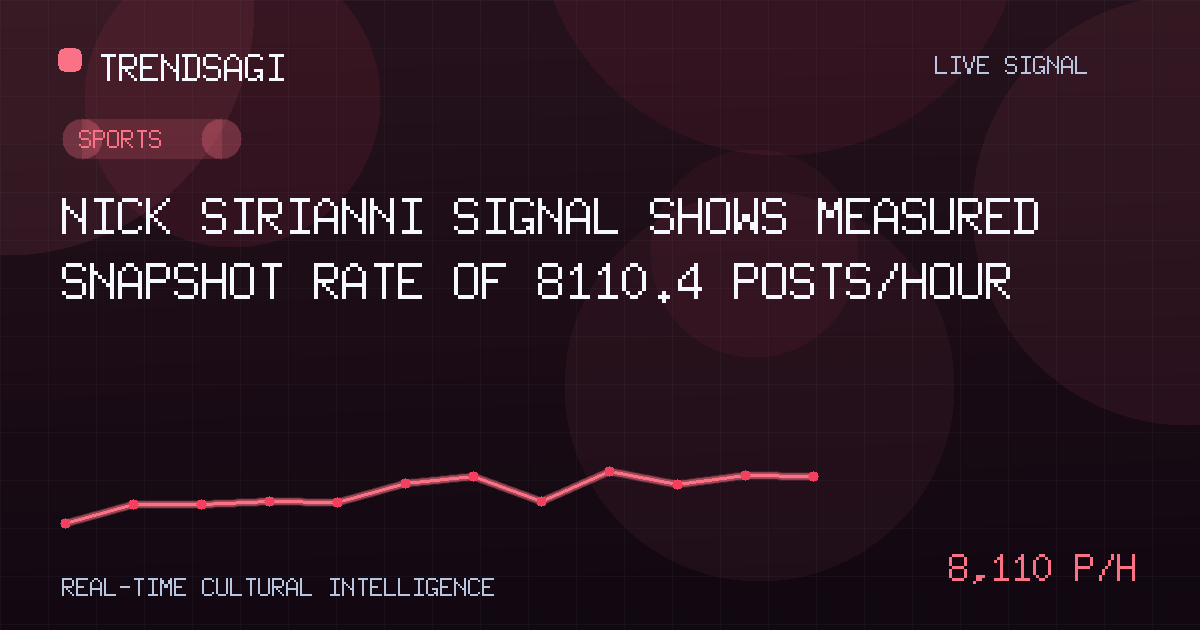
Nick Sirianni signal shows measured snapshot rate of 8110.4 posts/hour
A stored Nick Sirianni snapshot measured 8110.4 posts/hour; the cause is unverified, with practical checks for news, repetition, and data quality.
Automated briefing. Generated from stored signal measurements and source-backed research; it is not manually reviewed. Read the methodology and limitations.
Metrics in this briefing are a snapshot associated with its publication date and may not reflect current conditions.
What changed
The stored Nick Sirianni signal records a concentrated short-window change in posting activity, but the supplied material does not verify why it moved. The cause remains unclear: this is a monitoring alert that warrants source and data-quality checks, not a report of a specific trigger.
The measured snapshot rate is 8110.4 posts/hour over an exact 1817-second window using 2 stored observations, measured at 2026-09-29T01:11:37Z. The latest snapshot volume is 4235 posts. The rate describes only that stored measurement window—not a live or current rate, forecast, reach figure, engagement total, or unique-person count.
| Stored measure | Value |
|---|---|
| Observation time | 2026-09-29T01:11:37Z |
| Measured snapshot rate | 8110.4 posts/hour |
| Latest snapshot volume | 4235 posts |
| Measurement basis | Exact 1817-second window using 2 stored observations |
Taken together, the figures establish a measured change in stored posting activity over the specified window, but not why it occurred or whether each post represents distinct public conversation.
Why this topic may be moving
No verified public explanation accompanies the stored signal, so the cause remains unclear. The stored Sports category describes the classification assigned to the topic; it does not verify the content of any post or identify an event.
Several mechanisms could create this pattern, and each should be treated as a testable possibility rather than a finding:
- Event-linked coverage: A timed game, result, roster decision, award, or other sports development could prompt posts carrying Sirianni's name.
- Quote or clip circulation: A short quotation, interview segment, photograph, or video could be reposted faster than conventional news coverage.
- Secondhand amplification: Followers, media accounts, and fan communities could repeat the same underlying item, producing volume without equivalent new information.
- Data or labeling issue: Reposts, automated accounts, duplicates, or a mismatch in the tracked label could inflate apparent activity.
None of these possibilities is established by the snapshot. Choosing among them requires post-level timing, source, text, and duplication evidence, plus verified public context.
What the signal can and cannot establish
The signal is useful as a verification trigger. It tells an editor that the stored series recorded a measured change around an exact label at the stated time. It does not, by itself, explain the world event behind that change.
- Established: The observation time, latest snapshot volume, measured snapshot rate, exact window length, and count of stored observations used.
- Not established: The cause, sentiment, importance, authenticity, organic versus automated activity, geography, language, platform coverage, or duplicate status.
- No baseline: Whether the rate is high relative to normal Nick Sirianni activity. No historical comparison point is supplied.
- No persistence: Whether the change continues or reverses. A single measured window cannot establish a durable trend.
A topic spike is evidence of changed posting activity around a label, not proof of a triggering event, its importance, or who generated the posts.
Its appropriate role is to direct verification toward a narrow question: what concrete event, if any, aligns with the timing of the stored observations?
Why it matters
For sports editors, the immediate issue is attribution. A fast-moving label can create pressure to publish an explanation before one is verified. The responsible move is to describe the observed activity, state that the cause is unconfirmed, and check the earliest substantive posts and public reporting before assigning a narrative.
- Newsrooms should avoid attaching the surge to an unverified event and should seek a timestamped source that predates the wave.
- Research and monitoring teams should test whether the change is sustained, duplicated, automated, or concentrated in one source.
- Fan and community managers should separate new information from recycled posts before amplifying discussion.
Audience-facing teams should also avoid presenting the measured rate as a crowd count. Repetition can make a topic look broad while the underlying information remains narrow.
What to watch next
- Reproduce the measurement. Recover the underlying observations and confirm that they use the same label, matching rules, time zone, and collection window. Preserve each exact count and timestamp so the measured snapshot rate can be checked rather than inferred from search chatter.
- Inspect the earliest substantive posts. Record publication time, author or account type, quoted text, cited source, and whether the item is original or copied. The first credible timestamp is more useful for causal checking than a later wave of reposts.
- Check public context with Google Search. Look for timestamped reporting or a primary statement that predates the activity. Use multiple independent publishers and attribute any external fact to the publisher that reports it; search interest alone is not a cause.
- Measure composition and duplication. Compare original posts with copies or quotes, identify repeated text, and check whether automated accounts dominate any source cluster. A burst with little original information is an amplification signal, not evidence of a broad event.
- Take a fresh, independent snapshot. Do not turn 8110.4 posts/hour into a forecast. Compare a later separately measured rate with this reference point, and require additional observation windows before describing the movement as sustained or fading.
- Use concrete watch signals. A timestamped public report that aligns with the onset is a stronger causal candidate; multiple independent publishers strengthen it. Persistence across additional windows suggests broader discussion. A burst confined to repeated text, a sudden source-mix change, or a mismatch in the label instead points toward amplification or data-quality problems.
Methodology and limitations
The briefing uses the canonical observation timestamp, latest snapshot volume, and supplied measured change rate. The rate covers an exact 1817-second window using 2 stored observations and is presented as a measured snapshot rate, not as a live/current figure or projection.
The 4235-post volume describes the latest stored snapshot; the 8110.4 posts/hour figure describes measured change over the stated window. They are not interchangeable and should not be combined into an audience estimate. The record supplies no earlier count, historical comparison, collection query, platform coverage, geography or language settings, deduplication method, bot controls, source mix, post text, or sentiment.
Those omissions prevent conclusions about causation, authenticity, organic reach, or representativeness. Nick Sirianni is the tracked label and Sports is the stored category; neither independently verifies a story. The defensible conclusion is narrow: the stored series recorded the reported measured snapshot rate, and the reason remains unverified.
Track This Topic for New Signals
Set alerts for future velocity or sentiment changes around this topic.
Explore Tracking PlansAbout TrendsAGI research
TrendsAGI's automated research pipeline publishes dated signal snapshots, methodology notes, and practical workflows for teams evaluating cultural momentum. Read how signals are scoped, scored, and limited in our research methodology.