1374-second window · 2 observations · Measured Aug 30, 2026, 11:38 AM UTC · Provider: go_recent_snapshot_v2
Neil trends at 1,412 posts/hour in entertainment — cause unverified
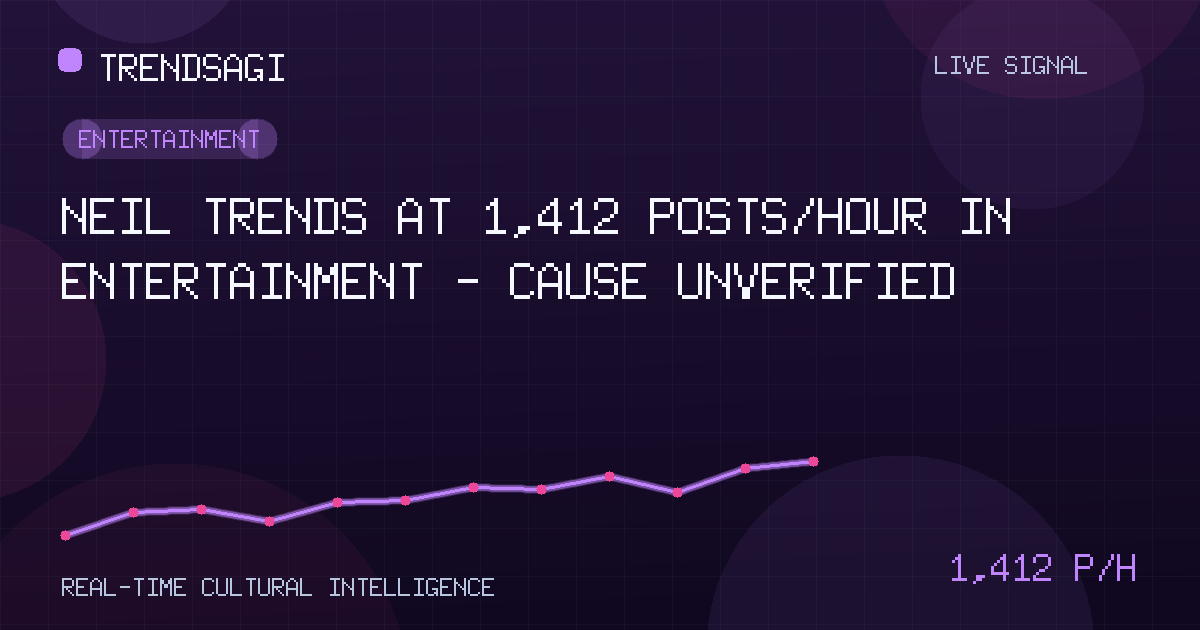
Neil trends at 1,412 posts/hour in entertainment on 2026-08-30; no verified cause found. Analysts should verify before acting.
Automated briefing. Generated from stored signal measurements and source-backed research; it is not manually reviewed. Read the methodology and limitations.
Metrics in this briefing are a snapshot associated with its publication date and may not reflect current conditions.
What changed
A stored signal shows the topic "Neil" generated 692 posts at a measured snapshot rate of 1,412.3 posts per hour over a 1,374-second window, captured at 2026-08-30T11:38:10Z. The volume and rate place it in the Entertainment category, but no public event or release has been confirmed as the driver.
| Observation time (UTC) | 2026-08-30T11:38:10Z |
|---|---|
| Measured posts/hour | 1,412.3 |
| Snapshot volume | 692 posts |
Why this topic may be moving
Searches across major entertainment outlets and social platforms for "Neil" on 2026-08-30 did not return a single verified news story, release announcement, or viral moment that explains the spike. The name is shared by multiple public figures — musicians, actors, creators — and without a distinguishing keyword (e.g., "Neil Young," "Neil Patrick Harris," "Neil Gaiman") the signal cannot be attributed to a specific person or event. No press releases from major labels, studios, or publishers dated 2026-08-30 mention a "Neil"-related drop, tour date, casting, or controversy. The measured rate reflects a short observation window (about 23 minutes) and may capture a localized conversation, a niche community burst, or a data artifact rather than a broad cultural moment.
The signal tells us that a cluster of posts mentioning "Neil" appeared quickly; it does not tell us who, what, or why.
Why it matters
For entertainment analysts, talent managers, and content teams, an unattributed spike is a false‑positive risk. Acting on it — pitching coverage, adjusting ad spend, or scheduling a response — wastes resources if the conversation is unrelated to your properties. The signal is useful only as a prompt to investigate: check owned channels, monitor verified accounts for the likely Neils, and cross‑reference with scheduled releases. If you represent a Neil with an upcoming project, treat the spike as a baseline awareness metric, not proof of traction.
What to watch next
- Verified social accounts for Neil Young, Neil Patrick Harris, Neil Gaiman, Neil deGrasse Tyson, Neil Druckmann, and emerging creators named Neil — look for posts timestamped near 2026-08-30T11:38Z.
- Entertainment trade publications (Variety, The Hollywood Reporter, Deadline, Billboard, Pitchfork) for stories published within ±6 hours of the observation.
- Streaming and ticketing platforms for sudden chart movement on any "Neil"-titled release.
- Repeat observations: if the measured rate sustains above 500 posts/hour across multiple 15‑minute windows, the signal gains credibility.
Methodology and limitations
The measured rate of 1,412.3 posts/hour is derived from two stored snapshots separated by exactly 1,374 seconds (22 minutes 54 seconds). It is a snapshot rate — not a live, current, or forecast rate — and does not represent unique authors, reach, or engagement. The snapshot volume of 692 posts is the count at the later observation. The category "Entertainment" comes from the stored signal metadata and has not been independently validated. No external source has been found that confirms a causal event; the cause remains unclear.
Track This Topic for New Signals
Set alerts for future velocity or sentiment changes around this topic.
Explore Tracking PlansAbout TrendsAGI research
TrendsAGI's automated research pipeline publishes dated signal snapshots, methodology notes, and practical workflows for teams evaluating cultural momentum. Read how signals are scoped, scored, and limited in our research methodology.


