901-second window · 3 observations · Measured Sep 24, 2026, 6:37 AM UTC · Provider: go_recent_snapshot_v2
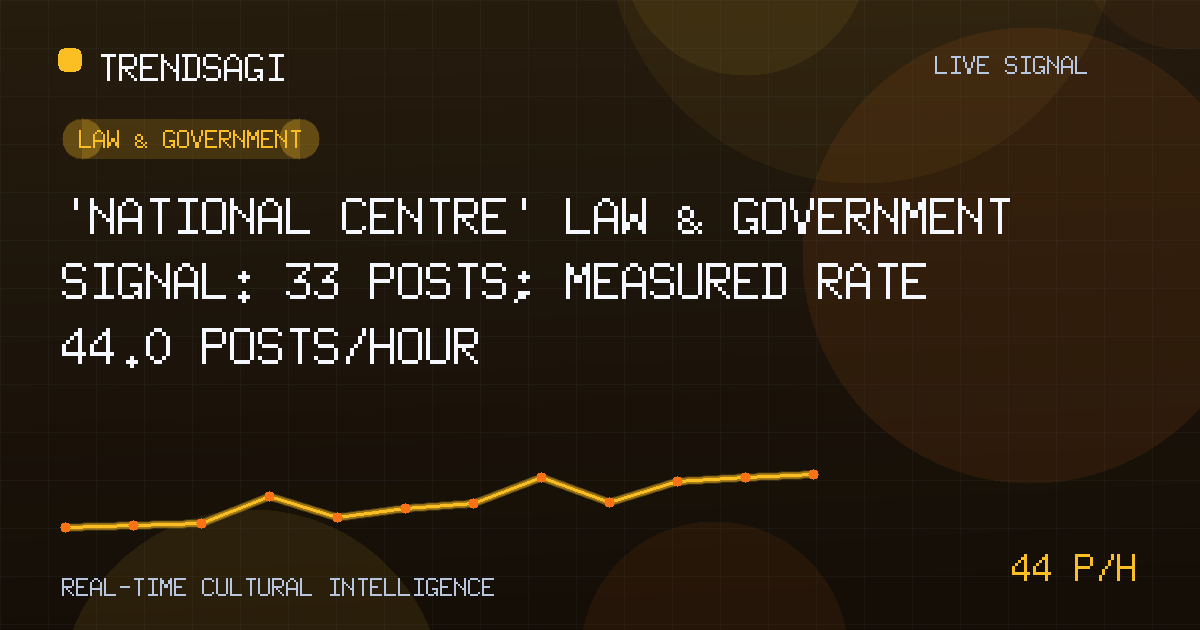
‘National Centre’ Law & Government signal: 33 posts; measured rate 44.0 posts/hour
A measured Law & Government signal shows 33 posts and 44.0 posts/hour; the cause remains unverified, with checks for identity, timing and persistence.
Automated briefing. Generated from stored signal measurements and source-backed research; it is not manually reviewed. Read the methodology and limitations.
Metrics in this briefing are a snapshot associated with its publication date and may not reflect current conditions.
What changed
The monitored “National Centre” topic shows increased posting activity in the measured window, but not a verified policy development. The latest snapshot contains 33 posts. The reason for the movement remains unverified: the label does not identify a country, institution, programme or underlying event.
At 2026-09-24T06:37:12Z, the measured change was 44.0 posts/hour, based on 3 stored observations across an exact 901-second window. This is a measured snapshot rate, not a live or current rate, forecast, reach figure, engagement measure or count of unique people. The 33 posts are snapshot volume, not an hourly rate.
| Observation time | Measured posts/hour | Snapshot volume |
|---|---|---|
| 2026-09-24T06:37:12Z | 44.0 posts/hour | 33 posts |
The two figures answer different questions. Snapshot volume shows how many posts were present in the latest observation; the measured rate describes the observed pace of change. Neither establishes why people were posting.
Why this topic may be moving
No verified public context was established for this signal, so the cause should be treated as unresolved rather than assigned to a plausible-sounding event. A government body may become active because of an announcement, report, consultation, enforcement action, political attention or reactions to an earlier story—but none of those is confirmed here. The topic could also be attracting attention for a reason unrelated to its formal government role.
The immediate verification problem is identity. “National Centre” may be a shortened name, a monitoring label, or one of several similarly named organisations. Without a full name, jurisdiction or originating source, discussion of unrelated entities could be combined. Even if all posts are genuinely about one organisation, activity could reflect repetition of one story rather than several independent developments.
Editorial takeaway: Treat the movement as a prompt to verify, not as evidence that an institution acted, a policy changed, or public concern is sustained.
What the signal can and cannot establish
The record supports a narrow, operational conclusion: posts accumulated quickly enough for the measured change rate to be 44.0 posts/hour during the specified window. It supports checking whether discussion persists, what entity is being referenced and whether public sources corroborate the apparent story.
It does not establish the topic’s importance, the identity or motives of posters, the accuracy of their claims, or whether the activity came from independent reporting, commentary, syndication or automated repetition. It also cannot show how many people saw or shared the posts, or whether discussion reflects broad public interest.
- Useful now: A time-stamped alert for verification and monitoring.
- Not established: A confirmed event, institutional response, causal explanation or sustained trend.
- Not measurable here: Sentiment, influence, factual accuracy, geographical reach or unique participants.
Why it matters
For journalists, policy specialists and public-affairs teams, a rapid change in a government-related conversation can matter because new facts, deadlines or official responses may need checking. The practical value is triage: decide whether the signal deserves reporting or monitoring before drawing conclusions.
For legal and regulatory readers, the distinction is especially important. Discussion volume is not evidence of legal change, and a label such as “National Centre” should not be treated as proof that a national body issued a statement. Teams working on procurement, regulation or public-sector communications should first resolve the entity and then compare the posts with official records.
More broadly, organisations with similarly named counterparts need to avoid monitoring the wrong institution. A fast-moving but misidentified conversation can send editorial, communications or risk-assessment resources in the wrong direction.
What to watch next
Verification should proceed from identity to evidence, then persistence:
- Resolve the label. Find the full entity name, jurisdiction, official account or distinctive programme terms. Reject matches that cannot be tied to the monitored posts.
- Locate the originating item. Examine the earliest accessible discussion and its links or references. Separate an original post from replies, quotations and copies, and record when the activity began.
- Check authoritative evidence. Look for a dated notice, speech, report, consultation, court document or other relevant record from the identified body. Confirm that its timing and subject fit the conversation; do not treat a matching keyword as confirmation.
- Test the explanation. Compare coverage from independent publishers and official stakeholders. A single official statement would support a news explanation; uncorroborated repetition would not. Attribute factual claims to their publishers before using them.
- Check persistence. Use later, comparable snapshots to see whether activity continues, recedes or changes topic. Keep the collection scope and counting method consistent before comparing observations.
Concrete follow-up signals include a full entity name, an attributable spokesperson statement, an official publication with a matching timestamp, independent reporting that adds distinct facts, or a documented correction or denial. Any of these would narrow the explanation. More copies of the same unsupported claim would not.
Methodology and limitations
The latest observation is timestamped 2026-09-24T06:37:12Z and records 33 posts. The 44.0 posts/hour measurement uses 3 stored observations over an exact 901-second window, measured at that timestamp. The figures describe the monitored signal; they are not an audit of all public conversation.
No verified external account explains the movement in this briefing. The record also does not provide the query definition, collection coverage or de-duplication method, so its completeness and comparability with other topics cannot be assessed. Activity may include multiple reactions to a common event, repeated material or unrelated uses of the label. Those possibilities should be tested, not presented as findings.
The appropriate next decision is therefore verification, not amplification: identify the entity, locate the source, corroborate the alleged trigger and monitor subsequent comparable observations. Until that work is done, report the measured activity and leave the cause open.
Track This Topic for New Signals
Set alerts for future velocity or sentiment changes around this topic.
Explore Tracking PlansAbout TrendsAGI research
TrendsAGI's automated research pipeline publishes dated signal snapshots, methodology notes, and practical workflows for teams evaluating cultural momentum. Read how signals are scoped, scored, and limited in our research methodology.