901-second window · 3 observations · Measured Oct 2, 2026, 3:07 AM UTC · Provider: go_recent_snapshot_v2
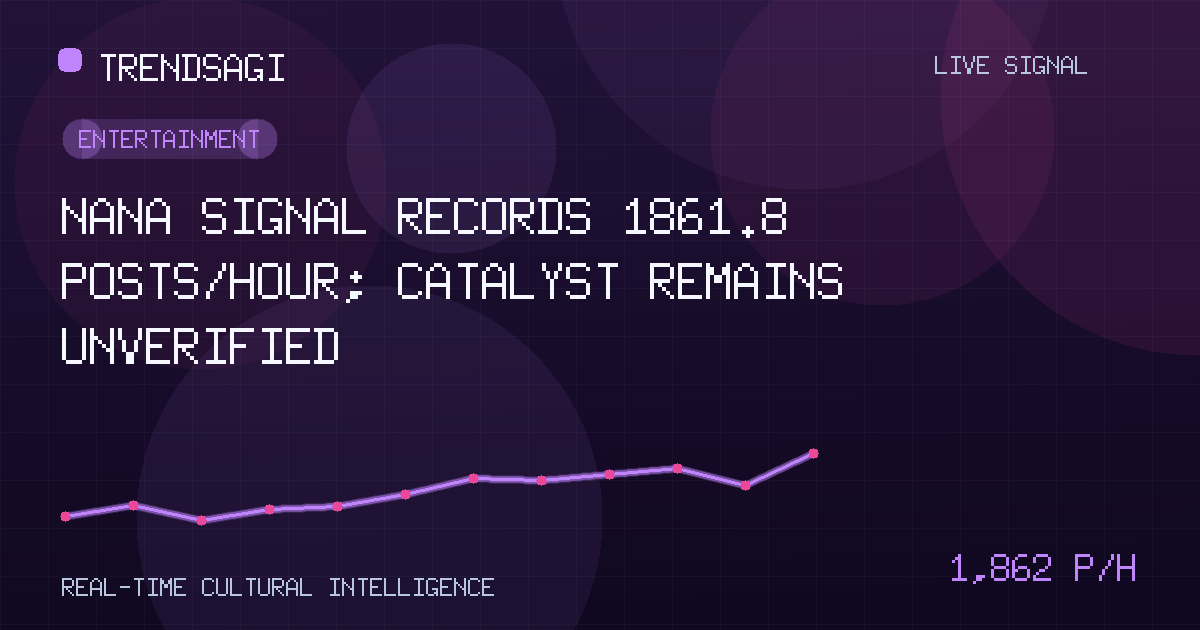
Nana signal records 1861.8 posts/hour; catalyst remains unverified
The stored “Nana” signal recorded 1861.8 posts/hour over 901 seconds; here is what is known, unresolved, and worth checking next.
Automated briefing. Generated from stored signal measurements and source-backed research; it is not manually reviewed. Read the methodology and limitations.
Metrics in this briefing are a snapshot associated with its publication date and may not reflect current conditions.
What changed
Direct answer: The stored signal labeled “Nana” registered a measured snapshot rate of 1861.8 posts/hour over an exact 901-second window, with 1333 posts in the latest snapshot observed at 2026-10-02T03:07:04Z. This confirms concentrated short-window activity in the monitored data, but it does not establish the cause.
The catalyst is unverified. The record contains no description and no corroborated public event that ties the movement to a particular work, person, announcement, controversy, or incident. Any more specific explanation would go beyond the available evidence.
| Observation time | 2026-10-02T03:07:04Z |
|---|---|
| Measured snapshot rate | 1861.8 posts/hour |
| Measurement window | Exact 901-second window using 3 stored observations |
| Latest snapshot volume | 1333 posts |
The 1861.8 figure is a measured snapshot rate, not a live/current rate, forecast, reach, engagement count, or unique-person count. The 1333 figure is latest snapshot volume, not a rate. The stored category is Entertainment, but that label does not resolve what “Nana” refers to.
Why this topic may be moving
No verified trigger is available, so the movement should be treated as a set of testable possibilities rather than a settled news event.
- Label ambiguity: “Nana” may be being used for a title, name, nickname, character, fandom label, hashtag, or imperfect transcription. If those uses are mixed, the volume may describe several conversations rather than one.
- Event-driven attention: If the posts refer to one identifiable subject, a release, appearance, announcement, episode, dispute, or viral item could have triggered discussion. None of those catalysts is confirmed here.
- Cross-community pickup: Repeated reactions, clips, quotations, or recommendations can carry a phrase beyond its original audience. That mechanism is plausible in general but has not been verified in this signal.
- Measurement artifact: Capitalization, spelling variants, tagging behavior, repost duplication, or loose matching can raise apparent volume without representing a single cultural event.
The strongest defensible conclusion is not that “Nana” has become broadly important, but that the monitored label was associated with a concentrated short-window flow of posts whose cause and composition remain unresolved.
These hypotheses are useful because each implies a different check. None should be presented as the reason for the movement until post-level evidence and public reporting agree.
Why it matters
The practical value of the signal is triage: it tells editors and monitoring teams where to look, not what the story means. A fast feed can reveal a conversation worth examining, but volume alone cannot establish significance.
- Media and culture desks should identify the subject before booking coverage or using “Nana” in a headline.
- Creators and community managers should determine whether the activity concerns their work, a person they represent, or an unrelated use of the label.
- Brand and communications teams should assess contextual exposure before responding; acting on the wrong interpretation could put them in an unrelated conversation.
- Audience researchers should treat the observations as a prompt to inspect language, source mix, and persistence, not as a ready-made measure of public interest.
The key limitation is compositional. The record does not show how many posts were original, copied, automated, or unique to accounts, nor does it show sentiment, location, platform, or audience size. Consequently, the signal cannot support claims about breadth, popularity, credibility, or impact.
What to watch next
The next useful step is to turn the label into a verified subject and then test whether the activity persists.
- Resolve the entity. Review the earliest and most representative raw posts. Ask whether “Nana” points to the same subject throughout or to multiple unrelated clusters.
- Establish chronology. Determine what appeared first: an original post, official announcement, media item, reaction clip, or repeated phrase. Earlier content can identify a lead, but timing alone does not prove cause.
- Verify the catalyst. Corroborate any proposed event with a primary announcement or reputable reporting, and confirm that its subject and timing match the posts.
- Separate spread from duplication. Check whether repeated wording is concentrated in reposts, reactions, or copied text. Compare original contributions with recirculation.
- Compare subsequent observations. Keep the query, collection method, and category stable, then look for comparable-window activity. A continuation would support persistence; a quick fade would be more consistent with a transient burst.
Concrete watch signals are a coherent set of posts about one verified subject; a corroborated event preceding the onset; new original contributions rather than only repeated copies; and continued activity under the same monitoring method. Counter-signals are unrelated meanings sharing the label, heavy duplication, unclear timing, or no comparable activity after the observed window.
Methodology and limitations
The measured rate comes from 3 stored observations in the exact 901-second window ending at 2026-10-02T03:07:04Z. The latest snapshot contains 1333 posts. No earlier baseline, comparison window, sampling frame, or collection settings are supplied, so the record cannot show how unusual the rate is relative to normal activity or whether momentum is rising beyond the measured interval.
“Entertainment” is a stored category, while the empty description leaves the underlying entity unresolved. The measured rate should not be recomputed as a live figure, projected forward, or treated as evidence of engagement or unique participants. Because no public catalyst has been verified, the defensible editorial conclusion is narrow: “Nana” was associated with 1333 posts in the monitored snapshot, and its meaning and cause still require validation.
Track This Topic for New Signals
Set alerts for future velocity or sentiment changes around this topic.
Explore Tracking PlansAbout TrendsAGI research
TrendsAGI's automated research pipeline publishes dated signal snapshots, methodology notes, and practical workflows for teams evaluating cultural momentum. Read how signals are scoped, scored, and limited in our research methodology.