903-second window · 3 observations · Measured Sep 24, 2026, 12:26 AM UTC · Provider: go_recent_snapshot_v2
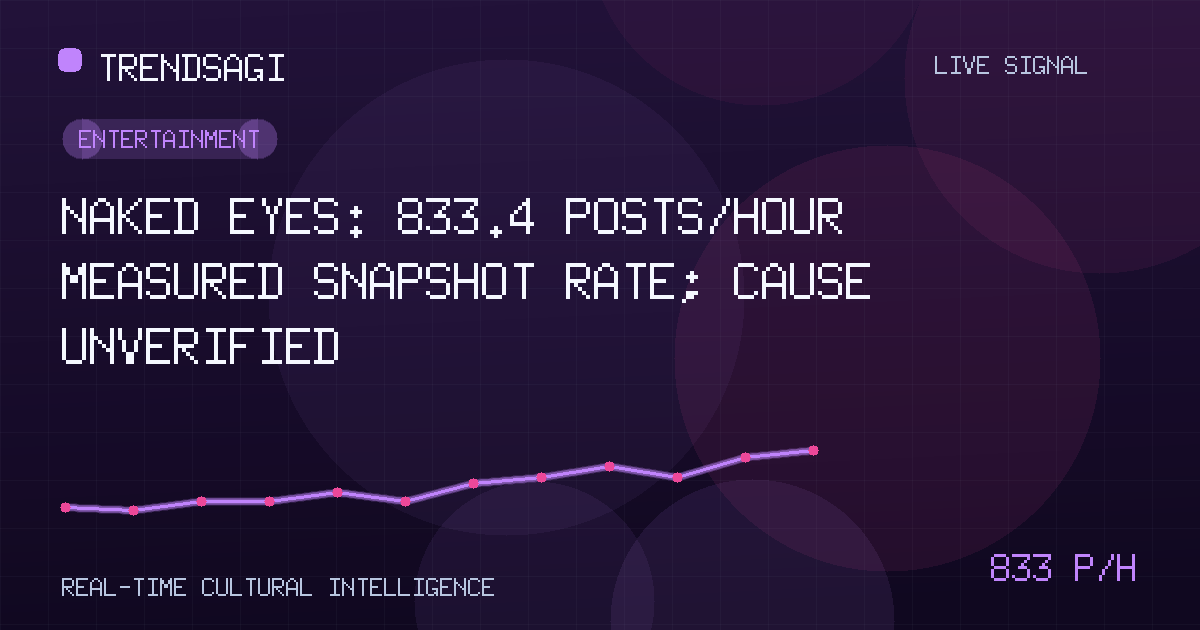
Naked Eyes: 833.4 posts/hour measured snapshot rate; cause unverified
Naked Eyes shows a measured snapshot rate of 833.4 posts/hour; learn what the 888-post snapshot establishes and how to verify the cause.
Automated briefing. Generated from stored signal measurements and source-backed research; it is not manually reviewed. Read the methodology and limitations.
Metrics in this briefing are a snapshot associated with its publication date and may not reflect current conditions.
What changed
“Naked Eyes” shows concentrated posting activity, but the available evidence does not establish why. The latest stored snapshot, observed at 2026-09-24T00:26:24Z, contained 888 posts. That figure describes the snapshot; it is not a rate, an audience estimate, or a count of unique people.
The measured snapshot rate was 833.4 posts/hour, based on 3 stored observations over an exact 903-second window ending at the recorded time. This documents a short-window change in captured post volume. It does not establish a live rate, a forecast, reach, engagement, or the reason behind the activity. No longer-run baseline is supplied, so the rate cannot be placed in the topic’s normal range.
| Signal measure | Stored value |
|---|---|
| Observation time | 2026-09-24T00:26:24Z |
| Measured snapshot rate | 833.4 posts/hour |
| Latest snapshot volume | 888 posts |
| Stored observations used | 3 |
The snapshot count and measured rate are separate measures and should not be treated as interchangeable.
Why this topic may be moving
No public trigger has been verified for this briefing. The stored topic is categorized as Entertainment, but its name alone does not show whether posts concern a film, television program, music, gaming, a performer, or an unrelated use of the phrase. A release, promotional push, controversy, or celebrity reference could produce attention, but none is established by the supplied record.
It would be misleading to present any of those possibilities as the cause. A useful explanation needs public evidence that directly connects the burst to an event, with timing that supports the connection. Repetition of a phrase in posts would show discussion, not why it began. The defensible conclusion is that attention increased during the measured interval while its cause remains unresolved.
What the signal establishes—and what it does not
What it establishes is narrow but useful: the record captured 888 posts at the stated observation time and measured 833.4 posts/hour across the specified window from 3 observations. For editors, this is evidence of concentrated short-window activity worth monitoring. It is not evidence of sustained momentum.
The key distinction is between “more posts were captured in this short window” and “a durable public-interest trend has formed.” Only the first is established here.
The signal does not provide post text, links, named accounts, geographic or language breakdowns, platform coverage, or a comparison period. It therefore cannot establish who posted, whether people were distinct, whether discussion was organic or coordinated, or whether the same story reached several communities. Nor can it measure sentiment, public reach, or commercial impact.
There is also no verified event link. The topic label should guide further checking, not serve as evidence that a particular work, incident, or person caused the activity.
Who should care
- Entertainment editors: Check whether the phrase is attached to a specific, current work before commissioning coverage or applying a trending label.
- Audience and community teams: Look for independently reported, continuing discussion rather than treating a short burst as a broad audience shift.
- Brand and communications teams: Require verified context and audience-quality checks before drawing conclusions from post volume.
- Researchers: Preserve the topic definition, collection method, and observation boundaries so the movement can be compared with later signals on the same basis.
What to watch next
- Identify the subject. Review a representative sample of posts for links, quotations, names, and recurring wording. Determine whether the phrase is being used consistently or pulled into unrelated meanings. A matching label alone is not a shared story.
- Find a dated public trigger. Use public search to look for announcements, release information, broadcast details, event appearances, or other primary material explicitly tied to the phrase. Attribute a causal claim only to a publisher or organization whose reporting or announcement directly supports it.
- Check independent corroboration. Look for established publishers reporting on the same development, rather than relying on many posts that repeat one unverified claim. Separate evidence that a source published something from evidence that its claim is true.
- Measure persistence. Compare subsequent stored observations using a consistent topic definition, collection method, and window. Check whether activity continues, changes in tone, or dissipates. Do not extend the measured snapshot rate beyond its original window.
- Test concentration. Examine how much activity comes from a small set of accounts and whether reposts are being counted repeatedly. Without author-level data, neither organic interest nor coordinated behavior can be concluded.
- Define the next decision. For an editorial alert, require a verified subject, a plausible timing link, and meaningful independent discussion. For a broader trend claim, also require persistence across comparable observations.
Methodology and limitations
This briefing uses the canonical stored signal as supplied: the “Naked Eyes” label, its Entertainment category, the observation time, the latest snapshot volume, and the measured rate from 3 observations over 903 seconds. The rate is reported as a measured snapshot rate, not recalculated or projected.
No independently verified public context is available here to explain the cause. A topic name, a count of posts, and a short-window rate can identify an anomaly for review, but they cannot identify its subject or establish why it occurred. The next useful evidence is a verified public event tied to the observed language, supported by comparable observations showing whether attention persists.
Track This Topic for New Signals
Set alerts for future velocity or sentiment changes around this topic.
Explore Tracking PlansAbout TrendsAGI research
TrendsAGI's automated research pipeline publishes dated signal snapshots, methodology notes, and practical workflows for teams evaluating cultural momentum. Read how signals are scoped, scored, and limited in our research methodology.


